

The foundation can shape more than how a manufactured home sits on its lot. When buying a manufactured home on a permanent foundation in Hesperia, CA, the key is to understand how the home, land, financing, and local approval process fit together. In California, a manufactured home on an approved permanent foundation may be classified as real property. The HCD-433A form is submitted when applying for the foundation’s building permit and should be recorded with the County Recorder.
Comparing a manufactured home with a site-built home means looking beyond price, layout, and long-term ownership. The property and installation plan matter, too. Financing can differ depending on whether the home is classified as personal or real property, while permits and site conditions shape the installation.
This guide explains what to consider when comparing financing, permits, foundations, floor plans, and manufactured-home listings in Hesperia. Use these details to understand the decisions involved and assess which options may suit your property and plans.
Key Takeaways
- See how a manufactured home on a permanent foundation differs from a site-built home, and why the land and foundation matter to the comparison.
- Understand how real-property classification can affect financing and the way a home is treated after installation.
- Learn what can shape the permitting and installation process, from site conditions to foundation design.
- Explore how floor plans and home sizes can inform your choice for a Hesperia property.
- Get a clearer view of local purchase considerations and how buyer representation can help you evaluate your options.
Manufactured homes compared with site-built homes
Buying a manufactured home on a permanent foundation in Hesperia, CA involves more than choosing a home. Consider how it was built, whether the property includes land, and how the foundation and ownership arrangement fit your plans.
Price and Financing Comparisons
There is no single price comparison that applies to every manufactured and site-built home in Hesperia. Compare the full property: the home’s condition, whether land is included, and how the purchase will be financed. A listing price alone may not show the difference between a home on owned land and one on a leased site.
Permanent Foundation Choices
A manufactured home can be installed on private property with a permanent foundation. The foundation design depends on the site and installation plan, including soil, drainage, and the home’s support needs. Consider how the foundation relates to the parcel and the home’s ownership classification, rather than viewing it as a stand-alone feature.
Manufactured homes and site-built homes also differ in construction. Manufactured homes are built on a steel chassis that remains in place under the HUD Code. The code establishes national construction standards, including foundation specifications. Homes built after June 15, 1976 must meet federal Manufactured Home Construction and Safety Standards.
Small prefabricated structures have separate classifications. A tiny home is defined as under 500 square feet for its classification purposes. Park models must remain under 400 square feet to qualify as recreational vehicles. These categories represent less than 1% of prefabricated home construction, so they’re not a direct substitute for most manufactured-home listings.
Hesperia listings vary in age, size, land arrangement, and foundation status. A home sold with private land is not directly comparable to one on a leased site. Before comparing either with a site-built property, review what the listing includes and how the home is installed.
Financing and real-property classification
Financing for a manufactured home can depend on whether it is treated as personal or real property. In Hesperia, the land arrangement, foundation approval, and loan-program criteria help determine which financing options may fit.
Manufactured-Home Financing Options
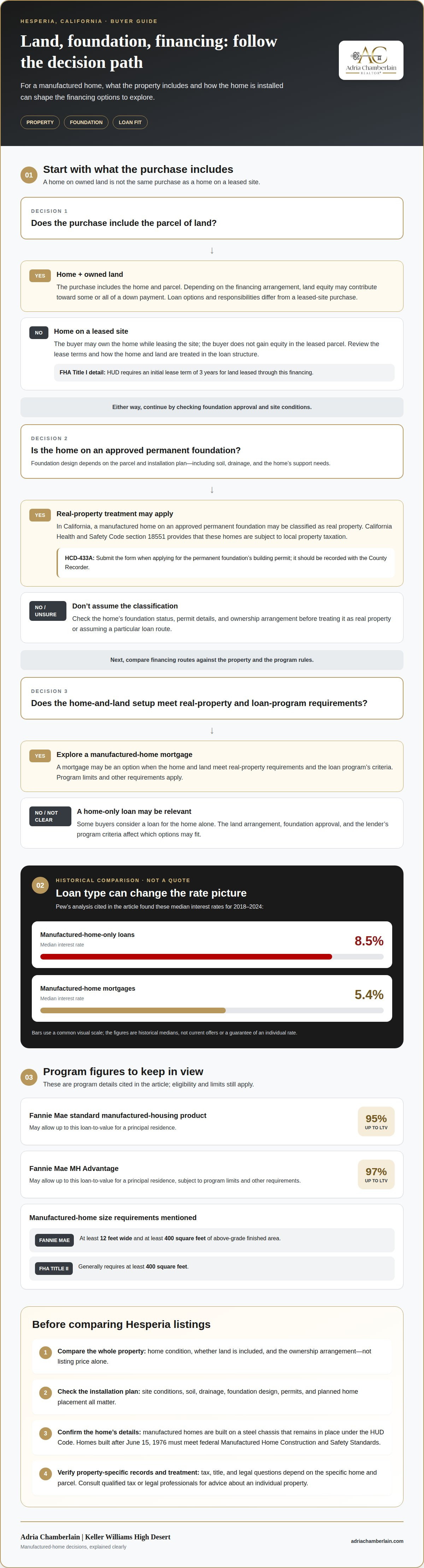
Some buyers consider a home-only loan, while others explore a mortgage when the home and land meet real-property requirements. Pew’s analysis found median interest rates of 8.5 percent for manufactured-home-only loans and 5.4 percent for manufactured-home mortgages from 2018 to 2024. Fannie Mae’s standard manufactured-housing product may allow up to 95 percent loan-to-value for a principal residence, while its MH Advantage product may allow up to 97 percent, subject to program limits and other requirements.
Financing Assistance
Financing assistance can help clarify how a home’s size, construction, and land arrangement fit a particular program. Fannie Mae’s manufactured-home lending rules require a home to be at least 12 feet wide, with at least 400 square feet of above-grade finished area. HUD requires an initial lease term of three years for land leased through FHA Title I financing. FHA Title II generally requires at least 400 square feet.
Program details matter. Beginning in 2026, CalHFA’s master servicer, Lakeview, allowed single-wide manufactured homes on all CalHFA Conventional programs. USDA updated its manufactured-housing provisions in 2025 to allow Section 502 Direct and Guaranteed programs to lend on certain existing homes that meet program standards. A lender can explain how a property’s features fit the applicable requirements.
Park or Owned-Land Risks
A park purchase may involve owning the home while leasing the site, so the home and the land have separate ownership arrangements. With owned land, the purchase includes both the home and parcel, bringing different responsibilities and financing considerations. In Hesperia, comparing the lease terms, included property, and loan structure helps clarify the differences between these options.
Depending on the financing arrangement, land equity may contribute toward some or all of a manufactured-home down payment. A leased site does not give the buyer equity in that parcel. This distinction can affect available funds and loan options. A qualified lender can explain how the specific property and ownership structure relate to financing.
Taxes and Title Registration
For educational purposes, California Health and Safety Code section 18551 provides that manufactured homes on an approved permanent foundation are subject to local property taxation. California’s HCD-433A form is submitted when applying for the building permit for the permanent foundation and should be recorded with the County Recorder. These are general requirements, not a determination of an individual property’s status.
Classification may also affect insurance and resale considerations. For advice about a specific home’s tax treatment or title records in San Bernardino County, consult qualified tax or legal professionals. Hesperia property guidance can help you consider the real-estate details as you evaluate your purchase.
Permits, delivery, and installation services
For an installation in Hesperia, coordinate parcel planning, permits, foundation work, and delivery. Site conditions and the planned home placement shape the project sequence, while zoning requirements depend on the parcel and proposed use.
Site Preparation and Permitting
Start site preparation by gathering information about the ground and planned foundation. A soil test can identify soil type, bearing capacity, and drainage characteristics before the foundation design is selected. These findings help determine how the site can support the home and manage water around the foundation.
The installation plan also needs to account for anchoring against wind and seismic forces, load-bearing capacity, drainage, and access to utilities and structural components. These factors affect the home’s placement and access for inspection and maintenance. Plan for delivery access and enough space to position the home, too.
Hesperia Zoning Rules
Zoning rules are specific to each parcel. For a Hesperia property, the zoning designation and proposed use are central to determining whether the planned manufactured-home placement fits local land-use requirements. General information about city rules cannot settle the question for an individual parcel.
Treat zoning questions separately from foundation and building-permit questions. The parcel’s designated use, intended home placement, and project plans help clarify which local requirements apply. A qualified local land-use professional can explain how those details relate to the property; requirements may differ across Hesperia.
Permit and inspection timing for manufactured-home foundation projects takes 2-4 weeks in most jurisdictions. Foundation construction adds time: concrete slabs typically take 1-2 weeks to install, including curing, while basement foundations often take 4-8 weeks or longer, depending on excavation and soil conditions. These ranges describe different parts of the work, not a guaranteed project schedule.
Plan delivery around the selected foundation, the route onto the parcel, and access to utilities. The site plan should also preserve access to structural components for inspection and maintenance. Soil and drainage inform site preparation, while the home’s dimensions and placement determine delivery access.
A practical sequence is to clarify parcel use and proposed placement, develop the site and foundation plan, and coordinate permits and inspections before scheduling delivery. For example, a basement foundation requires excavation, so its work sequence differs from a slab installation. Aligning these decisions helps clarify what must happen before the home arrives.
In Hesperia, treat the parcel and installation plan as connected decisions. Zoning, site preparation, foundation work, delivery access, and utility planning each address a different part of the project. Keeping them aligned clarifies the steps from selecting a home through installation.
Home sizes, layouts, and customization options
Manufactured-home listings in and around Hesperia vary widely in floor area and footprint. Compare those measurements with the parcel to narrow your options before evaluating a specific layout.
Examples in local listings include the Creekside Manor CM-4663A at 1,760 square feet, measuring 26 feet 8 inches by 66 feet. The Creekside Manor CM-3563D is 1,213 square feet, with dimensions of 23 feet 4 inches by 56 feet. Those figures make it easier to compare interior area and the space each home occupies.
Other examples span different sizes. The Bradford BD-05 lists 1,065 square feet and measures 23 feet 8 inches by 46 feet. The Bradford BD-09 lists 1,600 square feet and measures 26 feet 8 inches by 60 feet. The Victory M201J lists 1,319 square feet, with dimensions of 27 feet by 52 feet.
For a more compact example, the New Summit Series SM-25024 lists 1,183 square feet. A newly built Tempo Rising Sun 51TEM24442AH listed near Hesperia has 1,042 square feet. These examples help show why a model name alone isn’t enough; square footage and outside dimensions give buyers a clearer basis for comparison.
Modern manufactured homes described for Hesperia range from 640 to 2,640 square feet and larger. That range means buyers can compare different scales of housing rather than assume every manufactured home has the same footprint. A larger floor area may require a different site plan than a smaller example, so measurements matter alongside the home’s interior layout.
To compare layouts, start with the floor plan for each specific model. Note how its rooms are arranged and whether the available configuration suits daily routines. Then compare that plan with the listed area and exterior dimensions. For instance, a 1,213-square-foot Creekside Manor and a 1,319-square-foot Victory differ in both interior area and footprint, so their plans should be reviewed separately.
Customization depends on the models and layout options available for the home you are considering. Ask for the specific floor plan and options for that model rather than assuming homes with similar square footage have the same layout. A national standard governs manufactured-home construction, but sizes and dimensions vary by model.
For a Hesperia property, a practical comparison pairs the home’s floor plan with its footprint and the usable space on the parcel. The listed dimensions for the Bradford BD-09, for example, provide a concrete starting point for that review. This approach keeps the focus on fit, not just the home’s total square footage.
Manufactured home sales and construction in Hesperia
There is no single average price established here for a manufactured home on a permanent foundation in Hesperia.
Treat a listing as a starting point, not a direct comparison for every home. Price depends on factors such as age, condition, whether land is included, and the home’s foundation and property classification. A newer home with land and a permanent foundation is a different purchase from an older home on a leased site. Compare these arrangements side by side to put the asking price in context.
Hesperia buyers can encounter both newer manufactured homes and used homes with different histories. A pre-1976 home, for example, predates the federal construction standards that apply to manufactured homes built after June 15, 1976. That date is a useful point of reference when reviewing a listing. Age alone doesn’t describe the home’s current condition, so consider it alongside the property’s records and physical state.
For a used home, inspect the roof, floors, walls, windows, and visible signs of water intrusion. Look for movement or damage around the foundation, and note whether doors or windows appear misaligned. The condition of plumbing, electrical, and heating systems also matters. These are practical areas to assess, but they do not replace reviewing the home’s documents and ownership arrangement.
Records help connect the home with the land and its installation history. Review available permits, title documents, and information showing whether the home is treated as personal or real property. If land is included, compare the parcel details with the foundation status. If the land is leased, understand that the purchase involves a different ownership arrangement. These distinctions can affect financing and future resale.
Construction planning matters when a purchase involves placing a home on a Hesperia parcel. The home’s dimensions, site preparation, foundation design, and approval process need to align. A used home already on a permanent foundation presents a different situation from one that still needs installation. In either case, review the home and site together.
Use the same comparison for each listing: age, condition, included land, foundation, property classification, and available records. This approach clarifies what a listed price represents without treating one example as Hesperia’s average.
Adria Chamberlain | Keller Williams High Desert: First-Time Homebuyer Information
If you’re comparing Hesperia properties as a first-time homebuyer, consider which home fits your plans. For a manufactured-home purchase, review the real-estate details and compare your options. Think about your priorities, whether that means owning land, choosing a particular layout, or finding a home within your budget. Consult qualified professionals for financing and technical questions about foundations, permits, or taxes.
For personalized guidance when buying a manufactured home on permanent foundation Hesperia CA, contact Adria Chamberlain | Keller Williams High Desert.
Take the Next Step Toward Your Hesperia Home
Buying a manufactured home on a permanent foundation in Hesperia, CA connects your home search with your longer-term plans. Start by identifying your priorities, such as owning the land, finding a particular layout, or coordinating the purchase with a move from your current property. That focus can make discussions about specific listings more productive.
If you are a first-time buyer or preparing to sell, ask Adria Chamberlain | Keller Williams High Desert whether she can assist with buyer representation, listing your home, or a Home Valuation & Comparative Market Analysis. The right conversation depends on your goals and where you are in the process.
Contact Adria Chamberlain | Keller Williams High Desert to talk through your home search or next move. A clear plan can make your next step feel more manageable.
Frequently Asked Questions
What manufactured homes on permanent foundations are currently for sale in Hesperia, CA?
Treat it as one example, not a complete inventory. For any current listing, distinguish homes offered with land from homes on leased sites, and confirm that the foundation and ownership records match the property description.
What does Hesperia require for a manufactured home to qualify as real property?
In California, a manufactured home must have an approved permanent foundation to qualify for real-property treatment under the information discussed here. The HCD-433A form is submitted with the foundation building-permit application and should be recorded with the County Recorder. For a Hesperia property, the home’s permit and recorded documents are important to review together, since classification can affect property taxation and other ownership considerations.
What permits and inspections are required to install a manufactured home in Hesperia?
Installation planning typically involves reviewing the parcel and zoning, obtaining permits for the foundation work, and arranging the required project inspections. The review may address the foundation design, anchoring, structural support, drainage, and access to utilities. Requirements can vary with the site and project scope, so the proposed home location and installation plans should be considered together. Permit and inspection processes take 2-4 weeks in most jurisdictions.
What are the costs of the foundation, site preparation, utility connections, and permits in Hesperia?
Total costs depend on site conditions and project scope, including soil, drainage, foundation design, excavation, utility access, and required permits. A slab, for example, involves different work from a basement foundation. The home’s location on the parcel and distance to utility connections also affect the work involved.
Can you get a conventional, FHA, VA, or USDA loan for a manufactured home on a permanent foundation in California?
Conventional, FHA, and USDA financing can apply to certain manufactured homes when program and property requirements are met. FHA Title II generally requires at least 400 square feet, while USDA’s 2025 update allows certain existing homes under its Section 502 Direct and Guaranteed programs. VA financing depends on the home and applicable lender requirements. A lender can assess the home’s classification, foundation, dimensions, and land arrangement against each program.


