

A bright summer showing can hide how little winter sun reaches a home. When buying a home in Pinon Hills, weighing snow and weather factors means looking beyond the sunny-day view: a winter visit between about 11 a.m. and 2 p.m. can help you assess sunlight, and another visit at a different time can reveal how shadows shift.
It’s easy to focus on a home’s light, views, and outdoor spaces during a summer search. But orientation, window exposure, nearby trees or terrain, and how you use each room can matter just as much when days are shorter or weather changes. This guide explains how to assess winter sunlight when you can’t tour in winter, and how to weigh it alongside snow exposure, property access, heating, and insulation. Use these practical checks to decide which seasonal trade-offs fit your priorities instead of relying on one sunny showing.
Key Takeaways
- Use a summer showing to study a home’s orientation, windows, and potential sources of winter shade, then consider how those details affect the rooms you use most.
- A visit between about 11 a.m. and 2 p.m. can help you assess winter sunlight; another visit at a different time may reveal shifting shadows.
- Look beyond the house itself: the approach, roofline, and areas around entries and decks can shape how the property feels in changing weather.
- Ask about the heating system’s type, age, and service history, and consider how insulation may affect comfort through the colder season.
- Buyer representation can help you weigh sunlight and weather alongside your other priorities before deciding whether a home fits.
How can a buyer’s agent help you evaluate winter sun when you’re buying in summer?
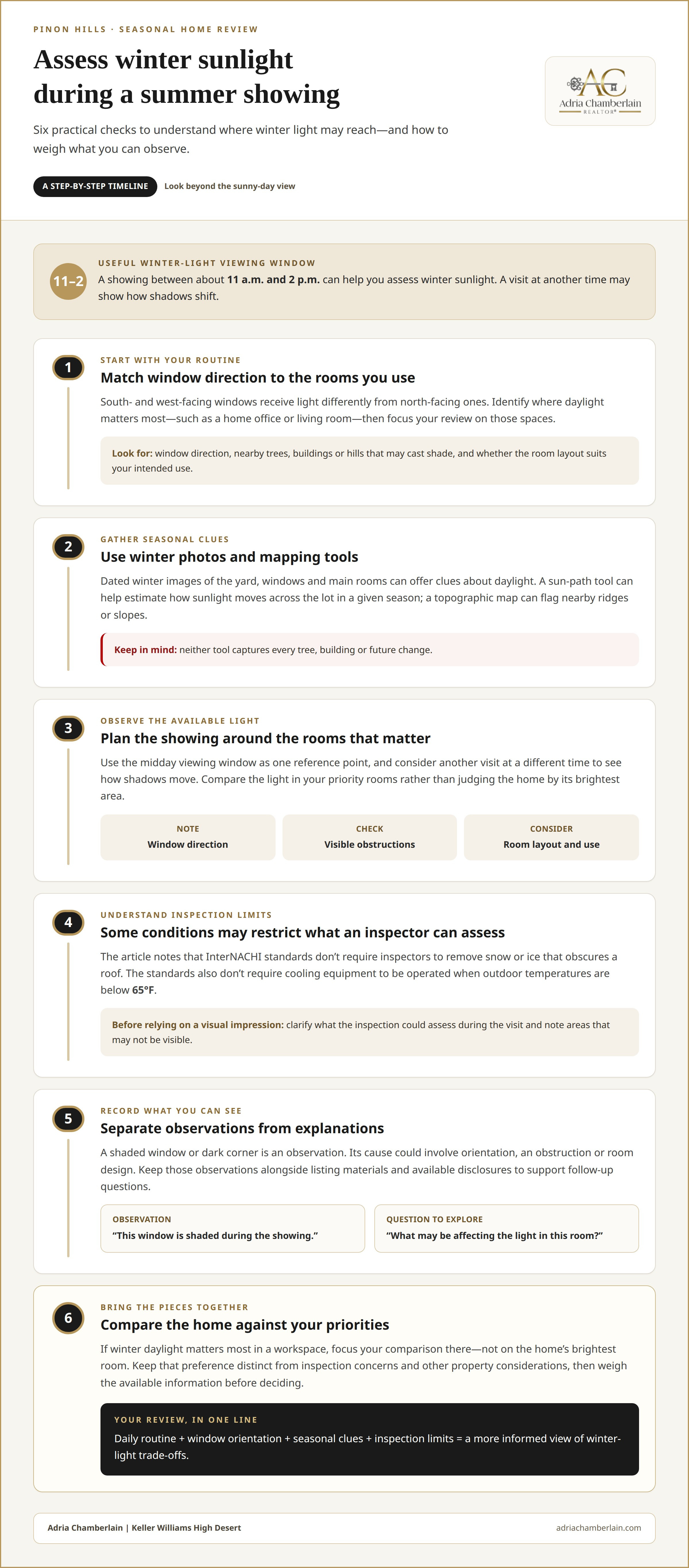
- Connect the home’s orientation with your daily routine. South- and west-facing windows receive light differently from north-facing ones, while nearby trees, buildings, and hills can cast shade. Identify the rooms where winter daylight matters most, such as a home office or living room. This keeps your review focused on the spaces you use, rather than treating every sunny area as equally important.
- Use dated winter photos as clues when touring Pinon Hills in summer. Images of the yard, windows, and main rooms can show how the property looked in winter daylight. A sun-path tool can help estimate how sunlight moves across the lot in a given season. A topographic map can flag nearby ridges or slopes, though neither tool captures every tree, building, or future change.
- Plan a showing that makes the available light easier to assess. A useful viewing window for winter sunlight is about 11 a.m. to 2 p.m.; a visit at another time can reveal how shadows shift. Your agent can coordinate access and help compare the light in rooms that matter to you. Note window direction, visible obstructions, and whether the room’s layout supports your intended use.
- Discuss inspection limits before relying on a visual impression. InterNACHI standards don’t require inspectors to remove snow or ice obscuring a roof, so some areas may not be visible. The standards also don’t require inspectors to operate cooling equipment when outdoor temperatures are below 65 degrees Fahrenheit. Your agent can help organize questions about what the inspection could assess during the visit.
- Separate observations from conclusions as you review the property. A shaded window or dark corner is something you can see; the reason for it may involve orientation, an obstruction, or room design. Your agent can help record those observations alongside listing materials and available disclosures. This gives you a clearer basis for discussing the home with the inspector and deciding whether additional property-specific information would help.
- Use the findings to shape a decision that reflects your priorities. If winter daylight matters most in a workspace, focus your comparison there rather than judging the home by its brightest room. Your agent can help keep that preference distinct from inspection concerns and other property considerations. If a question affects your willingness to proceed, address it during the relevant review period and weigh the available information before deciding.
Mountain weather and seasonal changes
Assess a Pinon Hills property based on its setting, seasonal needs, and available records. Nearby communities and market timing can add context, but the parcel itself should guide your decision.
-
Compare seasonal weather and home sales
Review local listings across seasons, comparing similar homes by condition, location, and features. Seasonal inventory can change the choices available, while prices also reflect buyer demand and each property’s condition. A January listing and a summer listing may offer different options, but the month alone doesn’t establish value.
For a home involved in an estate sale, review available disclosures and service records to understand its maintenance history. Keep that property-specific information separate from broader market patterns. An agent can help interpret comparable local listings and sales without treating one season’s activity as a prediction of future prices.
-
Compare nearby weather patterns
Compare Pinon Hills with Phelan, Wrightwood, and Victorville by considering each property’s elevation, terrain, and exposure. Conditions can vary from home to home, so a community name alone doesn’t reveal how a particular lot experiences winter weather. Note nearby slopes, open areas, trees, and structures that may affect the property’s setting.
Freezing conditions can affect exposed plumbing, so consider the layout and protection of pipes, wells, septic systems, and outdoor fixtures. Review available maintenance records and property disclosures for relevant details. Insurance premiums and availability also depend on the individual home and insurer’s assessment, including property features and exposure. Compare options for the specific address rather than assuming nearby homes receive identical terms.
-
Assess wildfire, wind, dust, and heat risks
Review the surroundings for vegetation near structures, exposed outdoor areas, and openings where dust may enter. These observations can help identify questions for the seller or inspector, but they don’t determine a property’s wildfire classification or predict future conditions. Read available disclosures and records for documented repairs or previous weather-related concerns.
For summer comfort, note which rooms receive afternoon sun and how windows, shade, and layout affect their use. Consider wind exposure around outdoor spaces and equipment, along with visible wear on exterior materials. Ask about heating and cooling equipment service history, then weigh those records against the home’s condition. A property-specific review gives you a clearer basis for comparing seasonal trade-offs.
How a buyer’s agent can help balance sunlight with other home-buying priorities
- Rank the features that shape your daily life before comparing homes. Separate essentials, such as a quiet bedroom or usable driveway, from preferences, such as afternoon light in the living room. For example, a buyer who works from home may value a bright office more than a sunny guest room. This list gives each property a consistent standard, so a striking view doesn’t outweigh practical needs.
- Compare sunlight in the rooms you use most. During a summer tour, note window direction, exterior shade, and where direct light falls. Then consider how those observations relate to your winter routine. A living room that feels bright during the showing may receive less direct light when the sun’s path changes. Treat orientation as one factor alongside room layout, privacy, and how you plan to use the space.
- Weigh sunlight against the property’s condition and upkeep. A home with appealing exposure may still need attention to its roof, drainage, insulation, or heating equipment. Keep visual observations distinct from inspection findings, so impressions don’t stand in for a professional assessment. For example, a shaded entry may matter less than a documented repair concern, depending on your priorities and the property’s overall condition.
- Compare every home against the same priorities. Organize property details around your needs, including commute, access, outdoor space, and natural light. A sunny yard may suit you if you plan to garden, while a more shaded yard could work better if you prefer less direct sun. When buying a home in Pinon Hills, weigh snow and weather factors alongside wind exposure, access, and window placement throughout the seasons.
- Use trade-offs to guide follow-up, not to force a quick choice. If a home offers a bright kitchen but a shaded living area, discuss whether that layout works for your routine. Your agent can help identify questions for the seller and keep available disclosures or service records in view. Inspection findings can also affect how you weigh the home’s advantages, especially when a concern changes expected maintenance or comfort.
- Set decision priorities before comparing offers or negotiating. An agent can help you distinguish a preference, like winter sunlight in a particular room, from a practical concern, such as safe access or needed repairs. For buyers considering snow and weather factors while buying a home in Pinon Hills, that distinction clarifies what deserves follow-up and what may be an acceptable compromise. A written comparison can keep bright summer showing conditions from dominating the decision.
Which Pinon Hills roads and neighborhoods are most exposed to snow, wind, or drifting?
- Trace the full route from the nearest main road to the property entrance. A short driveway may connect to a longer private or shared road, and the entire approach affects winter access. Look for open stretches, exposed slopes, and low areas where wind could move snow across the roadway. When buying a home in Pinon Hills, consider snow and weather factors along the whole route, not just conditions at the address.
- Drive the complete approach and consider how it might work after a storm. Note sharp turns, steep sections, narrow passages, and places where another vehicle cannot easily pass. Snow, ice, or drifting can reduce traction and visibility, making a route more difficult to navigate. Pay attention to how connecting roads meet the driveway, not just the final stretch.
- Find out who maintains each shared or private road and how the work is handled. Review available written agreements or property records for details about snow removal, grading, drainage, and repairs. A clear arrangement can explain who coordinates upkeep and how access is managed. Include the driveway in your review, since its maintenance may be separate from the road.
- Compare the home’s position with nearby terrain and wind exposure. Open land, gaps between buildings, and exposed ridgelines can affect where wind moves snow; fences, slopes, and structures can alter drifting. These features can help you identify areas to examine, but they don’t establish that one Pinon Hills neighborhood always receives more snow. Assess each parcel and its approach individually.
- Examine the roofline, gutters, entries, and decks for signs of where snow could slide or collect. Notice whether roof edges sit above walkways or doors, and whether parking areas lie beneath a slope. Ask about past snow-related maintenance and review available seller disclosures or service records. These details can help you consider how winter conditions may affect daily entry and outdoor spaces.
- Bring access and maintenance questions into the purchase discussion. A buyer’s agent can help organize property information, clarify what seller disclosures describe, and identify unanswered questions about the route. For buyers weighing snow and weather factors when buying a home in Pinon Hills, reviewing road arrangements alongside the property’s other details can make the decision more informed.
The most exposed spots include open road stretches, exposed slopes and ridgelines, and low areas where wind can push snow across the route. Exposure varies by parcel and approach, so it doesn’t consistently identify one neighborhood as snowier than others.
What should homebuyers know about heating costs and insulation for Pinon Hills winters?
- Ask what heats the home before comparing winter comfort. Identify the heating system and its energy source, then request available service records. A house heated by one system may have different operating needs from a home using another. The system type is a starting point, not a complete estimate of future bills.
- Review the equipment’s age and service history alongside the property documents. Ask when the heating system was last serviced and whether records describe repairs or recurring issues. A recent service visit can help explain its condition, but it doesn’t predict future operating costs. Consider the system’s age, maintenance history, and the home’s size together when weighing expected winter use.
- Consider insulation as part of the whole building, not as a single feature. The attic, exterior walls, floors, doors, and windows all affect how readily indoor warmth escapes. During a showing, note rooms that feel noticeably colder or warmer than others. Ask the inspector to assess visible insulation and potential air leaks, since surface impressions alone don’t reveal what is inside a wall.
- Relate window exposure and room layout to heating demand. A large, shaded window may affect comfort differently from a smaller, sun-facing one, while a drafty entry can make nearby rooms feel colder. Compare the living room, bedrooms, and home office rather than judging the whole house from one space. Your preferred thermostat setting and daily schedule also shape energy use.
- Use past utility information carefully when available. Ask whether the seller can share energy bills or usage records, then note the billing periods and whether the home was normally occupied. A bill from a mild season may not reflect colder weather, and a vacant home may use energy differently. Treat records as context alongside system type, maintenance, insulation, and household habits.
- Build a property-specific picture before deciding what winter comfort means to you. An agent can help organize heating details, service records, and inspection questions, then separate known information from assumptions. For example, an older system paired with uneven room temperatures may deserve closer attention than age alone. Compare those findings with your comfort priorities and the home’s overall condition.
- Consider heating alongside other ownership needs rather than using one feature as a shortcut. Insulation improvements, equipment repairs, and routine servicing involve different work, and the property’s actual condition determines which questions matter. Ask the inspector to explain relevant observations in plain language. For first-time buyers, dedicated representation can help keep those details in view while evaluating a home.
Adria Chamberlain | Keller Williams High Desert: First-Time Homebuyer Representation
Adria Chamberlain, REALTOR® with High Desert Real Estate Services, provides first-time homebuyer representation for buyers weighing winter sunlight, road access, and heating details alongside other priorities. This support can be useful when a summer showing leaves questions about seasonal conditions or when inspection findings need to be considered alongside your preferences. Adria can help organize property information, explain the home-buying steps, and keep your priorities in focus as you compare homes. For example, weigh a sunny living area against driveway access, heating-system history, and the home’s overall condition instead of judging it by one feature. If you’re preparing to search in Pinon Hills, contact Adria Chamberlain to discuss the home and seasonal considerations that matter to you.
Make your seasonal priorities part of your home search
Before your next showing, turn your preferences into a short decision guide. Note which rooms need natural light, what kind of road access suits your routine, and which property features deserve closer attention. Then separate must-haves from acceptable trade-offs. This gives each home a fair comparison, even when Pinon Hills weather differs from one showing day to another.
A thoughtful approach to buying a home in Pinon Hills means letting your priorities shape the search, rather than expecting one property to meet every preference. Share your questions and the details that matter most with a professional who can help you evaluate available homes and keep your next steps clear. Contact Adria Chamberlain | Keller Williams High Desert to discuss your home search and what you’re looking for. A clear plan can help you move forward with confidence as you choose a home that fits your life.
Frequently Asked Questions
Does winter sun help melt snow around a property?
Yes, sunlight can speed melting on exposed surfaces, but the resulting water needs somewhere to go. Runoff that collects near a walkway or low point, for example, may leave that area wet after brighter sections have cleared. When considering a home, look at where water flows away from paved areas and entrances. This helps you understand how the yard functions during a thaw, beyond simply noting sunny and shaded spots.
How can a buyer’s agent help you judge access in winter?
A buyer’s agent can help relate the property’s access to your ordinary travel needs. Consider whether you rely on one route, need room for more than one vehicle, or regularly travel before daylight. A showing-day drive offers only a snapshot, so ask about the seller’s experience with the route and review any relevant property records. Those details help you assess whether access fits your routine without assuming every winter day is alike.
How can a buyer’s agent help you evaluate the roof, exterior, and snow management?
A buyer’s agent helps keep property documents and seller responses organized, while the inspector evaluates physical conditions within the inspection’s scope. Ask for available records related to roof work, exterior repairs, and past water entry, then compare them with the inspection report. If a report identifies an area that could not be assessed, your agent can help track that question during the purchase review, rather than treating an unseen area as cleared.
How can a buyer’s agent help you decide whether winter sun should influence your decision?
A buyer’s agent can help you connect sunlight to your actual plans for the home. Try ranking the rooms and outdoor spaces you expect to use most, then decide which ones need daylight for work, hobbies, or relaxing. Compare that list with the home’s other strengths and drawbacks. This makes sunlight a deliberate preference in your decision, rather than allowing a bright showing or attractive window to carry too much weight.
What are average winter temperatures and snowfall in Pinon Hills, California?
Winter averages depend on the measurement period and location, while a particular home’s conditions also reflect its terrain and exposure. A town-wide average cannot describe every parcel or establish what one winter will bring. For a useful comparison, distinguish long-term climate averages from property-specific observations and records. This keeps a general seasonal figure from being mistaken for a promise about conditions at a specific address.
How often do roads in Pinon Hills close or become hazardous due to snow and ice?
Road conditions vary with each storm, the road’s surface and grade, and how the route is maintained. One annual frequency would not describe every street or driveway equally. For a specific property, consider whether access depends on one exposed stretch or includes alternate routes. Seller observations and road-maintenance records can add context, while a drive in clear weather cannot establish how a route performs during a storm.
Does Pinon Hills require snow removal, and who maintains roads in unincorporated areas?
Responsibility depends on the particular road and any arrangements tied to it; the home’s location alone doesn’t determine who handles upkeep. For a property on a shared route, look for recorded agreements, association documents, or other written maintenance information. For a private driveway, clarify whether it is covered by the same arrangement as the road. These distinctions help identify responsibility without assuming one rule applies throughout Pinon Hills.
What home features help withstand Pinon Hills snow, wind, and temperature swings?
Useful features include well-fitted exterior doors and windows, durable exterior finishes, sound drainage, and plumbing protected from exposure. The value of each depends on the home’s design and condition. For example, a home with sheltered entrances may be easier to use in windy weather, while well-directed runoff can help keep water away from access areas. An inspection can identify whether these features function as intended or need closer evaluation.


