
The community perks are only part of the ownership picture. Understanding Silver Lakes Helendale HOA fees and community perks starts with the assessment unit: a single-family residential lot is assigned one unit. Silver Lakes also has a 27-hole golf course, while access to specific facilities depends on the applicable membership and community rules.
When weighing Silver Lakes Helendale HOA fees and community perks, look beyond the recurring cost to how residents use the pools, golf, and racquet facilities. This guide explains how social membership relates to amenities, what to know about facility access, and which lot and building restrictions may affect a property decision.
You’ll also find the key setback and height rules explained clearly, so you can weigh community features alongside the practical details of owning a home there. Whether you’re considering a move or comparing properties in Helendale, understanding how assessments, access, and restrictions fit together can support a more informed decision.
Key Takeaways
- A single-family residential lot is assigned one assessment unit, a key detail for understanding how Silver Lakes assessments are structured.
- Silver Lakes offers community amenities that include lakes, beaches, outdoor activities, and a 27-hole golf course; membership rules shape access to facilities.
- Separate social membership and golf access can affect how residents use community amenities, so understand what applies to the property you’re considering.
- Building plans must account for setbacks and height limits, including a two-story limit unless the Environmental Control Committee approves greater height.
- Use the assessment structure, amenity access, and property restrictions together when deciding whether a Silver Lakes home fits your plans.
Social membership and included amenities
Silver Lakes in Helendale combines residential living with shared recreational spaces. The community includes two lakes measuring 112 and 165 acres, along with beaches, golf, and outdoor activities. Those features help explain the appeal, but ownership, social membership, and access to each amenity are separate details to understand.
A single-family residential lot carries one assessment unit. Silver Lakes Association also assigns the Lodge assessment unit at 20% of the number of living units. These unit rules describe how assessments are allocated; they do not establish which facilities a particular resident or tenant may use. For that, the relevant membership and association rules matter.
To compare Silver Lakes fees with those of nearby Helendale communities, look at each property’s assessment basis and the amenities covered, not only the headline amount. A single-family lot’s one-unit assessment is a useful starting point. The lakes, beaches, golf, and outdoor activities help show what the community offers.
Assessment units don’t determine whether payments are monthly, quarterly, or annual. The association’s current assessment notice sets the billing period and due dates, so use that schedule to plan household expenses.
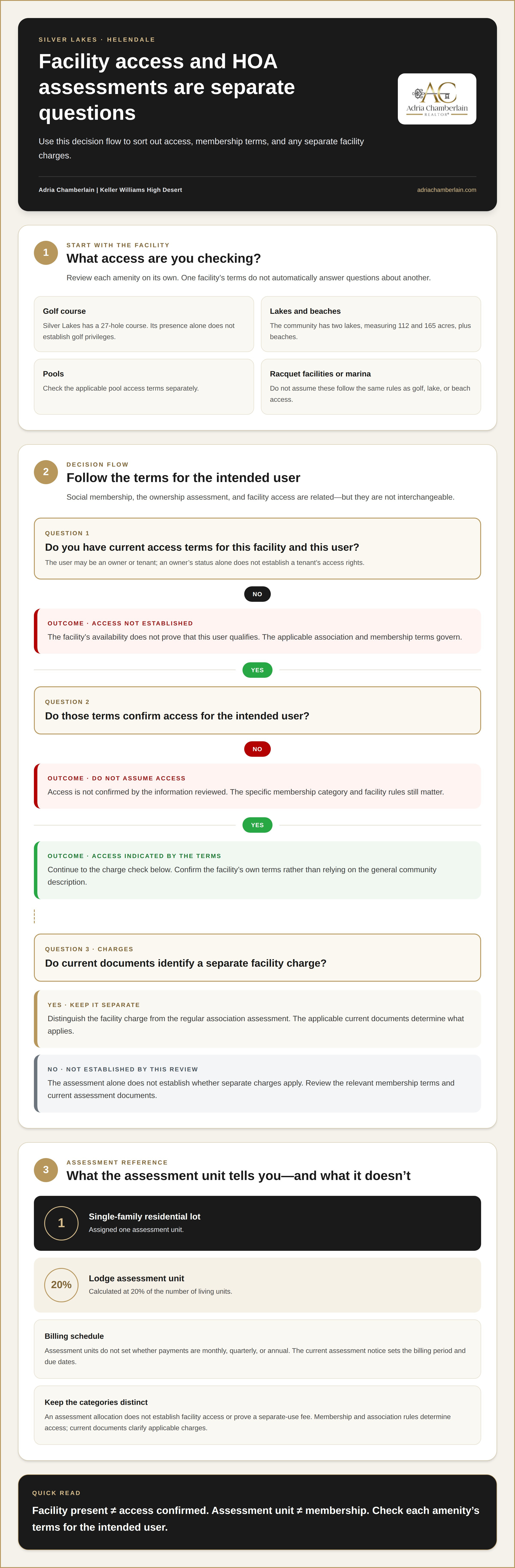
Social membership and community assessments are related to living in Silver Lakes, but they are not interchangeable. Before counting on pool, golf, beach, or other facility access, identify the applicable membership category and its rules. This distinction also matters for tenants: an owner’s status alone doesn’t establish a tenant’s access rights. The applicable association and membership rules govern.
Silver Lakes offers a resort-style mix of water and land activities. The two lakes, beaches, and golf course provide distinct recreation settings, while outdoor activities broaden the options beyond one facility. The community’s 27-hole golf course is a specific amenity; its presence does not by itself establish that every resident receives golf privileges through a social membership.
Ask whether an assessment includes a particular amenity or whether access follows a separate membership or use rule. That distinction helps clarify whether any additional community charges apply. The Lodge’s 20% assessment-unit calculation is a stated allocation rule, not a separate-use fee or proof of a special assessment.
For current Silver Lakes fees and governing documents, review the association’s latest assessment notice and governing-document materials. Compare the property type, assessment units, billing schedule, membership category, and facility-access terms. This helps distinguish shared community amenities from the specific access available to an owner or tenant.
Community pools, golf, and racquet facilities
Silver Lakes has a 27-hole golf course, a concrete feature for residents who enjoy playing close to home. The course’s presence doesn’t establish who may use it, whether a particular membership grants access, or whether use carries a separate charge. Those details depend on the applicable Silver Lakes membership and facility terms.
Keep the association assessment separate from any golf-related access arrangement. A regular assessment describes an ownership obligation, while facility rules describe access and use. For a buyer who expects to play regularly, that distinction matters: the course’s 27 holes describe its size, not an included playing entitlement or a golf package.
Silver Lakes’ private lakes and beaches are separate amenities from golf, and pool or racquet access should be considered separately as well. Don’t assume a general description of community recreation means every resident can use a pool or racquet facility, or that a particular membership includes access.
Are there separate fees for the Silver Lakes Country Club, golf, or marina? The association assessment alone doesn’t establish whether separate facility charges apply. The relevant membership terms and current assessment documents determine which charges apply to a particular property or type of use.
For each planned activity, separate three questions: whether the facility is available, who qualifies to use it, and whether separate charges apply. This prevents the existence of Silver Lakes’ 27-hole course from being mistaken for proof of included golf privileges. It also keeps lake, beach, pool, racquet, and marina questions from being bundled together without support.
A practical review can follow these steps:
- Identify the specific facility, such as Silver Lakes’ golf course, a private lake, or a beach.
- Find the membership or access terms that apply to the intended user.
- Distinguish the regular association assessment from any separately described facility charge.
Apply the same approach to a pool, racquet facility, or marina, without assuming another amenity’s terms also apply. Golf access terms, for example, don’t automatically answer questions about lake use. Reviewing each facility and membership provision separately gives buyers a clearer picture of how recreation fits their plans.
Before choosing a home for its recreational amenities, match the feature you value with the rules governing its use. A buyer who prioritizes golf can focus on golf access; someone drawn to the water can review lake and beach provisions. These distinctions turn Silver Lakes’ community features into practical questions to ask about a property.
If recreation access matters in your home search, property search guidance can help keep those questions alongside the property’s other details.
Lot and building restrictions
Silver Lakes building rules affect where a home can sit and how tall it can be. Rental, guest, and pet provisions are separate issues, so review the governing documents for their specific terms.
Home and Building Rules
For a Silver Lakes building plan, start with the required setbacks. The front yard must be at least 50 feet from the street centerline. The rear yard must cover at least 20% of the lot area and have a minimum depth of 25 feet. Side yards require 10 feet on one side and 5 feet on the other.
These measurements affect the space available for a home or other structures. Buildings are limited to two stories unless the Environmental Control Committee approves a greater height. The committee has three members. A design above two stories therefore requires its approval, not simply a change to the plans.
Signs have a separate limit: a for-sale or for-rent sign may have a maximum face area of 3 square feet. This matters when planning how a property will be marketed or rented. Keep sign dimensions in mind alongside the building layout, since both are subject to community restrictions.
Pet Rules
Read pet provisions separately from setback and height rules. Building measurements don’t say whether pets are permitted, what conditions apply, or how guest and tenant access is handled. For those details, review the applicable Silver Lakes governing documents rather than assuming one property rule answers another question.
If your household has pets, or you may rent the home to occupants with pets, include the relevant provisions in your property review. Guests raise a separate question: don’t infer visitor rules from owner or tenant terms. Keep the relevant documents together to clarify the property’s use, occupancy, and animal provisions.
For a practical review, separate the restrictions into three groups:
- Building placement: compare the 50-foot front setback, rear-yard area and depth, and 10-foot and 5-foot side-yard setbacks with the proposed layout.
- Building height: note the two-story limit and the Environmental Control Committee approval condition.
- Property use: review the governing-document provisions for rentals, guests, and pets independently.
That separation helps buyers and owners avoid confusing physical design limits with occupancy rules. For example, a plan that fits within the side-yard setbacks still needs to meet the two-story height limit. Likewise, a for-rent sign’s 3-square-foot maximum doesn’t explain tenant or pet terms.
When evaluating a Silver Lakes property, compare your intended plans and use with each applicable rule. A proposed addition calls for attention to setbacks and height; a rental plan calls for a separate review of tenant, guest, and pet provisions. This keeps the decision grounded in the property’s actual restrictions.
Membership and common-area access
Silver Lakes membership and common-area access raise related but distinct questions. The association describes private lakes, beaches, golf, and outdoor activities. A property’s assessment status alone doesn’t explain which household members may use each area. Review the applicable membership and governing-document provisions to understand how access is assigned.
Start by identifying who needs access: an owner, resident, tenant, or guest. Then match that person to the relevant membership category and amenity. Access to a private lake, for example, may be addressed differently from golf access. Don’t assume one general membership description settles the terms for every facility.
The Lodge illustrates why assessments, membership, and association participation should be considered separately. Silver Lakes Association assigns its Lodge assessment unit at 20% of the number of living units. The Lodge owner has 13 votes in the association. These figures describe distinct assessment and voting details; neither, by itself, explains an individual resident's access to common areas.
Organize your property review around how you plan to use it. A full-time resident may want to understand lake and beach access, while a tenant may need to know which rules apply to occupants. A household interested in golf should review the relevant golf provisions separately. This keeps the facility, user, and governing terms connected.
Use a simple access map to keep those details clear:
- Person: identify whether the user is an owner, resident, tenant, or guest.
- Place: name the specific common area, such as a private lake, beach, or golf facility.
- Rule: locate the membership or governing-document language that addresses that person and place.
- Charge: distinguish assessment obligations from any separately described membership or facility charge.
This process helps prevent assumptions from carrying over between different access questions. For example, don’t treat a tenant’s status as identical to an owner’s unless the applicable terms establish that. Likewise, Silver Lakes’ private lakes and beaches don’t mean every membership category covers every activity.
Keep assessment details beside, but separate from, access details. The Lodge's 20% assessment-unit calculation and 13 association votes concern different aspects of Silver Lakes Association. A clear review records what each provision actually addresses, rather than treating an assessment unit or vote as proof of amenity privileges.
Before deciding whether Silver Lakes suits your household’s plans, match each intended user with the facilities they expect to use. Review the relevant terms for owners, residents, tenants, and guests, and note any separate charges stated for particular facilities. This gives you a practical picture of how membership and shared spaces relate to everyday life.
What are the current Silver Lakes Helendale HOA fees?
Silver Lakes assessments are organized by assessment units, rather than assigned identically to every property type. A single-family residential lot carries one assessment unit. For buyers comparing Silver Lakes Helendale HOA fees and community perks, this is a useful starting point, but the unit doesn’t state the amount owed. The property classification and applicable assessment schedule determine the bill.
The Lodge follows a different allocation: its assessment unit is 20% of the number of living units. That calculation isn’t a flat charge for each household. When reviewing an account, match the property type to its assessment basis before interpreting the amount shown. This keeps the Lodge allocation distinct from the one-unit assignment for a single-family lot.
Separate recurring assessments from other possible obligations. The current assessment statement identifies the amount, payment schedule, and billing period for a property. Governing documents explain how the association allocates assessments. Neither document proves that golf, marina use, or another facility is automatically included in the regular charge.
Silver Lakes Association’s governing-document summary states that delinquent assessments accrue 9% annual interest and that the association may file an assessment lien after 10 days’ notice. This is a summary of the association documents, not legal advice. These provisions concern overdue assessments, not the regular assessment amount. Before relying on them, verify the current governing documents or consult a qualified professional. Keep these provisions separate when estimating routine ownership costs or reviewing an account balance.
Use this checklist to interpret a property’s assessment details:
- Property classification: identify whether the home is a single-family residential lot or another property type.
- Assessment basis: note the assigned unit and how the governing documents describe its calculation.
- Payment terms: read the current statement for the amount, due dates, and billing period.
- Additional obligations: distinguish regular assessments from any separately described facility charges or overdue amounts.
These distinctions matter when comparing Silver Lakes properties. A single-family lot has one assessment unit, while the Lodge uses a living-unit calculation. Those allocation rules don’t establish the total bill for either property. For an informed comparison, consider the applicable assessment statement, property classification, and payment terms together.
Consider Silver Lakes Helendale HOA fees and community perks together, but don’t confuse them. Amenity descriptions explain what the community offers; the assessment statement explains a property’s regular obligation. If facility access has separate terms or charges, include those separately in your ownership-cost review.
For budgeting, keep the current assessment statement and governing documents together. Use the statement to understand the account and payment schedule, then consult the governing documents for allocation and delinquency provisions. This review helps clarify what a recurring assessment covers and which obligations may be separate.
Adria Chamberlain | Keller Williams High Desert
Adria Chamberlain | Keller Williams High Desert can discuss how Silver Lakes ownership details relate to your real estate plans. If you’re considering a home, think about community features, assessments, and property restrictions as you explore your options. If you own a home and are considering selling, reviewing your plans and questions can help clarify possible next steps. Buyers considering an investment property can weigh how a property may fit their goals.
Bring your questions about the property, how you plan to use it, and what matters most to your household. Adria can offer guidance tailored to your plans, while keeping community amenities distinct from the association information you’ll need to review.
For personalized real estate guidance, contact Adria Chamberlain | Keller Williams High Desert.
Make your next property decision with confidence
Your decision about Silver Lakes Helendale HOA fees and community perks is part of a bigger question: does the property fit your plans and the way you want to live? Consider your priorities, timing, and whether you’re buying your first home or preparing to sell. This perspective can turn community details into a practical real estate decision.
Adria Chamberlain | Keller Williams High Desert can be a point of contact as you consider your options. A real estate professional can help you evaluate a purchase or plan a sale.
Contact Adria Chamberlain | Keller Williams High Desert to discuss your property goals and get guidance suited to your plans. A thoughtful next step can make the process feel more manageable.
Frequently Asked Questions
What do Silver Lakes HOA fees include?
Silver Lakes HOA fees are association assessments assigned according to each property’s assessment basis. A single-family residential lot carries one assessment unit, but that unit doesn’t identify every service or facility covered. For a specific home, review its current assessment statement for the amount and billing terms. Treat facility access and any separate use charges as distinct unless the governing documents state otherwise.
What amenities and community perks are available to Silver Lakes residents?
Silver Lakes offers private lakes, beaches, golf, and outdoor activities. The community’s golf course has 27 holes, providing a defined option for residents interested in playing. Amenities can serve different interests, from time near the water to outdoor recreation. For any particular facility, the applicable membership and access terms determine who may use it and under what conditions.
Are Silver Lakes amenities included with HOA membership or subject to extra charges?
Don’t assume every amenity is included with a general assessment or membership. Access may depend on the facility and the membership category that applies to the intended user. Consider golf access separately from lake or beach use, for example. Review the current association and membership documents to distinguish regular assessments from any separately described facility charges.
How do Silver Lakes HOA fees compare with nearby Helendale communities?
Compare the property’s assessment basis and included amenities, not only the headline amount. A single-family lot has one assessment unit, while access to facilities may depend on separate membership rules.
Are Silver Lakes HOA fees billed monthly, quarterly, or annually?
The association’s current assessment notice sets the billing period and due dates. Review it to see whether payments are monthly, quarterly, or annual.


