

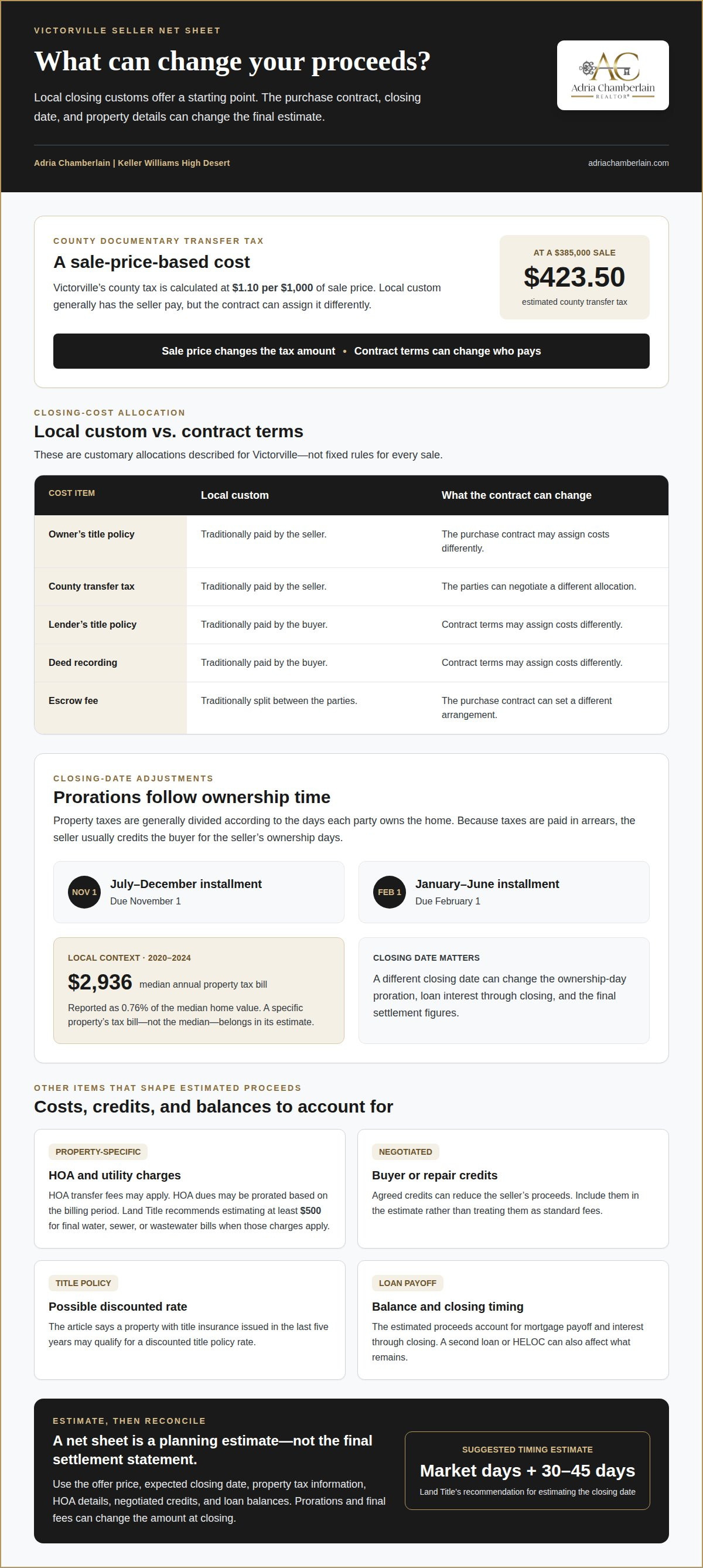
In Victorville, the county documentary transfer tax is $1.10 per $1,000 of sale price, or $423.50 on a $385,000 sale. A seller net sheet calculator for High Desert, CA can show how that charge fits into your estimated proceeds, alongside other closing costs and your mortgage payoff.
It’s natural to focus on the sale price, but what you keep depends on more than the offer. Local custom generally has the seller pay the county transfer tax, though the purchase contract can assign it differently. Property tax prorations, negotiated brokerage compensation, title and escrow costs, and loan balances also shape the estimate.
This guide explains how Victorville transfer taxes work, how property taxes are divided at closing, and how negotiated compensation and mortgage payoffs affect your net sheet. You’ll also learn why an estimate can differ from the final settlement statement, helping you assess an offer with the figures in context.
Key Takeaways
- See which title, escrow, recording, and HOA costs may affect a Victorville seller’s estimate, and how the purchase contract can shape who pays.
- Understand how property tax prorations account for the days each party owns the home, helping clarify the seller’s credit at closing.
- Learn why commission and any buyer-broker compensation are negotiable, and how they factor into estimated proceeds.
- Account for mortgage payoff balances, interest through closing, and any second loan or HELOC when estimating what remains.
- Use a net sheet to assess an offer while keeping in mind that prorations, credits, and final fees can change the settlement amount.
How much are seller closing costs in Victorville?
Victorville seller closing costs vary with the sale price, contract terms, property details, and closing date.
Seller-paid costs or concessions can include the owner’s title policy, county transfer tax, a share of escrow, mortgage-related fees, and negotiated buyer credits. In Victorville, local custom indicates who typically pays, but the purchase contract can assign costs differently.
Closing and HOA Transfer Fees
Closing fees cover services and records needed to complete a sale, while an HOA transfer fee relates to transferring a property in a homeowners association. In Victorville, local custom traditionally has sellers pay for the owner’s title policy and county transfer tax, buyers pay for the lender’s title policy and deed recording, and the parties split the escrow fee.
Its guidance says a property with title insurance issued in the last five years may qualify for a discounted title policy rate.
Estimated Seller Costs
An estimated seller-cost total combines transaction charges before subtracting the mortgage payoff.
HOA fees can add to the estimate when applicable. Land Title recommends estimating at least $500 for final water, sewer, or wastewater bills when those charges apply. The exact settlement total can also change with negotiated credits and property-specific charges.
Price and Closing Date Effects
Sale price affects the county documentary transfer tax, while the closing date influences the timing of prorations and payoff calculations. Victorville’s county tax is $1.10 per $1,000 of sale price, so the estimated tax on $385,000 is $423.50.
The purchase contract may change which party pays that tax, despite the local custom of seller payment. A different price changes the tax calculation, so a net estimate should use the offer price being considered. Land Title recommends estimating the closing date using average days on market plus an additional 30 to 45 days to close. A changed closing date can affect the final figures, including loan interest and property tax credits.
Common Seller-Paid Costs and Concessions
Seller-paid costs are charges assigned to the seller by local custom or the purchase contract; concessions are negotiated credits or payments that affect the seller’s proceeds. In Victorville, local custom traditionally assigns the owner’s title policy and county documentary transfer tax to the seller and splits escrow.
The parties can negotiate different payment terms in the contract. A buyer or repair credit can reduce the seller’s proceeds, so include any agreed amount in the estimate rather than treating it as a standard fee. Also account for an HOA transfer fee if the property belongs to an association. Separating customary charges from negotiated concessions makes the estimated closing total easier to interpret.
How are property taxes split when you sell in Victorville?
In a Victorville sale, property taxes are generally prorated according to the days each party owns the home. The seller usually credits the buyer for the seller’s ownership days because taxes are paid in arrears.
Property Tax Prorations
A property tax proration divides the tax obligation between seller and buyer based on ownership through the closing date. The adjustment matters because the bill may cover time before the buyer owned the property.
Victorville tax installments are due November 1 for July through December and February 1 for January through June. Since taxes are paid in arrears, the seller’s closing credit accounts for the days the seller owned the home during the applicable period. The closing date determines how many ownership days fall on each side of the transaction.
Victorville homeowners had a median annual property tax bill of $2,936 during 2020-2024, equal to 0.76% of the median home value. Those figures provide local context, not a substitute for a specific property’s tax bill. A net sheet should use the property’s own tax information and the expected closing date to estimate the proration.
HOA Dues and Prorations
An HOA proration allocates association dues between seller and buyer according to the closing date and the association’s billing period. It matters because prepaid dues or an unpaid balance can change the amount credited or charged at closing.
For example, if the seller has paid dues covering time after closing, the settlement may account for the buyer’s share. If dues remain unpaid for the seller’s ownership period, that balance may affect the seller’s proceeds. The exact adjustment depends on the HOA billing cycle and the transaction’s closing date.
Utilities are separate from property taxes and HOA dues. A final water, sewer, or other utility bill may cover service through a date near closing, so the settlement calculation may need to account for the outstanding balance. Keeping these charges distinct helps prevent a tax proration from being mistaken for a utility or association adjustment.
Residential Net Sheet Estimates
Online net sheet calculations cover 1-4 family residential properties, making them a useful starting point for many Victorville home sales. They estimate how closing adjustments affect proceeds, but property-specific tax and HOA figures still matter.
For a reliable estimate, use the expected sale and closing dates alongside the property’s tax installment details and HOA billing information. The November 1 and February 1 installment dates help identify the tax period involved. A change in closing date can shift the number of seller ownership days and therefore alter the estimated credit.
Victorville’s median home value was $385,600 during 2020-2024, while its median annual tax bill was $2,936 for that period. Neither median determines an individual home’s proration. The property’s actual bill, ownership dates, HOA charges, and utility balances shape its settlement adjustments.
Commission and buyer-broker compensation
Brokerage compensation is negotiated and deducted from the seller’s proceeds when the seller is responsible for it. Buyer-broker compensation is a separate amount that may also be negotiated. Including each agreed amount in a net sheet helps show how compensation affects estimated proceeds.
This is an illustration, not a required rate or a standard charge for every sale. The actual amount depends on the compensation terms agreed for the transaction and the sale price used in the calculation.
Keep the categories clear. A seller may agree to compensation for the listing brokerage, buyer-broker compensation, or both. Any buyer-broker compensation paid by the seller is negotiable. The written terms determine whether the seller pays it and how much; do not assume it automatically follows from the home’s sale price.
Brokerage compensation can also involve an agreed split between brokerages. That split concerns how compensation is allocated under the relevant agreements; it does not establish a universal percentage for Victorville transactions. A net sheet should reflect the seller’s actual agreement, not a presumed split or customary rate.
Offers of buyer-broker compensation cannot be communicated through a multiple listing service, or MLS. Sellers should distinguish this compensation from the listing price and other terms shown there. Compensation is negotiable and agreed as a transaction term, not a fixed charge dictated by the sale price.
For a useful estimate, enter each compensation amount separately and calculate it against the sale price when the agreement uses a percentage. Then subtract those amounts from the projected proceeds alongside other closing costs and the mortgage payoff. If a buyer’s offer requests a seller contribution toward compensation, include it as a proposed or agreed term, not an automatic expense.
Compare offers using both the proposed price and the compensation terms. A higher offer, for example, can produce a different estimated result if its negotiated seller-paid costs also differ. A net sheet makes those effects visible and keeps negotiated compensation distinct from taxes, title charges, and prorations. The final figures follow the signed agreements and settlement details.
Seller mortgage balances, interest, and prepayment penalties
A mortgage payoff is the amount needed to satisfy a loan by the scheduled closing date. A seller net sheet subtracts that payoff from the sale proceeds, then accounts for any additional secured loans, applicable charges, and property tax adjustments.
Mortgage payoffs, liens, and prorated property taxes appear as separate adjustments in a seller net sheet. Existing loan and mortgage balances, including HELOCs, reduce proceeds; the payoff statement includes interest through closing, while the tax proration reflects the seller’s ownership days.
Use the principal balances of every loan secured by the property as your starting point. Land Title recommends including existing mortgages and HELOCs when estimating net proceeds. List a second loan separately rather than assuming it is covered by the first mortgage balance.
The payoff amount can exceed the principal shown on a recent loan statement. Land Title says traditional mortgage interest is paid one month in arrears and recommends adding one full month of mortgage interest to the estimated payoff. The lender’s payoff statement should include interest through the closing date, providing a date-specific amount for the estimate.
Treat that as an estimate, not as principal or interest. If the loan terms include a prepayment penalty, show that charge separately in the payoff estimate. Its amount depends on the loan terms and the lender’s payoff figures.
A lien is a claim secured against the property. If a lien must be paid from the sale proceeds, include its payoff as a separate deduction rather than folding it into the mortgage balance. This shows how each obligation affects the estimated amount remaining after closing.
Property taxes belong on a different line from mortgage debt. In Victorville, taxes are paid in arrears, so the seller usually credits the buyer for the days the seller owned the home. The closing date determines the ownership period used for that proration. Keeping the tax adjustment separate makes the net sheet easier to compare with the loan payoff.
For a clearer estimate, organize the figures by category: first mortgage principal, any second loan or HELOC, interest through closing, lender fees, applicable prepayment charges, liens, and tax proration. Land Title’s payoff guidance emphasizes using secured loan balances and accounting for interest through closing. If the closing date changes, interest and tax adjustments can change too, so use the same expected date across the calculations.
Seller net sheet calculator
A seller net sheet estimates what may remain after sale costs and mortgage payoffs are deducted from the sale price. A seller net sheet calculator for High Desert, CA can organize those figures, but its usefulness depends on transaction-specific inputs, not just a target price.
Information for a Net Estimate
You’ll need the expected sale price, estimated closing costs, loan payoffs, and expected closing date. Each figure matters because it changes the proceeds calculation.
Include every mortgage and HELOC secured by the property, plus interest through closing and any applicable payoff charges. Add agreed brokerage compensation and buyer-broker compensation, title and escrow costs, transfer tax, HOA charges, and negotiated credits. Property tax prorations and applicable final utility balances also affect the estimate. A missing loan or credit can make the displayed net misleading.
Using the Net Sheet Calculator
A seller net sheet calculator subtracts estimated expenses and secured debt from the sale price to show estimated proceeds. For a High Desert, CA seller, it can clarify how a proposed offer and its terms may affect the amount remaining.
That example shows why the sale price alone does not reveal the seller’s proceeds. Other costs and adjustments account for the difference.
Build the estimate using the offer price under consideration, rather than a hoped-for sale amount. Then enter the expected closing date, since that date can affect interest through payoff and property tax proration. Use actual loan balances and list each secured loan separately. Land Title recommends estimating payoff from the principal balances of existing loans and mortgages, including HELOCs.
Separate fixed estimates from contract-dependent items. The county documentary transfer tax in Victorville is $1.10 per $1,000 of sale price, while the contract can change which party pays it. Commission and seller-paid buyer-broker compensation are negotiable, so enter the agreed terms rather than assuming a rate. HOA fees, utility balances, credits, and other transaction adjustments also belong in their own lines when applicable.
Land Title says a net sheet can help sellers evaluate whether to accept or counter a buyer’s offer. Compare estimated proceeds alongside the offer terms, then update the calculation when the price, closing date, or negotiated credits change. The final settlement statement can differ as payoff interest, tax and HOA prorations, repair credits, and fees are finalized.
For a home-specific estimate that reflects your expected sale price and transaction details, request personalized sale guidance.
Adria Chamberlain | Keller Williams High Desert
When you’re considering a sale, an estimated sale price is one part of understanding the costs and terms that may shape your proceeds. A property’s value can depend on factors such as its condition, location, and current market conditions. The accepted price, closing date, loan payoffs, and negotiated costs can also affect the final amount.
A net sheet is a useful starting point, but its figures depend on the details of a transaction and are not a guarantee of the final amount. If you’re weighing an offer or preparing to sell in the High Desert, contact Adria to discuss your plans and questions.
For a conversation about selling your home and estimating proceeds, contact Adria Chamberlain | Keller Williams High Desert.
Plan your next move with a clearer estimate
A net estimate can help you set expectations before committing to a sale. Treat it as a planning tool: update it as offer terms and transaction details take shape, and use remaining questions to guide your next conversation. A seller net sheet calculator for High Desert, CA is most useful when its assumptions match the property and proposed sale.
If you’re considering selling, a personalized discussion can connect your property’s likely sale price with the decisions ahead. For tax or loan questions, consult the qualified professional who handles those matters, since an estimate is not a substitute for their advice.
Contact Adria Chamberlain | Keller Williams High Desert to talk through your next step. A thoughtful plan can make the selling process feel more manageable.
Frequently Asked Questions
How much is the transfer tax in Victorville?
Victorville’s county documentary transfer tax is $1.10 per $1,000 of sale price. For example, a $385,000 sale has an estimated county tax of $423.50. Local custom generally assigns this charge to the seller, but the purchase contract can set a different arrangement. Include the tax in your estimate using the proposed sale price, then account for any contract terms that reassign payment.
When should I do a net sheet?
Prepare a net sheet while planning to sell, then update it as important terms become clearer. An early estimate can help you assess a possible listing price; once you receive an offer, revise the calculation using its price, credits, and proposed closing date. If the date or terms change during negotiations, update those inputs before comparing the offer with another option.
Does this include capital gains tax?
A typical sale-proceeds estimate focuses on transaction costs and loan payoffs; it doesn’t determine your capital gains tax. A qualifying homeowner may exclude up to $250,000 of gain, or $500,000 for most married couples filing jointly, if the home was their main home for at least 2 of the 5 years before sale. Tax outcomes depend on eligibility and circumstances, so discuss your situation with a qualified tax professional.
What costs are deducted from the sale price?
Common deductions include mortgage and other secured loan payoffs, agreed brokerage compensation, transfer tax, title and escrow charges, and applicable recording or processing costs. The estimate may also account for HOA charges, property tax prorations, utility balances, and negotiated credits. For a useful comparison, separate confirmed contract terms from estimates, then note which amounts could change with the closing date or final settlement figures.
What is a seller net sheet and how is it calculated?
A seller net sheet estimates the proceeds left after expected sale costs and loan payoffs are subtracted from the sale price. Start with the proposed price, deduct transaction expenses and secured debt, then include applicable credits or prorations. For example, a change in the buyer’s requested credit changes the estimated net even if the offer price stays the same. It is an estimate, not the final settlement statement.
What are typical home selling costs in the High Desert, California?
Costs depend on sale price, negotiated compensation, loan balances, property details, and contract terms. These figures illustrate one scenario, not a fixed charge for every High Desert home. HOA fees, credits, and payoff details can change an individual estimate.
What California transfer taxes and county recording fees apply when selling a home in San Bernardino County?
For a Victorville sale, the county documentary transfer tax is $1.10 per $1,000 of sale price, equivalent to $0.55 per $500. The contract can change customary payment arrangements. Recording costs depend on the documents involved, so distinguish deed recording from a loan-release recording.
What are typical escrow and title fees for home sellers in the High Desert?
Local custom traditionally assigns the owner’s policy to the seller and splits the escrow fee between both parties. These are estimates, not guaranteed charges for every property. Title policy pricing may be discounted when title insurance was issued within the last five years.


