

The largest assistance amount isn’t automatically the right fit: first-time home buyer down payment assistance in San Bernardino County for 2026 varies by program and eligibility.
It can be hard to tell which amount applies to your situation or whether a program’s requirements fit your household and home search. This guide compares assistance options, including repayment, income, participation, and financial eligibility. A program’s headline amount is only part of the decision: where you plan to buy and whether you meet the specific requirements matter, too.
Key Takeaways
- Compare how assistance is structured, including deferred loans and programs with an equity share, before weighing the headline amount.
- For 2025, the county’s 80% AMI income limit is $89,500 for a four-person household, effective April 23, 2025.
- Financial eligibility can involve more than a credit score: FHA requirements may be as low as 580, while HACSB has employment and personal-funds criteria.
- Learn which local programs are available and how program rules can shape your next steps toward buying a home.
1. What is the maximum down payment assistance available in San Bernardino County?
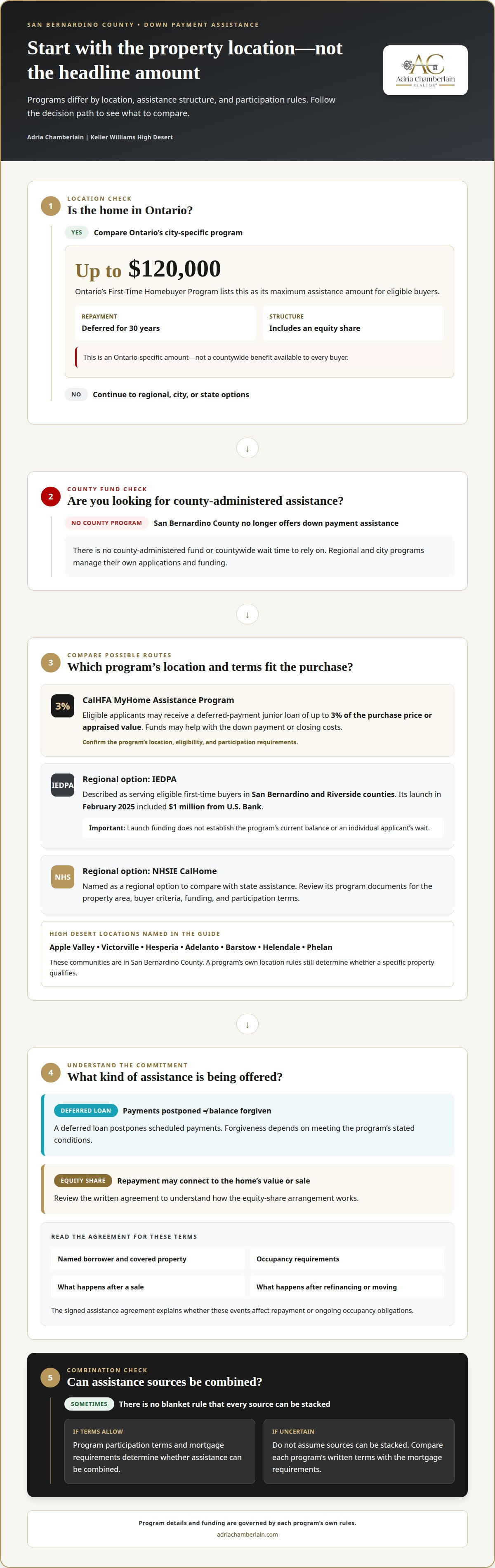
Ontario’s city program lists the largest single-program amount in the local options covered here. According to Ontario’s First-Time Homebuyer Program, eligible buyers may receive up to $120,000, with repayment deferred for 30 years and an equity share. These are Ontario-specific figures, not countywide benefits available to every buyer.
Other options have different amounts and structures. CalHFA’s MyHome Assistance Program offers eligible applicants a deferred-payment junior loan of up to 3% of the purchase price or appraised value. According to the California Housing Finance Agency, MyHome funds may help with the down payment or closing costs.
Can buyers combine county, city, state CalHFA, and federal assistance programs? Sometimes, but there is no blanket rule that every source can be stacked. Each program’s participation terms and the mortgage requirements determine whether assistance can be combined.
Are San Bernardino County assistance funds available now, and how long is the application or funding wait? San Bernardino County’s Community Development & Housing Department no longer offers down payment assistance, so there is no county-administered fund or countywide wait time to rely on. Regional and city programs manage their own applications and funding. IEDPA launched in February 2025 with $1 million from U.S. Bank; that launch funding does not establish its current balance or an individual applicant’s wait.
For High Desert buyers, the property’s location helps narrow the relevant options. Apple Valley, Victorville, Hesperia, Adelanto, Barstow, Helendale, and Phelan are in San Bernardino County, while Ontario’s program has its own city eligibility rules. NHSIE CalHome and IEDPA are regional options to compare with state assistance. First identify which programs cover the intended purchase location, then compare their assistance structures and participation terms.
Application steps generally follow each program’s process. First, select options that cover the property location, then review eligibility and repayment terms. Complete the relevant application and any required homebuyer education. Finally, coordinate the assistance with the mortgage and purchase timeline. This order helps clarify which program rules apply before you rely on a particular amount.
Length of participation in an eligible housing program
Participation can mean more than the time spent applying. For homebuyer assistance, distinguish the application process, any required education, and obligations that continue after closing. These serve different purposes. Completing a class before purchase, for example, does not explain how long assistance remains attached to a home.
IEDPA is described as serving eligible first-time buyers in San Bernardino and Riverside counties. These are the eligible counties identified for the program in this guide. If you plan to buy in either county, assess the program’s geographic fit, then review its buyer and property criteria. NeighborhoodLIFT is another program buyers may encounter, but evaluate its eligibility and forgiveness conditions separately rather than assuming they match IEDPA.
Program documents distinguish among deferred loans, forgivable loans, and equity-share arrangements. A deferred loan postpones scheduled payments, but that does not automatically mean the balance is forgiven. Forgiveness depends on meeting stated conditions. An equity-share arrangement may link repayment to the home’s value or sale, so review its written terms separately. These structures can create different obligations, even when they support the same type of purchase.
Do assistance loans need to be repaid if you sell, refinance, or move? The signed assistance agreement explains how those events affect the balance and any ongoing occupancy obligations. A sale may trigger repayment under one agreement, while another may set out a different process. Refinancing or moving may also have specific terms, so review each event separately.
Before accepting assistance, read the agreement for the named borrower, covered property, occupancy requirements, and actions that could change repayment. Check whether it describes a fixed participation period, payment deferral, or conditions for forgiveness. Those terms explain how long the homeowner’s obligations may continue. Keep the agreement with your mortgage paperwork for reference when making later decisions about the property.
To compare IEDPA and NeighborhoodLIFT, ask the same questions about each: which counties and properties qualify, what participation is required, and what happens after a sale, refinance, or move? Then distinguish program conditions from mortgage terms. This helps you understand the commitment attached to assistance, not just the funds available at closing. If you expect to relocate, pay close attention to occupancy language and any event that changes repayment obligations.
3. 2025 Household income limits
Income eligibility depends on the assistance program, application year, and household size. Area median income, or AMI, is a benchmark programs may use to set income thresholds. A limit based on a percentage of AMI is not automatically the same as another program’s fixed cap. Compare the specific program’s income table with your household details before treating a figure as applicable.
Household size matters because income tables commonly set different limits by the number of people in a household. A four-person household should use the four-person row; households with a different number of members should use the corresponding row. Don’t apply one household’s threshold to another. The program’s application instructions determine who counts as a household member.
The year matters, too. A 2025 income table should not be treated as a 2026 limit. Before using a table, match its effective period to the application and program. This helps prevent a past threshold from shaping a current homebuying plan. Keep the table’s stated year with your application notes so the comparison remains clear.
Use a practical sequence to assess income eligibility:
- Identify the specific assistance program and application period.
- Determine household size using that program’s instructions.
- Find the matching household-size row in the program’s applicable income table.
- Review the application’s directions for how household income is assessed.
Income eligibility may involve more than one wage amount. The program application explains which household members and income details it considers. Organize the requested information and use the same household definition throughout your comparison. For example, if an application counts several household members, compare the combined income it evaluates with the table row for that household size.
Keep income eligibility separate from other requirements. Meeting an income threshold does not by itself qualify you for assistance or a mortgage. A program may also consider its own buyer, property, and participation criteria. Treat the income table as one screening step, then review the remaining application requirements before deciding whether the program fits.
When comparing options in San Bernardino County, don’t carry one program’s income threshold into another program’s application. Match the program, year, household size, and income calculation. This makes the comparison more useful and helps you identify which assistance options merit further consideration.
4. Credit score and financial-history requirements
A credit score is one part of a mortgage application, not a complete picture of financial eligibility. FHA credit score requirements may be as low as 580. That figure is a possible threshold, not automatic approval for a mortgage or down payment assistance. The lender reviews the loan application, while an assistance program may also set its own participation rules.
Keep the mortgage decision separate from the assistance decision. You may meet a program’s income or participation criteria and still need to qualify for the mortgage used to buy the home. Conversely, mortgage eligibility alone does not establish eligibility for down payment assistance. Compare both sets of requirements to see which parts of the application need attention.
HACSB’s Homeownership Assistance Program includes financial and employment requirements. Applicants must be employed full time for at least two years, unless they are disabled or age 62 or older. The program also requires at least 1% of the minimum down payment to come from the applicant’s own funds. Gifts or grants can provide 2% of the down payment under the stated program terms.
Those HACSB rules make the source of funds important, not just the total available. For example, a buyer reviewing this program should distinguish personal funds from gifts or grants in the application. The stated percentages describe this program’s down-payment contribution rules, not a general rule for every San Bernardino County assistance program. Other programs may set different participation and financial requirements.
Review your financial history carefully before submitting a mortgage application. Organize income and asset records, list recurring debts, and make sure the application reflects your current finances. These steps help present a consistent picture to the mortgage lender and assistance program, but they don’t replace either organization’s eligibility review.
For a clear comparison, divide the questions into three checks:
- Credit: What credit score and mortgage criteria apply to the selected loan?
- Program participation: Does the assistance program have employment, age, disability, or homebuyer requirements?
- Funds: Which portion must come from the buyer, and which sources may count as gifts or grants?
A first-time buyer considering FHA financing can use the possible 580 score threshold as an initial reference, then review the lender’s full mortgage criteria. A buyer considering HACSB assistance should separately assess the two-year full-time employment rule and required personal contribution. Credit, income, employment, and down-payment sources each answer a different application question. Keeping those categories distinct makes it easier to identify the requirements that apply to a particular home purchase and community.
5. San Bernardino County down payment assistance programs
San Bernardino County buyers can compare local, regional, city, and state assistance programs. The main options discussed here include NHSIE CalHome, the Inland Empire Down Payment Assistance Program (IEDPA), Ontario’s city program, and CalHFA MyHome. They differ in service area, eligibility, funding structure, and repayment terms, so the first useful comparison is whether a program covers the property you plan to purchase.
What are the home purchase price limits for San Bernardino County assistance programs in 2026? There isn’t one universal countywide limit; purchase eligibility depends on the specific program and property location. Compare the program’s applicable purchase-price criteria with the home you’re considering before relying on its assistance.
NHSIE CalHome and IEDPA are relevant options for eligible first-time buyers in the region. NHSIE CalHome’s terms distinguish it from a grant: assistance is structured as a loan with simple interest, deferred for 30 years, and no monthly payments. IEDPA is also a deferred loan, but its stated terms specify zero interest and a 30-year term. Those differences matter to families weighing affordability over the full period of homeownership, not just the cash needed at closing.
IEDPA serves eligible first-time buyers in San Bernardino and Riverside counties. Its launch in February 2025 included $1 million in funding from U.S. Bank. That launch information describes the program’s start, not its current funding status. Ontario’s assistance is different because eligibility connects to the city and its qualifying ties, such as residency, employment, or former residence. A buyer searching in Apple Valley, Victorville, or Hesperia should distinguish those local boundaries from Ontario’s city-specific rules.
CalHFA MyHome is a state option, while NHSIE and IEDPA are regionally connected. A federal mortgage option may also be part of a purchase, but assistance programs have their own rules on combining funds. Treat grants, deferred loans, and mortgage financing as separate parts of the transaction. A grant does not have the same repayment structure as a loan, and a deferred loan can still carry repayment terms.
Compare options in a consistent order:
- Location: Match the property’s city and county to the program’s service area.
- Eligibility: Compare first-time buyer, household-income, and participation requirements.
- Funding structure: Identify whether assistance is a grant, deferred loan, or another form.
- Purchase criteria: Review the applicable price limit and how the program treats the property.
For a local home search, plan your home purchase around the communities and program areas that fit your goals. A location-first comparison can help narrow the assistance programs worth considering before you move forward with a property.
Adria Chamberlain | Keller Williams High Desert: First-Time Homebuyer Representation
Adria Chamberlain | Keller Williams High Desert provides First-Time Homebuyer Representation for buyers moving from assistance research to a home search. Once you’ve identified programs that may fit, Adria can help you evaluate properties and communities that align with your plans, including Apple Valley, Victorville, Hesperia, Adelanto, Barstow, Helendale/Silver Lakes, and Phelan.
Representation can help as you move from comparing program rules to evaluating homes and making purchase decisions. Assistance eligibility and mortgage approval remain governed by the relevant program and lender, so keep those requirements in view as you shape your search.
Contact Adria Chamberlain | Keller Williams High Desert for guidance with your home search.
Take the Next Step Toward a Home That Fits
Choosing a home is about more than qualifying for assistance. It’s also about finding a property and community that make sense for your plans. As you consider first-time home buyer down payment assistance in San Bernardino County in 2026, keep your home search focused on what you need and the program requirements you’ve reviewed.
Adria Chamberlain | Keller Williams High Desert provides First-Time Homebuyer Representation to support your purchase decisions. If your plans also involve selling a home, Adria offers Home Valuation & Comparative Market Analysis (CMA) and Residential Property Listing Services. These services can help you consider both sides of a move together.
For a conversation about your home search or next move, contact Adria Chamberlain | Keller Williams High Desert. A thoughtful next step can make the path ahead feel more manageable.
Frequently Asked Questions
Program Comparison: Which DPA Is Right for You?
The right down payment assistance program depends on where you’re buying, your eligibility, and the loan terms you can manage. For first-time home buyer down payment assistance in San Bernardino County in 2026, compare NHSIE CalHome, IEDPA, CalHFA MyHome, and city-specific Ontario assistance. For example, a buyer planning to purchase in Ontario should compare that city program’s location requirements with regional options. Also weigh repayment terms, household income rules, and whether assistance can be combined.
What are the 2025 income limits for San Bernardino County DPA programs?
For 2025, the county’s 80% area median income limit is $89,500 for a four-person household, effective April 23, 2025. NHSIE CalHome lists the same limit for a four-person family. A household with a different number of members must use the limit for its household size. For instance, a four-person household can use $89,500 as a comparison point, then review the selected program’s other eligibility criteria.
What is the maximum down payment assistance available in San Bernardino County?
These figures apply to Ontario’s program, not every county buyer. Compare the property location and program terms before treating a maximum as relevant to your purchase.
What first-time homebuyer down payment assistance programs are available in San Bernardino County in 2026?
Programs to compare include NHSIE CalHome, IEDPA, CalHFA MyHome, Ontario’s First-Time Homebuyer Program, and HACSB’s Homeownership Assistance Program. San Bernardino County’s Community Development & Housing Department no longer offers down payment assistance. Each option has distinct geographic and buyer criteria, so a buyer looking in Victorville, for example, should distinguish regional programs from Ontario’s city-specific assistance. Funding and application details are program-specific.
What are the 2026 income limits for San Bernardino County down payment assistance programs?
Income limits depend on the assistance program and household size. The published 2025 county figure is $89,500 at 80% AMI for a four-person household, but that 2025 value should not be treated as a 2026 limit. For a 2026 application, use the income table applicable to that program and year. The household count and the program’s method for assessing income both affect the comparison.
How much down payment and closing cost assistance can eligible buyers receive in San Bernardino County?
The amount varies by program and eligible purchase. CalHFA MyHome offers an eligible applicant a deferred-payment junior loan of up to 3% of the purchase price or appraised value for a down payment or closing costs. NHSIE CalHome and IEDPA have separate assistance limits and repayment terms. Ontario also states a combined assistance maximum for qualifying people. Buyers should compare the specific amount and permitted use, rather than assume every program covers both costs.
What credit score, debt-to-income, and minimum buyer contribution rules apply?
FHA credit score requirements may be as low as 580, while the mortgage lender assesses the full loan application, including debts and income. A single score doesn’t establish eligibility for assistance. HACSB’s program requires at least 1% of the minimum down payment from the applicant’s own funds; 2% may come from gifts or grants. Its employment rule also applies, with an exception for applicants who are disabled or age 62 or older.
Which cities in San Bernardino County offer their own first-time homebuyer assistance programs?
Ontario has a city-specific First-Time Homebuyer Program, with eligibility connected to qualifying ties such as residency, employment, or former residence. The available program facts identify Ontario; they do not establish city programs elsewhere. If you’re looking in Apple Valley, Hesperia, Victorville, Adelanto, Oak Hills, Helendale, Barstow, Phelan, Pinon Hills, or Lucerne Valley, compare regional and state assistance based on the property’s location.


