
An as-is sale doesn’t make known code issues disappear, but it can let you sell without completing every repair first. Selling a house with code violations in Adelanto, CA may also mean repairing the issues or listing the home traditionally, depending on the violations, your timeline, and the property’s condition. California sellers must disclose known material defects and code violations through the Transfer Disclosure Statement, according to the California Legislature.
It’s understandable to wonder whether a violation could lower your home’s value or delay a sale. This guide explains what may count as a code violation, how unresolved issues can affect buyers and offers, and how an as-is sale compares with repairing the home or listing it traditionally. You’ll have a clearer basis for weighing the options for your Adelanto property.
Key Takeaways
- Learn which property conditions may count as code violations and why known material issues still matter when selling.
- Compare selling as-is, correcting violations before listing, and a traditional sale by weighing repair needs, timing, and likely buyer concerns.
- Understand why unpermitted work may need local review, and how the approval process can depend on current requirements and the work’s condition.
- See how open enforcement matters, fines, or liens can affect a sale and the proceeds available at closing.
- Use the home’s condition and your priorities to choose a practical path, then explore how a property valuation and listing guidance can support your decision.
What Counts as a Code Violation in California?
A code violation is a condition or alteration that doesn’t meet an applicable building, safety, or property-maintenance requirement. In California, examples can include faulty wiring, inadequate sanitation, or structural work that doesn’t meet required standards. Health and Safety Code section 17920.3 addresses substandard building conditions. A concern may also involve unpermitted work, such as an addition completed without required permits.
Not every repair issue is a formal code enforcement case. A notice from code enforcement, an unapproved alteration, and a defect affecting safety are distinct matters, though they can overlap. For example, an unpermitted room addition may raise questions about its approval, construction, and whether its square footage can be represented as part of the home. Buyers need accurate information to understand the property they’re considering.
California sellers must disclose known material defects and code violations through the Transfer Disclosure Statement and Seller Property Questionnaire under Civil Code Section 1102 and related statutes, according to the California Legislature. These forms give buyers information about the seller’s knowledge of the property’s condition. An as-is sale doesn’t remove the obligation to disclose known material issues, and the Transfer Disclosure Statement cannot be waived in an as-is sale.
Describe what you know clearly. If a prior owner added a room without permits, disclose that history rather than presenting it as permitted living space. If the city sent a correction notice about wiring, share the notice and explain whether the work was completed. Don’t guess about compliance or describe an open issue as resolved. Permit records, contractor invoices, and code enforcement correspondence can help clarify the property’s history.
Recent purchases and renovations can bring additional disclosure considerations. For offers accepted on or after July 1, 2024, California sellers of a single-family home who accept an offer within 18 months of acquiring title have additional disclosure duties for certain contractor-performed work. Keep renovation records together, including contractor details and permits, so relevant information can be reported accurately.
Omitting information can have consequences. California Civil Code section 1102.13 says a sale isn’t invalidated solely because a seller failed to comply with the disclosure article, but willful or negligent violations can result in liability for the buyer’s actual damages. For a sale in Adelanto, distinguish what you personally know from assumptions, and disclose known issues through the required forms. A real estate or legal professional can help explain how disclosure rules apply to a particular transaction.
Cash sale versus correcting violations or listing traditionally
In Adelanto, the practical choice is whether to spend time on repairs, list with unresolved issues, or consider an as-is cash offer. Compare likely net proceeds, the work needed for compliance, and how much time you can allow for the sale.
Repairing Before a Sale
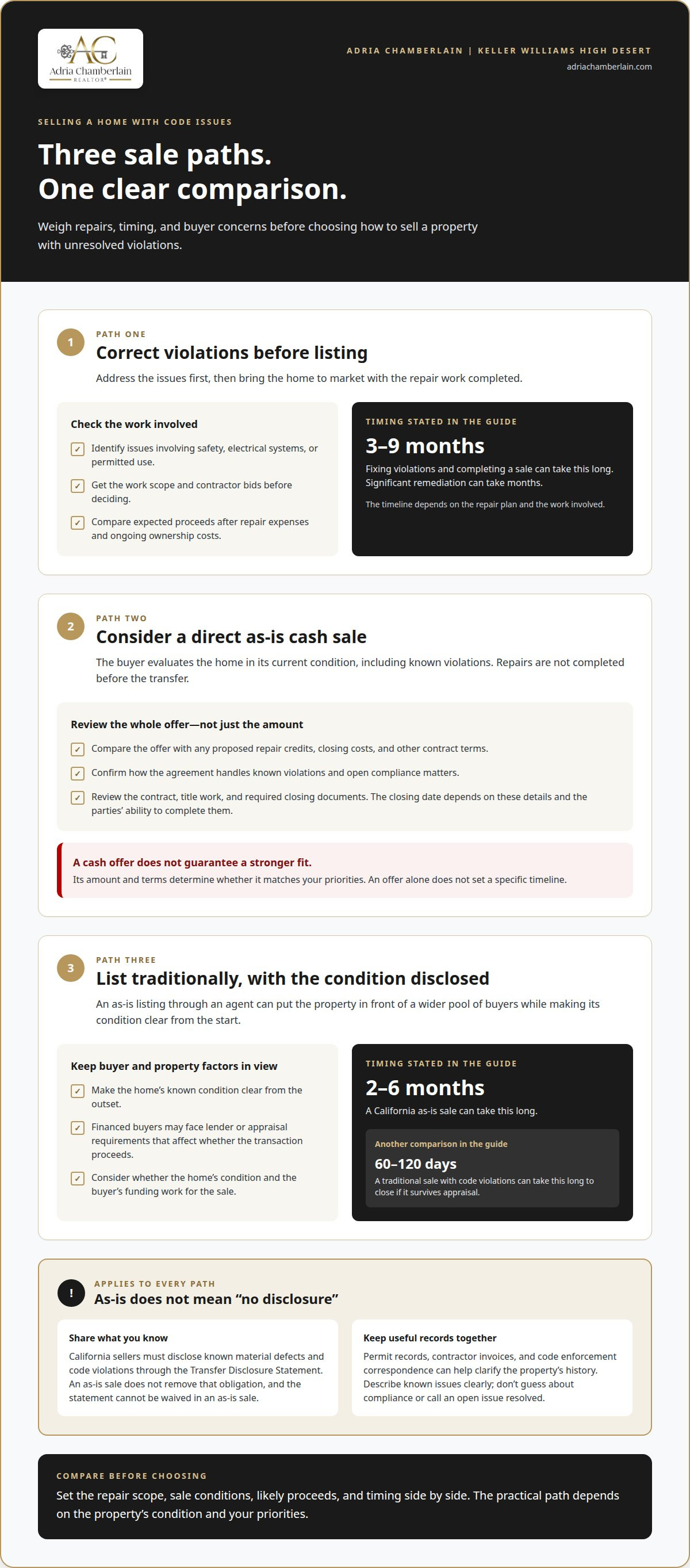
Correcting violations before listing can address buyer concerns and make the home easier to evaluate. Start by identifying which issues affect safety, electrical systems, or permitted use, then obtain the scope of work and contractor bids. Significant remediation can take months. Fixing violations before listing and completing a sale can take 3-9 months, so weigh the repair plan against your schedule and ability to manage the work.
Repairs aren’t automatically the most practical route. A traditional listing may net more when the property is in sound condition and you can wait. But the comparison changes if repairs are extensive, contractors uncover additional work, or the property is difficult for financed buyers to evaluate. Consider expected proceeds after repair expenses and ongoing ownership costs, not just the possible list price.
Direct Cash Sale Option
An as-is cash sale may suit a seller who doesn’t want to complete repairs before transferring the property. The buyer considers the home in its current condition, including known violations, and makes an offer. Review the offer alongside any proposed repair credits, closing costs, and other contract terms. A cash offer isn’t automatically the strongest option: its amount and terms determine whether it fits your priorities.
Selling as-is through an agent is another path. It can expose the property to a wider pool of buyers while making its condition clear from the start. A California as-is sale can take 2-6 months. Buyers using financing may face lender or appraisal requirements that affect whether the transaction proceeds, so the property’s condition and buyer’s funding both matter.
Cash-Sale Process and Timing
For a direct sale, the steps generally include reviewing the property, receiving and evaluating an offer, agreeing on contract terms, and completing title and closing paperwork. Confirm how the agreement addresses known violations and open compliance matters. The closing date depends on the contract, title work, and the parties’ ability to complete required documents. A cash offer alone doesn’t establish a specific timeline.
A traditional sale with code violations can take 60-120 days to close if it survives appraisal. Use that range as a comparison, not a promise for a particular Adelanto home. Before choosing, set the repair scope, sale conditions, and timing side by side. Residential listing guidance can help you assess how an agent-listed sale fits your property and priorities.
Does unpermitted work have to be removed or legalized before I sell?
Adelanto’s correction requirements depend on the violation and any active notice; a city or county notice sets a correction date. Repair costs depend on the issue, materials, access, and inspection findings. Many minor violations can cost less than $1,000 to correct, while unpermitted additions may require plans, permits, and additional work.
Checking Permit and Enforcement Records
Start by comparing the home’s additions and alterations with available permit records. An open code enforcement notice can identify the issue, required correction, and deadline. For an unpermitted addition, note its location, approximate dimensions, and known construction history. These details help clarify whether the concern involves missing paperwork, a safety defect, or both.
Organize notices, permits, plans, and contractor records before deciding what to do. If the property has an active case, the written correction terms are more useful than a general description of the problem. A room built without permits, for example, may need an inspection to reveal concealed work.
Repairing Violations and Seeking Permits
Some problems call for repairs; others require approval for work already completed. California’s substandard-building provisions allow an agency to require repair, rehabilitation, vacation, or demolition. The appropriate path depends on the property’s condition and the notice. For unpermitted additions, learn the local jurisdiction’s requirements before requesting contractor bids, because retroactive approval is judged against current code.
Keep the steps in order: understand the notice, determine which permits or repairs apply, then plan the work and inspections. If inspection reveals deficiencies behind walls, the work may expand. Keep the correction deadline in mind while deciding whether to resolve the case before the sale.
After-the-Fact Permits and Amnesty
Some jurisdictions allow after-the-fact permits when completed work can meet current requirements. Some also offer amnesty programs, particularly for older accessory dwelling units. These options don’t automatically apply to every Adelanto property or unpermitted addition. The local jurisdiction’s process, the work’s safety, and inspection results determine whether approval is possible.
Legalizing work may involve documenting what was built, submitting plans, and making areas accessible for inspection. If the addition fails current requirements, repairs may be needed before approval. Treat an amnesty option as a possible route, not a substitute for addressing an active enforcement notice.
Retroactive Permit Costs and Requirements
A simple, mostly compliant addition may cost less to legalize than one with major structural or safety problems. These figures illustrate how costs can accumulate; they aren’t a quote for an Adelanto property. For a common violation, the needed correction, contractor work, permit review, and inspection findings determine the expense. Disclose known issues whether you repair them or sell with work unresolved.
How do code violations affect what my house is worth?
Unresolved violations can affect buyer interest, financing, repair negotiations, and sale proceeds. In Adelanto, an open enforcement case or recorded lien can also affect the transfer process.
Open Cases, Fines, and Liens
An open code enforcement case tells buyers that a condition may still need attention. Buyers may factor in repair work, uncertainty, and the effort required to reach compliance. Price reductions of 2-5% are reported when violations surface during inspections. Minor violations may reduce value by 5-10%, while major issues can reduce offers by 20-40% or more. These ranges aren’t a property-specific appraisal.
California cities may use compliance orders, administrative citations, penalties, hearings, and liens. Uncorrected violations may lead to daily fines of $100-$1,000 or more per day per violation. An addition without permits can also affect a buyer’s view of usable space. California appraisers usually exclude unpermitted square footage from appraisal calculations, which may affect a financed buyer’s loan.
Reviewing City Enforcement Records
Before setting an asking price, find out whether Adelanto has an open case tied to the property. Review available city code enforcement records by address, then compare any notice with the property’s condition. Note the violation, correction deadline, penalties, and case status. Also identify additions or alterations that may not appear in permit records.
Keep the city notice, permit documents, and correction receipts together. A case marked open can raise different questions from a resolved case with completed work. If a county record or title document also references enforcement, keep it with the city paperwork. Clear records help buyers understand what remains unresolved and what has already been addressed.
Code Liens at Closing
Fines or enforcement costs may become liens against the property. In California, code violations, fines, and liens generally remain attached to the property when it’s sold. If a violation notice has been recorded against title, escrow addresses it during the transaction. The lien can affect your net proceeds because amounts due may need to be resolved as part of closing.
Some California jurisdictions may record abatement costs as a special assessment and collect them like property taxes. Enforcement costs may also be recovered through the property tax roll under Government Code section 38773.5. The lien or assessment amount, its status, and the sale’s closing statement all matter. Don’t treat an open case and a recorded lien as the same thing; each can have separate effects.
To estimate value for a home with violations, look beyond comparable sales. Consider the property’s condition, unpermitted area, repair scope, buyer financing, and any recorded amounts due. Disclose known issues and share relevant records so buyers can evaluate the home. The final offer reflects the specific property and transaction terms, not a percentage range alone.
Selling a house as-is with code violations
Yes, you can sell a home in Adelanto with unresolved code violations, and a buyer can purchase it as-is. Selling a house with code violations in Adelanto, CA means planning for the property’s condition to shape buyer questions, offer terms, and the path to closing.
Selling the Property As-Is
An as-is listing presents the home in its current condition rather than promising repairs before transfer. Describe the property accurately and don’t suggest unpermitted additions are approved living space. For example, identify an addition as unpermitted if that is what the records show. Clear wording helps buyers assess the home without mistaking an assumption for a permit or approval.
Review each offer as a complete proposal, not just a price. Pay attention to requested repairs, inspection terms, closing conditions, and what the buyer expects to receive with the property. A buyer might accept the home’s condition but still propose terms that require discussion. The written agreement should make those expectations clear.
Selling With Unresolved Violations
An unresolved case doesn’t automatically make a sale impossible, but it can affect which buyers are prepared to proceed. Some may be comfortable evaluating repair needs; others may decide the uncertainty doesn’t fit their plans. A buyer relying on financing may also face property-condition requirements from the mortgage company. The practical impact depends on the issue and transaction.
Before listing, organize the information that explains the property’s status. Distinguish completed work from remaining work, and keep relevant notices and permit records together. For instance, if a correction has been made but a case remains open, don’t describe the matter as fully closed. Accurate details help interested buyers understand what they would be taking on.
Consider how the listing will answer predictable buyer questions: What condition is the home in? Which issues remain unresolved? What records describe the work or city communication? A concise, consistent presentation can reduce confusion during showings and negotiations. It also keeps the conversation focused on the property rather than assumptions about its history.
As-is doesn’t mean every buyer will offer the same terms or that a direct cash offer is automatically preferable. Compare the proposed closing conditions, requested concessions, and your priorities. If repairs, timing, or uncertainty are influencing your decision, weigh those factors together rather than treating the label “as-is” as a complete sale plan.
If you’re considering an as-is listing, discuss listing your property and the options that fit your Adelanto home.
Adria Chamberlain | Keller Williams High Desert
Adria Chamberlain | Keller Williams High Desert can help you compare selling options for a home with code violations. A Home Valuation & Comparative Market Analysis (CMA) can provide a property-specific basis for considering condition, unresolved issues, and comparable sales. If an agent-listed sale fits your plans, Residential Property Listing Services can support the next steps in bringing the home to market.
Turn to Adria when you’re weighing repairs against an as-is sale, considering how known issues may affect buyer interest, or deciding how to position the property. The right approach depends on the home, the violations, and your priorities. For guidance on your Adelanto property and its sale options, contact Adria Chamberlain | Keller Williams High Desert.
Choose the Next Step That Fits Your Plans
Start by identifying what matters most: timing, the home’s current condition, and how much repair work you’re prepared to manage. For selling a house with code violations in Adelanto, CA, set a practical priority, then compare the sale paths that support it. A focused conversation with Adria Chamberlain can help turn an uncertain decision into a plan for your property.
Adria Chamberlain | Keller Williams High Desert can discuss how the home’s condition and local market context may shape your options. If you’re preparing to sell, you can ask about a property valuation and listing guidance as possible next steps. Contact Adria Chamberlain | Keller Williams High Desert to discuss your Adelanto home and the approach you’re considering. You can take the next step at a pace that feels right for you.
Frequently Asked Questions
What Happens to the Code Violation After the Sale?
A sale doesn’t automatically close an open enforcement case. The violation may remain associated with the property, so distinguish the city’s correction requirements from the purchase agreement. For example, a contract may address who handles specified work, but it doesn’t itself erase a city notice. Confirm the case status and any recorded lien to understand the transaction.
Daily Fines Piling Up?
If Adelanto assesses daily penalties for an unresolved violation, the balance can grow while the issue remains open. The amount depends on the city’s enforcement action and the specific case. Review the latest notice for its deadline and penalty terms, then obtain the current case status from the City of Adelanto Code Compliance Division. Don’t rely on an older notice to show what is currently owed.
Do I have to fix the violations before selling to you?
Adria Chamberlain | Keller Williams High Desert provides residential listing services, not direct cash purchases of homes. A listing doesn’t automatically mean every violation must be repaired first, but an active city order may have its own correction requirements. Adria can help you consider how the property’s condition affects a listing plan. Disclose known material issues whether repairs are completed or left unresolved.
Inland Empire Code Violations?
Code enforcement is handled by the local jurisdiction, so a violation in Adelanto may follow a different process from one elsewhere in the Inland Empire. The city’s role also has limits: Adelanto Code Compliance doesn’t investigate civil disputes such as disagreements over fence repairs, overhanging tree branches, or private Covenants, Conditions, and Restrictions. Identifying whether an issue is a city matter or a private dispute helps clarify the next step.
What if I don't know whether my house has open violations?
Not knowing about a case doesn’t establish that the property has no open violations. Start with notices or correspondence kept with the home’s records, then look for address-based code enforcement information from the relevant jurisdiction. Permit history can also help identify additions or alterations that need clarification. If you find a notice, compare its case number and correction status with later correspondence before describing the issue to buyers.
What code violations must be disclosed when selling a house in California?
Disclose known material property issues, including code violations, through the applicable seller disclosures. Examples may include a known safety problem, an unresolved enforcement notice, or an addition completed without permits. Be precise about what you know: describe the notice or work and its current status rather than guessing whether it meets code. Keep records of relevant contractor-performed work available for accurate disclosure.
How can I check for open permits, code violations, or liens on an Adelanto property?
For a home in Adelanto, use the property address when reviewing available permit and code enforcement records. The City of Adelanto Code Compliance Division can be reached at 442-249-1177; its office is at 11600 Air Expressway, Adelanto, CA 92301. For liens, review title and escrow documents, since a recorded enforcement notice may be addressed during escrow. Keep copies of any case or permit records you locate.
Do Adelanto code enforcement fines or liens transfer to the buyer at closing?
Code violations, fines, and liens generally remain attached to the property when it sells, but that doesn’t by itself explain who ultimately pays a balance. If a notice is recorded against title, escrow addresses it during the transaction. The lien’s status and the sale documents matter. Have the closing paperwork show how any amount due is handled, and don’t assume an unresolved case disappears at transfer.


