

The freeway you choose can change the workday: on the 91 or I-10, leaving at 6:30 AM instead of 7:30 AM can save 20 to 35 minutes each way. A real estate guide to the commute from Hesperia to the Inland Empire should start with your actual destination and schedule, because there isn’t one travel time that fits every route.
It’s natural to weigh the commute alongside the home itself. Compare freeway routes, peak-hour travel, your work schedule, and the space and location you want. This guide to the commute from Hesperia to Inland Empire destinations explains why a home that looks convenient on a map may feel different once you account for the drive. Planning around your routine helps you focus your search on more than the distance between two places.
Key Takeaways
- Compare commute options using your specific Inland Empire destination and work schedule, rather than relying on a single regional travel-time estimate.
- Use average commute times in cities such as Corona, Riverside, and Moreno Valley as reference points, then consider how your own route and routine may differ.
- Weigh housing budget and location together: county-level home-price patterns can help frame your search, while the right fit also depends on the space and daily drive you want.
- Account for the full cost of a long freeway commute, including vehicle wear, when comparing the appeal of a home with its day-to-day location.
- A home valuation or comparative market analysis can help sellers understand their property’s market position, while buyer representation can help connect a home search with commute and budget priorities.
Access to Inland Empire and Los Angeles for remote and hybrid workers
For Hesperia residents, commute options depend on the destination, travel time, and how often work requires an in-person trip. A drive to Los Angeles can differ sharply from travel within the Inland Empire.
Hesperia-to-Los Angeles Distance and Travel Times
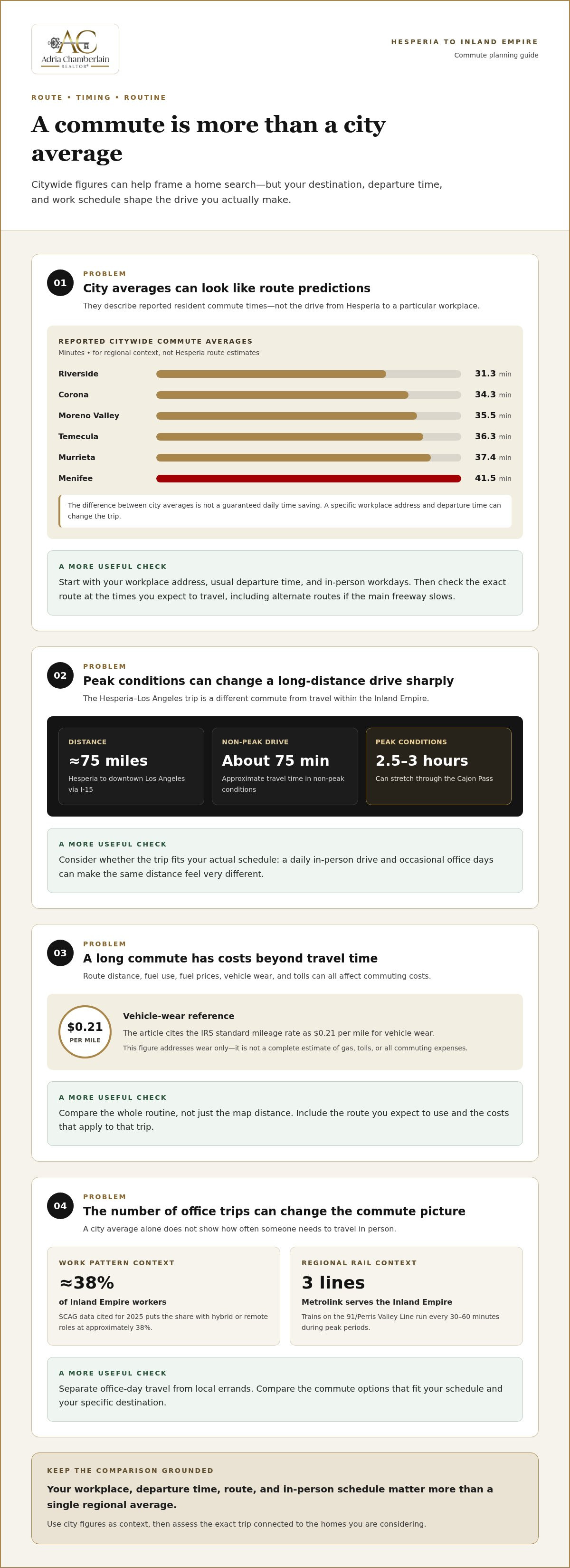
Hesperia is approximately 75 miles from downtown Los Angeles via Interstate 15. The drive takes about 75 minutes in non-peak conditions, but can stretch to 2.5 to 3 hours during peak conditions through the Cajon Pass. That difference matters when deciding whether a Los Angeles job fits a daily commute or works better with occasional office days.
Regional City Commute Patterns
As regional context rather than service locations, other Southern California areas experience varied commute dynamics. Commuters heading from points like Corona, Norco, Fontana, Rancho Cucamonga, Riverside, Moreno Valley, Temecula, Murrieta, Menifee, or Ontario face different starting points and traffic patterns toward Los Angeles or Orange County than Hesperia commuters. Peak traffic heavily affects travel across these broader regional hubs. Destination and departure time both shape the routine.
These figures cover different periods and measures, so treat them as context rather than a direct comparison.
Property taxes, HOA fees, and homeowners insurance vary by property and location. A home’s assessed value and tax details affect property-tax costs, HOA fees depend on whether an association and shared services apply, and insurance costs reflect the home’s characteristics and location.
Hesperia school-district boundaries vary by area: most of ZIP code 92345 is served by Hesperia Unified, while some parts of West Hesperia’s 92344 fall within Snowline Joint Unified. Crime and amenities can differ by neighborhood, so compare the specific locations that fit your commute and daily needs.
Commuting costs depend on route distance, fuel use, fuel prices, and vehicle wear; tolls depend on the route chosen. The IRS standard mileage rate is cited as $0.21 per mile for vehicle wear. That figure addresses wear, not a complete estimate of gas, tolls, and all commuting expenses.
A Hesperia home may suit buyers who value its local housing market and can manage a longer drive to some Inland Empire destinations. The trade-off is time on the road, especially if you regularly travel through the Cajon Pass during peak hours.
Wildfire, earthquake, and insurance considerations depend on a property’s location, construction, and coverage terms. When considering a Hesperia home, include these factors and insurance costs alongside the home’s condition in your ownership budget.
Remote and hybrid schedules can change how often the commute matters. SCAG data cited for 2025 puts the share of Inland Empire workers with hybrid or remote roles at approximately 38%. Metrolink serves the Inland Empire with three lines; trains on the 91/Perris Valley Line run every 30-60 minutes during peak periods.
Average commute times
Citywide commute averages can help compare Inland Empire locations, but they can’t predict a specific trip from Hesperia. Your destination, departure time, and freeway conditions all affect driving time.
Among the reported city averages, Riverside is 31.3 minutes, Corona is 34.3 minutes, and Moreno Valley is 35.5 minutes. These figures offer a broad comparison of residents’ commutes, not drive-time estimates between Hesperia and each city. A home’s location within a city and a worker’s destination can make an individual route shorter or longer than the average.
Other Inland Empire comparisons show how location relates to daily travel. Temecula averages 36.3 minutes, Murrieta 37.4 minutes, and Menifee 41.5 minutes. These averages can help frame a location search, but they don’t rank neighborhoods by convenience for a particular employer. For example, a shorter citywide average doesn’t necessarily mean a faster drive to a job site reached by a different freeway corridor.
A useful Hesperia-to-Inland Empire commute comparison starts with your workplace and office schedule, not just city averages. A buyer traveling to Riverside on selected office days may weigh the route differently from someone driving to Moreno Valley every weekday.
Use city averages as a starting point, then compare the exact origin and destination for your routine. Check the route at your expected travel times and consider alternate routes if the main freeway slows. If you work a hybrid schedule, distinguish office-day travel from local errands. One average won’t capture both patterns.
Keep the numbers in perspective: the difference between Riverside’s 31.3-minute average and Menifee’s 41.5-minute average is a city-level comparison, not a guaranteed daily saving. Your commute also depends on the workplace address and when you leave. That distinction can prevent a broad statistic from driving a home decision that should account for your actual routine.
As you narrow your search, note your work destination, typical departure time, and in-person workdays. Compare these details with the city averages for Riverside, Corona, and Moreno Valley. This helps connect your travel priorities to the homes you’re considering.
For a home search shaped by your travel priorities, explore homes with your commute in mind.
For another regional reference, Santa Clarita, California, has an average commute time of 34.1 minutes, though that figure also cannot predict a Hesperia route.
Buyer priorities for budget, space, and location
Comparing Hesperia with a home closer to work means balancing your purchase budget, location, space, and commute. Start with your workplace, then compare specific homes and routes rather than treating an entire city as one option.
Regional home values offer useful context, but the measures aren’t always identical. These figures aren’t directly comparable with Hesperia’s median sold price, which uses a different measure.
Compare the space each home offers, too. For every Hesperia or Inland Empire property, consider the rooms and outdoor areas you’ll use alongside its location and commute. A larger home farther from work may suit someone who values space at home, while a smaller home closer to work may appeal to someone prioritizing a shorter drive. Listing details and your routine make the trade-off specific.
Compare the full cost of ownership, not just the advertised home price. Property taxes, any homeowners association dues, insurance, and regular commuting expenses all affect your household budget. These costs vary by property and location, so compare them for each home you’re considering. A Corona property and a Hesperia property, for example, may have different recurring expenses even if their purchase budgets appear similar.
To compare Hesperia with a home closer to work, write down your work address, expected office schedule, and housing priorities. Then compare each property’s total monthly housing expenses, route, and available space. Comparing a Hesperia home with one in Riverside can make the trade-offs clearer for your household.
Location also affects everyday access to amenities and services. Compare specific neighborhoods in Hesperia, Corona, or Moreno Valley rather than assuming every part of each city offers the same routine. Map your trips to work, errands, and places your household visits regularly. This helps you decide whether more space or a different location better fits your daily needs.
Use comparable homes when judging value. Compare properties with similar size, condition, and features, and distinguish between market measures: a median owner-occupied value is not the same as a median sold price. This gives Hesperia buyers a grounded way to balance budget, space, and proximity to Inland Empire workplaces.
Freeway-oriented Inland Empire commuting
For Hesperia commuters, I-15 and Highway 395 connect local trips with major Inland Empire routes. The practical choice depends on your destination, departure time, and preferred freeway corridor.
Routes to Inland Empire Destinations
Routes from Hesperia to Ontario, Rancho Cucamonga, Riverside, and San Bernardino depend on the destination and current road conditions. I-15 is the central southbound corridor from Hesperia toward the Inland Empire, while connecting freeways shape the final leg. This matters because a home’s access to I-15 can affect how easily you reach different job centers, even when destinations sit in the same region.
For a trip to Riverside, compare the route to your actual workplace, not just the city boundary. Ontario and Rancho Cucamonga are distinct destinations, too. A job near a freeway interchange may require a different route from one farther across town, while San Bernardino has its own destination pattern. Mapping each work address shows how local streets connect with the freeway network.
Neighborhood Access to Major Roads
In Hesperia, compare properties by their actual access to I-15 and Highway 395, rather than relying on a neighborhood label alone. The Mesa corridor is one named area to include in a location comparison, but road access depends on the property’s precise position. This distinction matters because two homes described as being in Hesperia may connect differently to your regular route.
For practical access, assess each home’s drive to I-15 or Highway 395 and the route from that road to work. Compare the Mesa corridor and other candidate areas using the exact address; that gives a more useful answer than assuming an entire neighborhood offers the same connection.
Departure time can change the value of a freeway location. On the 91 or I-10, leaving at 6:30 AM instead of 7:30 AM can save 20 to 35 minutes each way. That difference matters for workers whose schedule allows an earlier start, but it may not help someone required to travel later. Match the route comparison to your real work hours.
Long-distance driving adds direct expenses beyond housing. That makes commute frequency important: a hybrid schedule with fewer office trips changes your yearly driving pattern compared with a five-day commute.
Compare freeway access with the whole trip, including local streets at both ends. For example, a property near I-15 may still leave a lengthy drive to a workplace away from the freeway. Build a realistic comparison for Ontario, Rancho Cucamonga, Riverside, or San Bernardino using the home address, work address, and departure time. That process helps identify whether the freeway-oriented location suits your routine.
What are the best routes from Hesperia to Ontario, Rancho Cucamonga, Riverside, and San Bernardino?
For these Inland Empire destinations, I-15 south is the main corridor from Hesperia. The most suitable route depends on the exact workplace, local streets, and traffic at departure time. Choosing a route by city name alone can miss important differences between an office near a freeway and one deeper inside the city.
Ontario: Use I-15 south as the starting corridor, then compare the final approach to the workplace. Ontario covers multiple destinations, including areas near major roads and locations farther from them. A job address near an interchange may call for a different final stretch than an office reached through local streets. Put the exact address into your route comparison.
Rancho Cucamonga: From Hesperia, begin with the southbound I-15 corridor and assess the last part of the trip separately. Rancho Cucamonga workplaces can sit in different parts of the city, so a route that suits one address may not suit another. Compare the route to the worksite, not simply to a central map marker.
Riverside: I-15 south provides the initial corridor, while connecting roads determine the approach to a particular Riverside destination. The final route can vary depending on where the workplace sits. Compare the trip to the actual address and include the local-road portion, especially if your destination is away from a major freeway.
San Bernardino: Start by comparing I-15 south with the route’s final connection toward the destination. The right approach depends on the neighborhood and work address within San Bernardino. A commute to a site near a freeway differs from one requiring more local driving, so compare complete door-to-door routes rather than freeway segments alone.
For each destination, compare routes from the same starting point in Hesperia and use the same arrival time. This keeps the comparison consistent. Check the main route and an alternative, then note where each leaves the freeway and how much local driving remains. A map estimate to a city center won’t reflect the full trip to Ontario, Rancho Cucamonga, Riverside, or San Bernardino.
Make route comparisons part of your home search. For example, test the drive from a Hesperia property to your Ontario office, then compare it with a Rancho Cucamonga worksite if your employer may change locations. Comparing specific addresses helps you judge whether a home supports your commute, rather than relying on a broad city-to-city label.
Adria Chamberlain | Keller Williams High Desert: Home Valuation & Comparative Market Analysis (CMA)
Adria Chamberlain | Keller Williams High Desert can help connect your commute priorities with a practical home decision. If you’re considering selling in Hesperia before moving closer to work, a Home Valuation & Comparative Market Analysis (CMA) can show how your property compares with similar homes. Residential Property Listing Services can support your next step when you’re ready to sell.
For buyers, First-Time Homebuyer Representation can help you weigh location, budget, and daily travel while comparing homes. If you’re considering an investment purchase, Investment Property Acquisition can keep your property goals central to the search. The right starting point depends on whether you’re buying, selling, or planning both parts of a relocation.
Contact Adria Chamberlain | Keller Williams High Desert to discuss your home search or selling plans.
Make Your Next Move Fit Your Daily Life
Turn your commute priorities into a clear home-search plan. Identify what’s fixed, such as your workplace and arrival time, and where you have flexibility, such as office days or the space you need. This can help you compare Hesperia with other Inland Empire locations without letting one factor decide everything.
This real estate guide to commuting from Hesperia to the Inland Empire is most useful when you apply it to your plans. If you’re buying, bring your preferred destinations and housing priorities into the search. If you’re preparing to sell before relocating, consider how your timing and next location fit together.
Adria Chamberlain | Keller Williams High Desert can help you think through the real estate side of that decision. Contact Adria to discuss your home search or selling plans, and take the next step with a plan shaped around your needs.
Frequently Asked Questions
How long is the commute from Hesperia to major Inland Empire cities during rush hour?
There isn’t one rush-hour travel time for every Hesperia-to-Inland-Empire trip; the destination and route determine the drive. For context, Rancho Cucamonga to downtown Los Angeles is estimated at 65-90 minutes during the 7-8:30 AM weekday rush. Hesperia to downtown Los Angeles can take 2.5 to 3 hours during peak conditions through the Cajon Pass. For Ontario, Riverside, and San Bernardino, compare the exact work address and departure time.
Are there public transit options from Hesperia to Inland Empire job centers?
Metrolink serves the Inland Empire with three lines, but the available train route depends on your destination and how you reach a station from Hesperia. The 91/Perris Valley Line runs every 30-60 minutes during peak periods. For a job in Ontario, Riverside, or another center, consider the complete trip, including access to the station and travel from the arrival station to work. A train schedule alone won’t show the full commute.
How do Hesperia schools, crime rates, and amenities compare with nearby Inland Empire communities?
Most of ZIP code 92345 is served by Hesperia Unified, while some parts of West Hesperia’s 92344 fall within Snowline Joint Unified. Crime and amenities can differ by neighborhood, so compare specific locations that fit your commute and daily needs.


