
A well isn’t automatic just because a Phelan parcel is vacant. When buying vacant land in Phelan, water well requirements begin with confirming whether a well can be permitted on that specific parcel. San Bernardino County planning or environmental health can help determine eligibility. Owning the land also doesn’t automatically give you the right to use nearby water.
It’s understandable to focus on a parcel’s location, price, and future plans, but water access can determine whether the land will work for you. A listing that mentions a well or water source is only a starting point. Find out what’s permitted and which water rights are documented before relying on the claim.
This guide explains how to research local water rules, assess well eligibility and permit records, and consider hauled water and storage. You’ll also learn what to look for in water-rights documents and how to distinguish an established right from the possibility of installing a well later. These checks help you assess the parcel’s water situation before moving ahead with a purchase.
Key Takeaways
- Research parcel-specific water rules and building or septic considerations before deciding how the land will be used.
- Ask the county planning or environmental health department whether a domestic well may be permitted on the parcel.
- Assess hauled water as a possible option, including the county rules that apply to on-site storage tanks.
- Don’t assume that owning land or being near a water source grants the right to use that water.
- Review documents carefully to distinguish an existing, documented water right from the possibility of a future well.
County and state water research
For a Phelan parcel, start water research with San Bernardino County’s well eligibility process and applicable state information. Consider how water access fits the parcel’s planned home, septic system, and household needs.
Well Regulation
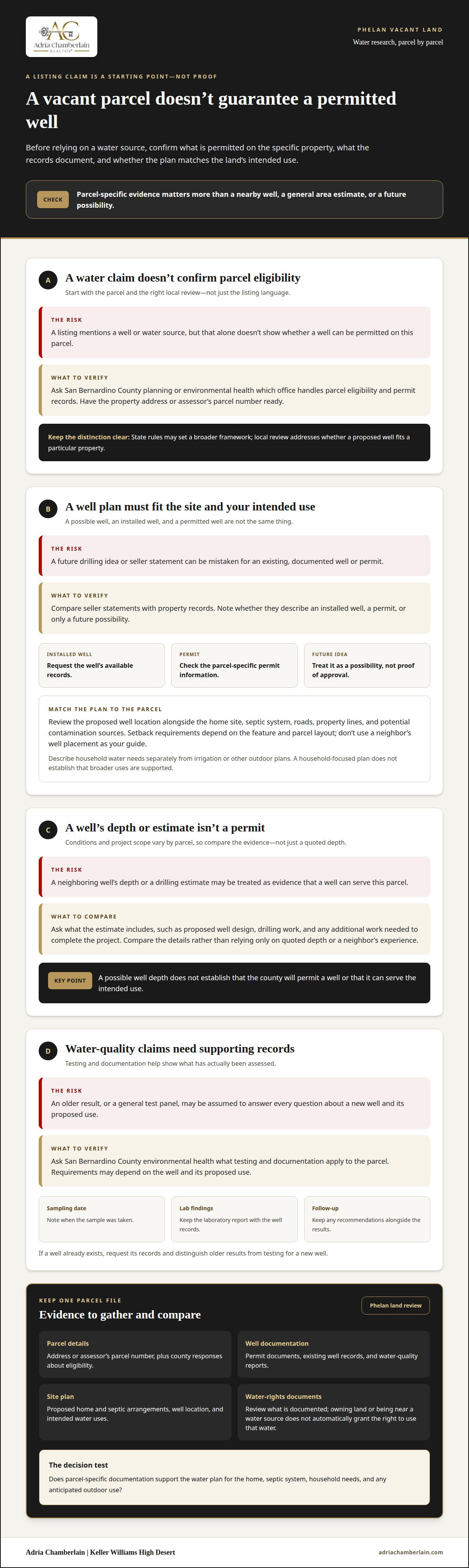
For vacant land in Phelan, San Bernardino County planning or environmental health can help determine whether a well can be permitted. The right department may depend on your question, so ask which office handles parcel eligibility and permit records before relying on a listing’s water claims. Have the property address or assessor’s parcel number ready.
Separate general water research from parcel-specific decisions. State rules may set a broader framework, while local review addresses whether a proposed well fits a particular property. For example, the planned home and septic system may affect what needs review. Ask the county which local restrictions apply, then keep its guidance with the parcel records.
New Well Water Testing
Water-quality testing assesses whether water from a newly drilled well is suitable for its intended household use. Arrange testing before treating the well as a dependable domestic supply, and ask San Bernardino County environmental health what testing and documentation apply to the parcel. Requirements may depend on the well and its proposed use, so don’t assume a general test panel meets every local requirement.
Keep test results with the well and permit records. Note the sampling date, laboratory findings, and any follow-up recommendations in the report. If the parcel already has a well, request its records and distinguish older results from testing for a new well. This makes it easier to assess the evidence behind water-quality claims.
Drilling Costs and Well Depths
Well-drilling costs and depths depend on ground conditions, water availability, and project scope. No single figure applies across Phelan: a neighboring well’s depth doesn’t establish what another parcel will require. For your purchase decision, distinguish a drilling estimate from evidence that a permitted well can serve the intended use.
Ask what an estimate includes, such as the proposed well design, drilling work, and any additional work needed to complete the project. Compare the details instead of relying only on a quoted depth or a neighbor’s experience. Conditions vary by parcel. A well’s possible depth also doesn’t establish that the county will permit it.
Keep a simple file for the parcel as you research. Include the assessor’s parcel number, county responses, permit documents, well records, and water-quality reports. Compare these with the planned home and septic arrangements. If a listing describes a future well as a possibility, treat that differently from a well with parcel-specific permit records. This prevents general area information from being mistaken for evidence about the land.
Domestic well eligibility and permits
A well plan needs to match how you expect to use the property. Before choosing a site layout, distinguish household needs from future plans for outdoor water use.
Setback requirements for a proposed well in relation to septic systems, property lines, roads, and contamination sources depend on parcel conditions and applicable rules. Don’t assume one standard distance applies to every feature. Review the proposed layout against the requirements for that site.
Domestic Use and Irrigation
Domestic use means household water, while irrigation means watering land or plants. For buyers, the key distinction is the property’s full intended use, not just its first planned improvement. If your household plans to add a garden or keep livestock, describe those uses separately. This helps align the water plan with how you may actually use the land.
When buying vacant land in Phelan, evaluate water well requirements against both current and anticipated uses. Note whether your plans could extend beyond household needs, and don’t treat a household-focused water plan as evidence that broader uses are supported. This distinction can affect whether the parcel remains suitable as your plans develop.
Domestic Well Eligibility
Well eligibility depends on the parcel, so distinguish a documented well from a proposed one before deciding to buy. Compare the seller’s statements with available property records, noting whether they describe an installed well, a permit, or an idea for future drilling. Each represents a different stage of a water plan.
Keep your intended use consistent in your property notes, seller discussions, and document review. If you plan household and outdoor uses, record both rather than describing the project only as residential. Clear notes help you identify what the parcel information actually covers and compare the site with other land you may consider.
Well Setbacks and Contamination Sources
Setbacks affect where a well can be located in relation to other site features. Review the proposed location alongside roads, boundaries, septic areas, and potential contamination sources, then consider how those constraints affect usable space. Required separation can depend on the feature and parcel layout, so don’t use a neighbor’s well placement as your guide.
Think beyond the initial site plan. Changes to the home site, driveway, or septic plan can affect the space available for a well. Keep each version of the plan together so you can see how proposed changes affect placement and compare the water plan with the property’s intended use.
If you’re weighing land as an investment, Adria’s Investment Property Acquisition may help you consider how a parcel fits your goals.
Hauled water and storage tanks
Hauled water may be part of a vacant parcel’s water plan when a well isn’t available or installed. In Phelan, review delivery arrangements and storage rules before deciding this option will work for a future home. A tank on the property alone doesn’t establish that water can be stored or supplied as planned.
Start with San Bernardino County’s rules for hauled-water storage on vacant parcels. Ask how they apply to the specific parcel and intended use. Keep the county’s response with the property records, particularly if a listing mentions a tank or describes hauled water as an existing option. The parcel’s zoning and proposed use may affect what needs review.
Next, consider how a delivery vehicle would reach the planned tank location. Review the parcel entrance, driveway route, turning space, slopes, and obstacles. For example, a tank behind a future home site may be harder to access than one near the entrance. Compare the proposed location with the site plan, not just listing photos.
Storage capacity should suit the household’s anticipated use and delivery schedule. Consider everyday needs, outdoor use, and times when access may be difficult. Don’t assume a neighbor’s tank size or delivery pattern will work for your parcel. A nearby property can provide context, but its setup doesn’t determine the right arrangement for your land.
Review the tank as part of the full site plan. Its location can affect access, building placement, and space for other improvements. Record the intended location and compare it with county guidance. If the seller points to an existing tank, clarify whether it’s included with the property and review related documents.
Use these questions to organize your review of a hauled-water plan:
- What county rules apply to storing hauled water on this parcel?
- Where could a tank fit alongside the planned home and site access?
- Can a delivery vehicle reach that location using the parcel’s access route?
- What documents describe an existing tank or water-storage arrangement?
Separate listing facts from assumptions. “Water available” might refer to a seller’s plan, a tank, or a possible future arrangement. Those descriptions aren’t interchangeable. Record the exact claim, then compare it with county guidance and parcel documents before relying on it in your purchase decision.
Finally, consider how hauled water would fit your intended use over time. A plan for occasional visits differs from one for a full-time residence. Record household needs, the proposed tank location, access conditions, and the county’s response together. This gives you a practical basis for comparing parcels without mistaking a tank mention for a complete water setup.
Water rights and ownership
Owning a Phelan parcel doesn’t automatically grant the right to use water on or near it. In western water-rights systems, a neighboring water source or visible well doesn’t establish that you may use that water. Treat water rights as a separate part of your property review, not an automatic benefit of buying land.
This distinction matters when a listing mentions a spring, irrigation, or a nearby water source. The description may identify a feature, but it doesn’t explain who may use the water or for what purpose. Land beside a flowing channel, for example, isn’t necessarily entitled to draw from it. Any right to use water needs its own supporting documentation.
Start by identifying exactly what the seller says is included. Is the claim about an existing well, a spring, irrigation access, or the possibility of drilling later? These are different situations. A well may exist without the listing establishing a separate water right; future drilling remains a possibility, not an existing supply. Keep the seller’s statements with the property documents.
Review documents supporting the claimed right and compare their details with the parcel. Look for the property identification, named parties, water source, stated use, and any terms describing access or limits. If a document refers to a neighboring parcel, shared arrangement, or irrigation purpose, note the connection. A reference to water alone may not establish that the right applies to your land.
Match the paperwork to your intended use. If you plan to build a home, distinguish household water from documents describing irrigation. A parcel marketed for agricultural use may have different water-related claims from land promoted for residential plans. Don’t treat one stated use as proof that another is covered. Record what the documents say and compare it with your plans.
When a listing advertises water rights, request the supporting documents and check whether they identify the parcel being sold. Compare the seller’s wording with the records. “Near a spring” describes location; a claimed right to use spring water needs documentary support. A map or aerial image can show proximity, but it can’t establish water-use rights.
Keep these questions alongside the parcel file:
- Does the document identify this specific parcel?
- Which water source does the claimed right concern?
- What use does the document describe, such as household supply or irrigation?
- Does the seller’s description match the wording in the supporting records?
For Phelan land, distinguish physical water features from documented rights. A well, spring, or irrigation line on or near a property doesn’t by itself establish your right to use the water. Base your understanding on parcel-specific documents and the stated scope of any claimed right.
Water rights due diligence for vacant land
Compare the parcel’s actual water arrangement with your intended use. For land in Phelan, distinguish community service, an existing private well, and the possibility of a future well.
Private Wells and Community Water
A private well serves a parcel through its own well, while community service comes through a shared water system. This affects which water records and arrangements matter to your plans. For a Phelan parcel, establish whether community service reaches the property or the listing relies on a private well. Nearby service doesn’t prove that this parcel is connected.
Compare documents for the specific property. A claim of community service should identify the parcel’s connection; a well claim should distinguish an existing well from future drilling potential. Note the stated water source and intended use in either case. This shows what the purchase includes, rather than relying on a neighborhood map or listing shorthand.
Septic Approval with a Private Well
Septic approval determines whether a proposed wastewater system fits the parcel’s site and building plans. If the land has a private well, review septic and well placement together. San Bernardino County planning or environmental health can help identify local restrictions connected to septic or building plans. Share a site plan showing the proposed home, septic area, and well location.
Don’t assess septic feasibility separately from the water plan. A proposed home site, for example, may affect where both systems can go. Ask which parcel-specific restrictions apply and keep the response with your site documents. This helps establish what needs review before you rely on a listing’s description of future residential use.
Well and Land Due Diligence Risks
Well and land due diligence means reviewing records and access conditions that could affect water use. A dry well, groundwater restriction, or easement can change how the parcel’s water plan works. Review existing well records for the well’s status and use. Check parcel documents for recorded restrictions and easements related to water access or infrastructure.
An easement may give someone a right to use part of a property for a particular purpose. If a claimed water line crosses another parcel, identify the recorded access rights and the land they cover. For groundwater restrictions, determine whether records describe limits affecting the parcel. Don’t infer rights from a nearby well or water feature.
Keep the review tied to the parcel. Collect the listing’s water claims, well records, county guidance, and documents describing restrictions or easements. Compare each record with the planned home and water source. If the parcel only has the possibility of a future well, treat that differently from a documented water right or operating well. This frames your decision around what the land supports now and what remains a proposal.
Adria Chamberlain | Keller Williams High Desert: Home Valuation & Comparative Market Analysis (CMA)
Adria Chamberlain | Keller Williams High Desert can help you connect water due diligence with your property decision. After you review well eligibility, water rights, and site constraints, Adria can assist with an investment property search or acquisition. A Home Valuation & Comparative Market Analysis (CMA) can also provide market context as you evaluate a property.
Bring your priorities to the conversation, including the intended use, water plan, and parcel details. Adria can help you weigh these real estate considerations and identify properties that align with your goals. Questions about permits, testing, or water rights should go to the relevant county offices and qualified professionals.
For help with a property search or acquisition, contact Adria Chamberlain | Keller Williams High Desert or visit adriachamberlain.com.
Choose land that fits your long-term plans
Before committing to a Phelan parcel, consider how its water plan fits the way you expect to use the land over time. A property that suits one buyer may not suit another. As you assess water well requirements when buying vacant land in Phelan, connect the available water information to your planned home, daily needs, and future use of the site.
It can help to bring your priorities and parcel details into one conversation before deciding what to pursue. That gives you a clearer way to compare properties and keep your next steps focused on your goals. For personalized real estate guidance, contact Adria Chamberlain | Keller Williams High Desert.
Take the time you need to make a thoughtful choice. Choose the next step that best fits your plans.
Frequently Asked Questions
Does San Bernardino County require a well permit before drilling on vacant land in Phelan?
Confirm parcel eligibility and permitting with San Bernardino County before treating drilling as an option. The county’s planning or environmental health department can help determine whether a well can be permitted on a specific parcel. Share the parcel number, intended well location, and planned use. A nearby well or listing description doesn’t establish that your parcel is eligible.
What are the current well drilling permit fees and application requirements in San Bernardino County?
Get permit fees and application requirements from San Bernardino County’s current well-permitting process rather than assuming they’re the same as for another parcel. Prepare the assessor’s parcel number, proposed well location, intended use, and available site plans showing planned buildings and septic areas. These details tie the application to the property and proposed project. Don’t rely on an old fee amount or another owner’s paperwork as a guide to your parcel’s current requirements.
How can buyers check groundwater availability and existing well records for a Phelan parcel?
Start with parcel-specific well records and county information, then compare them with documents from the seller. Ask whether records identify an existing well, its location, and its documented use. Distinguish those facts from the general possibility of drilling. A neighboring well can offer context, but it doesn’t establish groundwater availability or well performance on the parcel you’re considering.
Can a private well provide enough water for a home, livestock, and irrigation in Phelan?
A private well can support these uses only if its permitted use and available supply meet the combined demand. Household needs, livestock watering, and irrigation each add to the plan, so describe all intended uses rather than assessing domestic needs alone. A well discussed for household use, for example, shouldn’t automatically be assumed adequate for irrigation or livestock without supporting well information.


