

The right home near a desert trail isn’t always the one with the largest lot.
It’s sensible to look beyond the asking price. Bedroom count, lot size, and how you plan to use the property can all shape which home feels like the right fit. The listed Apple Valley examples include a four-bedroom home and properties on lots of approximately 0.42, 0.62, and 5 acres; they illustrate variety, not a single price standard for every home near a trail.
This article explains which home sizes and features to weigh, how professional representation can support a purchase, and how to compare Apple Valley with nearby communities such as Victorville and Hesperia. Use these practical criteria to assess listings and focus on the details that matter most to your search.
Key Takeaways
- Match bedroom count and lot size to how you plan to use the home, not just its proximity to trails.
- Consider how trail access fits your daily routines and which property features matter most to you.
- Compare Apple Valley listings with nearby-city prices using similar homes and the same time period.
- Use price per square foot as one comparison tool, alongside condition, lot size, and property features.
- Professional first-time buyer representation can help you evaluate options and move through the purchase process with guidance.
Home sizes and property features
Apple Valley listings show why bedroom count and lot size deserve separate attention. A five-acre parcel differs greatly from a typical residential lot, but acreage alone doesn’t show whether a home will suit your needs. Compare interior space, outdoor area, and intended use separately. A household that needs several bedrooms may prioritize the floor plan, while a buyer seeking open land may put more weight on the parcel. When buying a home near Apple Valley’s desert trails, match each feature to your everyday plans.
At 23766 Valley View Road, the property covers 5 acres. That figure describes the parcel, not the home’s interior size or layout. Consider how the listed acreage fits your plans, including how much outdoor space you want and whether existing improvements suit your needs. A larger parcel can look appealing on paper, but the address and property details still matter. Keep land size distinct from bedroom count, building area, and condition.
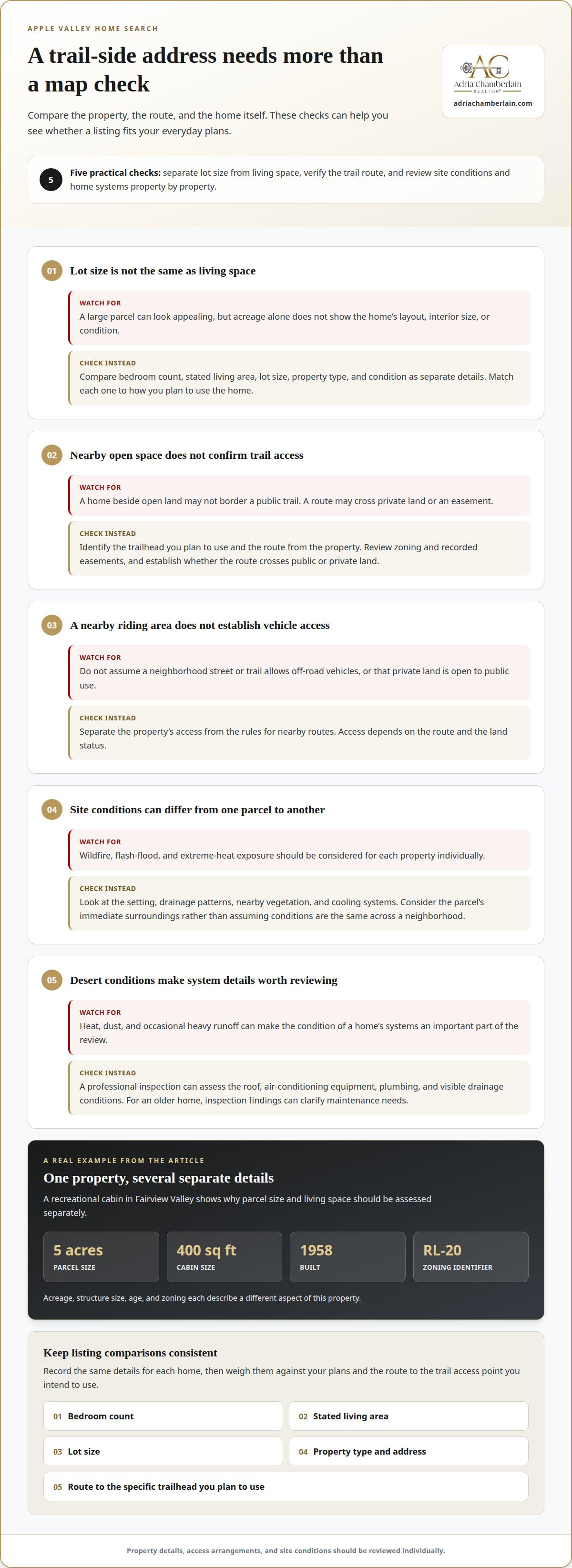
Fairview Valley offers another example: a recreational cabin built in 1958 sits on a 5-acre property. The cabin measures 400 square feet, a notably different living-space profile from a full-size residence. The property also has RL-20 zoning. Treat those details separately: the cabin’s age, stated size, acreage, and zoning identifier each describe a different aspect. Assess whether the existing structure and parcel match your intended use.
How close are Apple Valley neighborhoods to popular desert trails and outdoor recreation areas? It depends on the property’s address, your preferred trailhead, and the route between them. Compare each home with the access point you plan to use rather than assuming every Apple Valley neighborhood is equally close.
For a trail-oriented search, separate must-haves from preferences. Choose the bedroom count and interior layout that suit daily life, then consider how much land you want to use. A 400-square-foot cabin and a 5-acre parcel illustrate why a small structure doesn’t necessarily mean a small property. Likewise, a large lot doesn’t tell you how much usable living space the home provides. Review each feature on its own before weighing the complete property.
Use a consistent comparison when reviewing Apple Valley listings. Record each home’s bedroom count, stated living area, lot size, property type, and address. Then consider how each feature supports your plans, including access to a specific trailhead. For buyers weighing homes near Apple Valley’s desert trails, this organized comparison can clarify trade-offs without letting acreage alone drive the decision. For the Fairview Valley cabin, consider its 1958 build date and 400-square-foot size alongside the 5-acre parcel and RL-20 zoning.
Home-buying guidance
A trail-adjacent address deserves more than a quick look at a map. For an Apple Valley purchase, consider the parcel, access route, property condition, and intended use together. A home beside open space may not border a public trail. A nearby route could cross private land or an easement, a recorded right to use a specific area. Clarifying these details early helps keep your search focused on properties that fit your plans.
Zoning, easements, and access arrangements vary by Apple Valley parcel. Review the property’s zoning designation and recorded easements, and establish whether the route to a trail crosses public or private land. Nearby open space alone does not grant permission to cross a property or use a particular route.
Off-road vehicle access also depends on the route and land status. Don’t assume a neighborhood street or trail allows off-road vehicles, or that private land is open to public use. If you’re considering a home near a riding area, distinguish the property’s access from the rules for nearby routes.
Consider wildfire, flash-flood, and extreme-heat exposure for each property individually. When reviewing an Apple Valley home, look at its setting, drainage patterns, nearby vegetation, and cooling systems. These details can help you identify practical questions without assuming every home beside a trail has the same conditions.
Desert homes call for close attention to systems exposed to heat, dust, and occasional heavy runoff. A professional inspection can assess the roof, air-conditioning equipment, plumbing, and visible drainage conditions. For an older home, the findings can clarify maintenance needs and inform your purchase decisions.
A purchase review can keep these checks organized:
- Parcel details: Match the property address to its zoning and recorded access information.
- Trail connection: Identify the route and whether it involves public or private land.
- Site conditions: Consider drainage, vegetation, and the parcel’s immediate surroundings.
- Home systems: Review inspection findings for the roof, cooling equipment, plumbing, and drainage.
For example, a home near open land may appeal because of its setting, yet its usable trail access depends on the route itself. Pairing parcel information with inspection findings gives buyers a clearer basis for comparing that home with another Apple Valley property. If you’re considering a trail-oriented purchase, contact Adria for guidance with property comparisons and the transaction.
Rules vary by parcel, so review its zoning designation and recorded easements, and establish whether the route to the trail crosses public or private land. Nearby open space does not grant crossing rights, and off-road vehicle access depends on the route and land status.
Nearby city home prices
To compare Apple Valley with Victorville or Hesperia, start with similar property types. A detached home with comparable living space, lot size, and condition is a more useful comparison than a land listing or small recreational cabin. Keep asking prices separate from reported sale prices. Individual examples are reference points, not a single price for every home in a city.
Apple Valley listings illustrate the range among individual homes. These are asking prices for specific properties, not citywide averages or guarantees of final sale prices. Differences in size, features, condition, and location help explain why listings vary.
Desert Knolls provides a separate local comparison. Its reported sale price was $429K, down 5.5% since last year. Four homes sold during the period represented by the displayed market trends. The number of sales is small enough that individual transactions can strongly shape a reported figure. Read that result as a snapshot of the represented period, not as a prediction for a particular Apple Valley home.
Days on market offers another point of comparison, but it describes listing activity rather than value. Homes in Desert Knolls were reported on the market for 63 days. That figure doesn’t establish how quickly another property will sell. Property condition, asking price, and buyer interest all relate to how a specific listing performs. Compare this measure alongside sale prices, not in place of them.
For nearby-city comparisons, use a consistent process:
- Match the property: Compare homes with similar size, lot, condition, and use.
- Separate listing from sale: Keep asking prices distinct from completed-sale figures.
- Check the period: Compare market snapshots that represent the same timeframe.
- Read the sample size: Note how many sales support a reported trend.
Victorville and Hesperia may belong on your search map, but a meaningful price comparison requires similar listings and sales from those cities. Don’t treat Apple Valley’s Keota, Cuyamaca Road, or Riverside examples as direct substitutes for homes elsewhere. Trail distance may influence your choice, but price comparisons still require similar homes and market periods. Consider these factors separately to judge whether a listing fits your priorities, rather than relying on one headline figure.
Because the displayed market trends represent 4 homes sold in Desert Knolls, California, the result is best treated as a limited reference point rather than a complete picture of nearby housing. A small set of sales can offer context, but it cannot show that every home with similar features would sell for the same amount. Keep the property’s own size, condition, lot, and location in view when weighing that signal.
For a practical comparison, use the Desert Knolls figure alongside asking prices and completed sales for genuinely similar homes in Apple Valley, Victorville, or Hesperia, when examples are available. If properties differ substantially, note the differences instead of treating their prices as interchangeable. This keeps neighborhood trends in perspective and lets each home’s details inform your price judgment.
Price per square foot
Price per square foot gives buyers a quick way to compare home prices with interior size. The calculation divides a home’s price by its reported square footage. In Desert Knolls, the reported sale price per square foot is $254, up 13.6% since last year. Treat that figure as a market reference, not a target value for every Apple Valley home. A specific property’s features and condition still affect how useful the comparison is.
Start by comparing like with like. Dividing an asking price by listed living area gives an asking-price measure, not a completed-sale measure. Compare it with similar homes’ asking-price figures. For a sale-based comparison, use completed sales and their corresponding living areas. Mixing listing and sale data can make homes seem more comparable than they are.
Square footage leaves out features that may matter to you. A home’s layout, condition, lot, and usable outdoor space aren’t reflected in its price per square foot. Two properties with similar interior areas may have different layouts or amounts of land. For a trail-focused search, the figure also doesn’t show how convenient the address is for reaching your preferred trailhead.
Treat the figure as one part of your comparison, not a final decision rule. A lower price per square foot, for example, may reflect a larger home, but won’t tell you whether the extra space suits your needs. A smaller home may have a higher figure but a layout or location that better fits your priorities. Review the property details alongside the calculation.
A consistent comparison helps make the number more useful:
- Use the same price type: Compare asking prices with asking prices, or sale prices with sale prices.
- Match property types: Compare homes with broadly similar layouts, condition, and lot characteristics.
- Check the area figure: Confirm that the square footage refers to interior living space.
- Keep context: Consider location, property features, and trail access separately.
Desert Knolls’ $254 per-square-foot figure provides a local point of reference, while its 13.6% year-over-year increase describes a reported change. Neither tells you what an individual home should cost. A useful review pairs the metric with comparable properties and the period those sales represent. For Apple Valley buyers, that approach keeps one attractive number from outweighing the home’s condition, size, or location.
Which Apple Valley neighborhoods have convenient access to hiking and off-road trails?
Trail convenience in Apple Valley depends on the specific address and route. A neighborhood name alone doesn’t establish direct trail access. Desert Knolls and Fairview Valley are local areas, but assess access property by property. Compare the route from each home to the outdoor destination you plan to use.
For a neighborhood search, start with the trailhead or recreation area that matters most to you. Then compare potential addresses with that destination, including the route between them. A home can be close to open land without connecting directly to a public trail. Distinguish nearby outdoor space from a usable access point.
Access details matter for hiking and off-road riding. A route may cross public land, private property, or an easement, a recorded right to use part of a property. Don’t assume a visible track gives you permission to cross land. Review the home’s location separately from the legal status of nearby routes.
Desert Knolls may appear in a search for Apple Valley homes, while Fairview Valley includes properties with larger parcels. Neither neighborhood name establishes trail proximity or permitted vehicle use. Compare actual addresses, parcel boundaries, and routes. This is especially helpful when a listing mentions open space but gives little detail about trail connections.
A buyer’s representative can organize the location comparison around practical priorities:
- Preferred activity: Separate hiking access from off-road vehicle access.
- Destination: Identify the specific trailhead or recreation area you want nearby.
- Route: Review how the property connects to that destination.
- Land status: Distinguish public access from private land and recorded easements.
- Daily fit: Consider whether the route works with your regular schedule and intended use.
Two Apple Valley homes in different areas may both promote outdoor appeal, for example. The better fit depends on your destination, the route, and whether access suits your activity. Desert Knolls and Fairview Valley can be starting points for a search, not proof that every home there offers convenient trail access. Compare specific addresses to keep the decision grounded in the property, not just the neighborhood name.
As you narrow Apple Valley locations, keep trail access separate from home features and asking price. A scenic setting may suit your priorities, while the actual route determines practical convenience. Explore Apple Valley home options with your preferred outdoor destinations in mind.
Adria Chamberlain | Keller Williams High Desert: First-Time Homebuyer Representation
For first-time buyers considering an Apple Valley purchase, it can help to clarify your priorities before comparing homes. If trail access is part of your search, consider how each property’s location, features, and asking price fit your needs. This can help you weigh details such as the route to a preferred trailhead alongside the home’s layout and lot.
As you move from comparing listings to choosing a property, keep track of your questions and the details that matter most to you. Share your priorities, including preferred areas and must-have features, with a real estate professional. For guidance with your Apple Valley home search, contact Adria Chamberlain | Keller Williams High Desert.
Make your next move with a clear plan
Before making an offer, decide which trade-offs you’re comfortable with. A trail-focused search may mean balancing everyday needs with location preferences, so a short list of priorities can keep your decisions grounded. If you’re buying a home near desert trails in Apple Valley, identify which features you can compromise on and which should guide every comparison.
If you’re selling before a move, a home valuation and comparative market analysis (CMA) may help inform your next step. A CMA compares a home with relevant properties to help assess its market value. Contact Adria Chamberlain | Keller Williams High Desert to ask about your options.
Whether you’re planning a purchase or coordinating a sale, a conversation can help clarify the right next step. Contact Adria Chamberlain | Keller Williams High Desert to discuss your plans and get personal guidance for your move. You can take the process one thoughtful decision at a time.
Frequently Asked Questions
What are current home prices in Apple Valley, California, near desert trails?
Individual Apple Valley listings show varied asking prices, not one price range for every trail-adjacent home. These are different property types, so they aren’t direct comparisons. When buying a home near desert trails in Apple Valley, assess each listing’s location, property type, size, and features instead of treating one asking price as the local standard.
How do Apple Valley home prices and amenities compare with nearby Victorville and Hesperia?
A fair comparison requires similar homes and current information from each city. The Apple Valley examples alone don’t establish whether homes cost more or less than comparable properties in Victorville or Hesperia. Compare homes with similar size, condition, and lot characteristics, then consider the amenities and trail routes that matter to you. A citywide label can’t tell you whether a specific address fits your day-to-day needs.


