

A listing can expire when its price doesn’t match buyers’ expectations, the marketing misses the mark, or unresolved property concerns create hesitation. If you’re asking why your listing expired in High Desert, CA, start by reviewing those factors, along with how the season and local market conditions may have shaped buyer response.
It’s frustrating to put your home on the market and reach the end of the listing period without a sale. That doesn’t mean your property can’t sell. It may mean one or more parts of the selling strategy need a closer look.
This article explains how pricing, marketing, property condition, and sale obstacles can affect a listing in Apple Valley, Victorville, Hesperia, Adelanto, Barstow, Helendale/Silver Lakes, and Phelan. You’ll learn what to review in the previous listing and how to use those details to plan your next steps.
Key Takeaways
- Look beyond the expiration date: review the previous pricing, marketing approach, timing, and buyer response to identify possible gaps.
- An asking price that doesn’t align with buyers’ perceptions of value can reduce interest; a price change may help, but it won’t address every obstacle.
- Small visible issues can influence a buyer’s first impression, so consider which repairs or access concerns may have made the home harder to choose.
- Clear photos and thoughtful presentation help buyers assess a property online and decide whether to visit.
- A fresh comparative market analysis can help shape a new selling plan around the home’s condition and current competition.
Diagnosing problems with a previous listing strategy
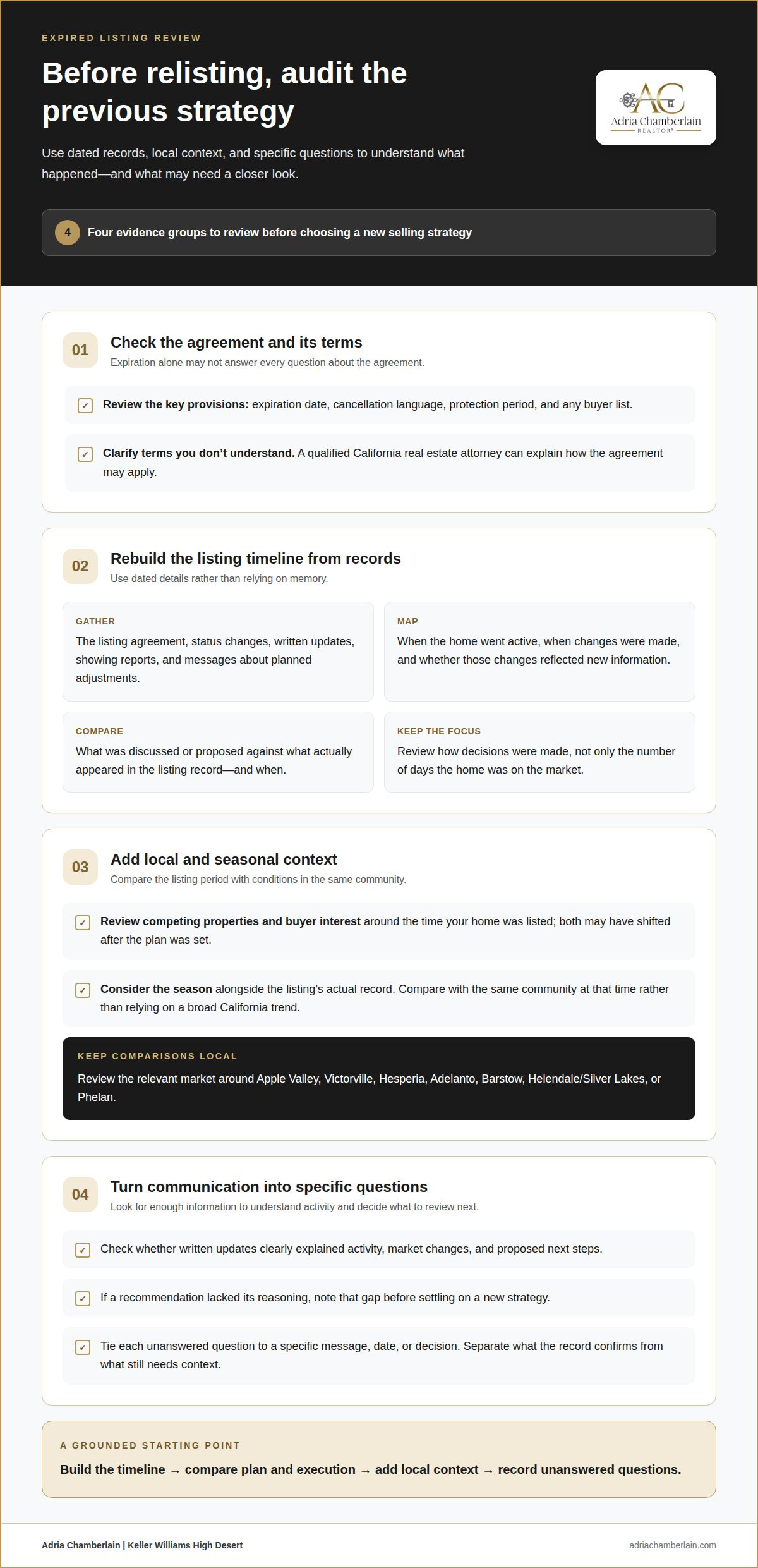
The listing agreement you signed sets out commission, cancellation, and protection-period terms. Expiration alone may not settle questions about those terms, so review the agreement and consult a qualified California real estate attorney if you’re unsure how it applies.
After expiration, you can consider relisting with another agent, but first review the agreement’s expiration date, cancellation language, protection period, and any buyer list. These provisions can affect your next steps. Ask a qualified professional to explain any terms you don’t understand.
Reconstruct the previous strategy from dated records rather than memory. Gather the listing agreement, status changes, written updates, showing reports, and messages about planned adjustments. If a change was discussed but never appeared in the listing record, distinguish what was proposed from what actually happened.
Compare the strategy’s timing with market conditions during the listing period. Buyer activity and available inventory may have changed after the plan was set. Review new competing properties and shifts in buyer interest around Apple Valley, Victorville, or Hesperia. This context can show whether the original approach remained relevant.
Review the listing calendar as a sequence of decisions. Note when the home went active, when updates were made, and whether those updates reflected new information. A Victorville listing that stayed unchanged while nearby competition shifted needs a different review from one that adapted. Focus on how decisions were made, not just the number of days on market.
Check whether communication gave you enough information to make timely decisions. Review written updates for clear explanations of activity, market changes, and proposed next steps. If you received a recommendation without its rationale, note that gap before choosing a new strategy. Specific questions are more useful than a general sense that the listing lacked attention.
- Build the timeline: Match dated records to listing changes and decisions.
- Compare plan and execution: Identify which intended actions occurred and when.
- Add local context: Consider how conditions and competing listings changed in the relevant High Desert community.
- Record unanswered questions: Keep each question tied to a specific message, date, or decision.
Seasonality can also help explain buyer activity. The time of year may affect which buyers are looking and what alternatives they see. Compare your listing period with conditions in the same community at that time, rather than relying on a broad California trend. Consider seasonal shifts alongside the listing’s actual record.
Separate evidence from interpretation. A missed update is a verifiable event; understanding why it happened may require more context. This distinction provides a grounded starting point for discussing a different selling strategy in Barstow, Adelanto, Helendale/Silver Lakes, or Phelan.
The signed listing agreement governs commission, cancellation, and any protection period. Expiration alone may not settle those terms, so review the agreement before relisting.
Review the previous selling strategy alongside the season and market trends. Identify what may have prevented a sale before choosing a new approach.
Overpricing and buyer perceptions of value
An asking price can affect how many buyers consider a home. In the High Desert, buyers compare a property with available alternatives, not only the seller’s investment or preferred proceeds. Overpricing is a common reason California listings expire. A price that seems reasonable to the owner may still feel out of step with competing homes.
Buyers assess value based on details such as location, condition, layout, usable land, and comparable sales. A home in Apple Valley may not compete directly with a similar-looking property in Barstow. Even in Victorville, setting, features, and nearby options can change how buyers judge the asking price.
Examine the comparison set used to set the previous price. Look at homes that were available while yours was listed, and compare their condition, features, and location. A property near a national park may appeal to buyers seeking that setting, but the appeal alone doesn’t justify a higher price. Buyers still weigh it against alternatives that fit their needs and budget.
Listing activity offers clues, but it doesn’t explain pricing on its own. If buyers viewed the home but made no offers, consider whether the asking price matched what they saw in person. If interest was limited, check whether the online presentation accurately showed the property and whether competing listings offered a more appealing mix of price and features.
- Compare like with like: Use nearby homes with similar condition, property type, and usable features.
- Review timing: Compare the asking price with the options buyers had during the listing period.
- Track response: Consider whether inquiries, showings, and buyer comments changed after a price adjustment.
- Separate appeal from value: A distinctive view or setting may attract attention, but buyers still compare the full property.
A price reduction may address a gap between the asking price and buyer expectations, but it won’t resolve every obstacle. A lower price, for example, may not answer concerns about access, condition, or unclear information. In Hesperia, questions about a home’s features may call for a clearer presentation, not just another price change.
Consider each price change in context. Did a reduction lead to more showings? Did visitors raise the same concern afterward? Did nearby competition change while the home was listed? These questions help distinguish a pricing issue from a presentation or property concern. A reduction without a clear rationale may also leave buyers wondering whether the asking price reflects the home’s value.
For a fresh pricing perspective, compare the home’s specific features with current alternatives in its immediate area. A comparative market analysis organizes relevant information about similar properties and differences that may affect buyer perception. In Adelanto, Phelan, or Helendale/Silver Lakes, useful comparisons reflect the property’s actual setting and features, rather than a broad regional average.
Consider what a price change can and cannot address. A reduction may lessen some barriers to a sale, but it won’t solve every issue.
Removing obstacles to a sale
After expiration, separate market signals from issues you can address. In the High Desert, review the listing’s performance, presentation, and practical obstacles before deciding what to change.
Market Performance Measures
Marketing-time measures can offer useful context when reviewing a listing’s performance. The sale-to-list price ratio compares its sale price with its asking price. Together, these measures help show whether timing and pricing aligned with buyer activity.
Compare Apple Valley, Victorville, and Hesperia using similar property types and the same market period. A broad valley-wide average can hide differences between neighborhoods, land parcels, and homes with distinct features. Longer marketing times in one city don’t establish the cause for your home. Check comparable properties’ condition, location, and asking prices before drawing conclusions.
Use these measures as context, not a verdict. If a home spent longer on the market than comparable Victorville listings, for example, review its access, condition, and presentation. The sale-to-list ratio shows how final prices compared with asking prices, but not why buyers negotiated. Pair the figures with showing patterns and feedback to identify practical changes.
Condition and Listing Presentation
Condition and presentation shape what buyers notice in person and in listing photos, so visible problems can create avoidable hesitation. In a High Desert home, peeling paint, a cracked window, or faulty outdoor lighting can be fixed within a couple of days.
Start with concerns that affect a buyer’s understanding or use of the property. A cracked window may distract from a room, while an unlit entry can make an evening showing harder to assess. Staging means arranging rooms to help buyers understand how they can be used; it doesn’t mean hiding defects or making unsupported claims.
Photos and advertising are part of a home’s marketing. Review each image to make sure it clearly shows the rooms, exterior, and relevant features. If a photograph makes a space confusing or leaves out an important feature, buyers may form an incomplete impression before visiting. A clean, accessible home also helps visitors focus on the property.
Steps After Listing Expiration
After a listing expires in California, review the previous agreement and listing record, address unresolved obstacles, and then decide whether and how to relist. A new launch is more useful when it takes account of what the previous one revealed.
Save the listing materials, dates, showing activity, and buyer feedback. Note concerns that came up more than once, such as difficult access or repair questions. Then group potential changes into property work, clearer information, and marketing adjustments. This keeps the next plan specific instead of treating expiration as a reason to change everything.
Assess what can be handled before the property returns to market. A faulty outdoor light or peeling paint may be relatively simple to address; a more involved concern may require a different plan. Describe the home’s condition and features accurately, and consider whether showing arrangements make visits practical for interested buyers.
Compare the next listing plan with the previous one. Identify what will change in price, presentation, access, or timing, and connect each change to evidence from the earlier listing. If you’re weighing a new launch in Barstow, Adelanto, or Phelan, use local comparable homes and the property’s specific features to guide your decision.
Condition, Staging, and Photography in High Desert Sales
For buyers browsing homes in Victorville or Phelan, listing images are often their first look inside a property. The images should communicate the home’s actual layout and character. When they leave basic questions unanswered, buyers may struggle to picture how the rooms connect or whether the property suits their needs.
Review the images in sequence as a guided visit. Do they move logically from the entry through the main living spaces, or jump between unrelated rooms? A sequence that clarifies the floor plan helps viewers understand how the spaces connect. If a room’s purpose isn’t obvious, its place in the sequence and the accompanying description can add context.
Furniture placement affects how a room looks in photographs and during a visit. In a smaller bedroom, bulky furniture can make it harder to see how people move through the space. In a larger living room, a thoughtful arrangement can show how the space might accommodate seating or conversation. Furnishings should help viewers understand proportions without implying that they come with the property.
Present outdoor areas just as clearly. A photograph of a yard, patio, or driveway can help viewers understand the property’s setting, but it should show what is actually there. For a home in Apple Valley, a useful view might clarify how the house relates to its outdoor space. The description can add context without suggesting features the property doesn’t have.
Check that each image serves a purpose. A close view may explain a distinctive finish, while a wider view can show how the kitchen connects to nearby living space. Repeated angles add little unless they clarify something new. A balanced selection gives viewers a fuller impression without distorting room size or concealing the home’s condition.
- Image order: Follow a path that helps viewers understand how the rooms connect.
- Room scale: Keep furniture from obscuring the usable shape of a space.
- Outdoor context: Show the property’s setting accurately and clearly.
- Image purpose: Use each photograph to communicate a distinct feature or view.
Compare the listing’s visual impression with visitors’ experience. If a room felt smaller in person than it looked online, consider whether the camera angle or furniture arrangement created that mismatch. If visitors couldn’t tell what a room was for, a clearer image sequence or description may help. The aim is consistency between the online presentation and the home, not making the property appear different.
Before another listing goes live, review the presentation from a buyer’s perspective. Can someone unfamiliar with the home understand its layout, rooms, and setting from the images and descriptions? A home in Barstow may need a different visual emphasis from a property in Helendale because each has its own features to communicate.
If you’re considering a new listing and want to discuss how the home should be presented, talk through your home-selling plans.
Adria Chamberlain | Keller Williams High Desert: Home Valuation & Comparative Market Analysis (CMA)
Adria Chamberlain | Keller Williams High Desert can help reassess your home’s position with a Home Valuation & Comparative Market Analysis (CMA). A CMA compares your property with relevant market information, supporting a more informed pricing discussion after buyer response or changing conditions challenged the previous listing.
When you’re ready to review what happened and consider a new plan, Adria’s Residential Property Listing Services can support your next listing. The strategy can reflect your home’s features, condition, and local competition in communities such as Apple Valley, Victorville, and Hesperia.
For personalized guidance on your next steps, contact Adria Chamberlain | Keller Williams High Desert or visit adriachamberlain.com.
Choose a clear next step for your move
If you’re still asking why your listing expired in High Desert, California, use the next decision to align your selling plan with what matters now. Your timing, priorities, and plans for the property may have changed since the last listing. Decide what you need from a sale before settling on a new approach.
If selling is part of a larger move, consider how your next home fits into the plan. Adria Chamberlain | Keller Williams High Desert also offers First-Time Homebuyer Representation for people preparing to buy their first home. Discussing your goals can help you focus on the decisions ahead without rushing into another listing.
Contact Adria Chamberlain | Keller Williams High Desert to talk through your next step. A thoughtful plan can make the way forward feel more manageable.
Frequently Asked Questions
Why Do Real Estate Listings Expire?
A listing expires when its agreed marketing term ends without a completed sale or renewed agreement. Expiration changes the listing’s status; it doesn’t permanently prevent a sale. For a home in Apple Valley or elsewhere in the High Desert, the owner can use this point to decide whether to pause, revise the plan, or prepare for another listing period.
What are the most common reasons a real estate listing expires in High Desert, California?
Sometimes a sale stalls because buyers need clearer information before moving forward. A seller, for example, may need to organize records about property features, access arrangements, or improvements. In areas such as Phelan or Lucerne Valley, details about the property’s setting may be especially relevant to buyers’ questions. Identifying unanswered questions can clarify what to address before another sale attempt.
How does a listing price compare with recent comparable sales in my High Desert neighborhood?
One useful calculation is the sale-to-list ratio: divide a comparable home’s final sale price by its final asking price. Compare the results across suitable sales, noting differences such as condition or included features. Two homes in Hesperia, for example, may have different ratios because buyers valued their features differently. The calculation describes past transactions; it doesn’t establish the right asking price for your home.
How can I evaluate whether my real estate agent's marketing and showing activity were adequate?
Review the campaign record to see where the listing appeared, how inquiries were tracked, and what follow-up happened after buyer visits. Compare that record with the communication plan you agreed on. If a showing led to feedback, look for a timely summary and any next step discussed. This helps you assess how consistently information was shared, rather than judging the effort by the final outcome alone.
What commission, cancellation, and protection-period rules apply to an expired California listing?
The signed listing agreement governs commission, cancellation, and any protection period. Expiration alone may not settle those terms, so review the agreement and consult a qualified California real estate attorney if you’re unsure how it applies.


