

Acreage alone doesn’t set a Lucerne Valley land asking price.
It’s understandable to look at nearby listings and wonder where your parcel fits. But price per acre is only a starting point: views, access, nearby utilities, and the work needed for an off-grid setup can all shape how buyers assess a property.
This guide explains how asking prices and acreage compare, why a larger parcel may have a lower asking price per acre, and which land features can affect buyer interest. You’ll also learn how to assess your property in context and identify what makes it distinct.
Key Takeaways
- Compare parcels by location and features, not acreage alone, to understand why asking prices can vary widely.
- Assess access to electricity and the work an off-grid setup may require when describing your land to buyers.
- Use price per acre as a comparison tool, while accounting for parcel size and property-specific characteristics.
- Make acreage, road access, views, and nearby utilities clear in your listing so buyers can better judge the property.
- A comparative market analysis can help you consider nearby land listings and build a pricing approach suited to your parcel.
Lucerne Valley land listings and asking prices
Asking prices for land around Lucerne Valley vary widely, so one listing rarely tells the whole story. Those figures describe advertised prices, not confirmed sale amounts.
The same listing snapshot reports 65 cheap properties for sale near Lucerne Valley, with 331 acres of cheap land inventory and an average property size of 12.7 acres. The average listing age is 164 days. Together, those figures offer context: buyers can compare multiple parcels, and a listing may remain available while sellers and buyers assess its features and asking price.
Individual examples show why a broad average cannot price a specific parcel. These are asking prices for distinct listings, not proof that similar land will sell for the same amount.
Higher asking prices appear in the same local inventory. Differences in location, access, zoning, views, utilities, and parcel condition can influence buyer interest, so compare those details rather than acreage alone.
Should I sell vacant land with a real estate agent, land broker, or directly to a buyer? Choose the approach that fits your need for pricing guidance, listing support, and help with negotiations. Adria Chamberlain provides residential property listing services, including support with presenting a property and handling buyer inquiries. A direct sale means managing buyer discussions and transaction coordination yourself.
What disclosures and documents are required when selling vacant land in California? Required documents and disclosures depend on the parcel and transaction. Gather ownership and parcel records, then review disclosure requirements with qualified real estate and legal professionals before accepting an offer.
What are the zoning and land-use rules for vacant parcels in Lucerne Valley? Permitted uses depend on the parcel’s zoning and applicable land-use rules. Confirm the parcel-specific designation with San Bernardino County before describing possible uses to buyers.
What taxes, title fees, and closing costs apply when selling California vacant land? Costs depend on the sale terms, ownership details, and title and escrow services involved. A tax professional can assess tax consequences, while the closing documents identify transaction charges.
What are the steps to sell vacant land in San Bernardino County? Identify the parcel, review its access and land-use details, set an asking price, prepare listing information, evaluate offers, and complete the agreed closing process. For Lucerne Valley land, accurate parcel details help buyers assess the property.
How can I verify legal access, parcel boundaries, and easements before selling land? Compare the deed and parcel records with title information, and use a qualified survey professional when boundary locations need clarification. Review recorded easement information so the listing describes access accurately.
Off-grid land considerations
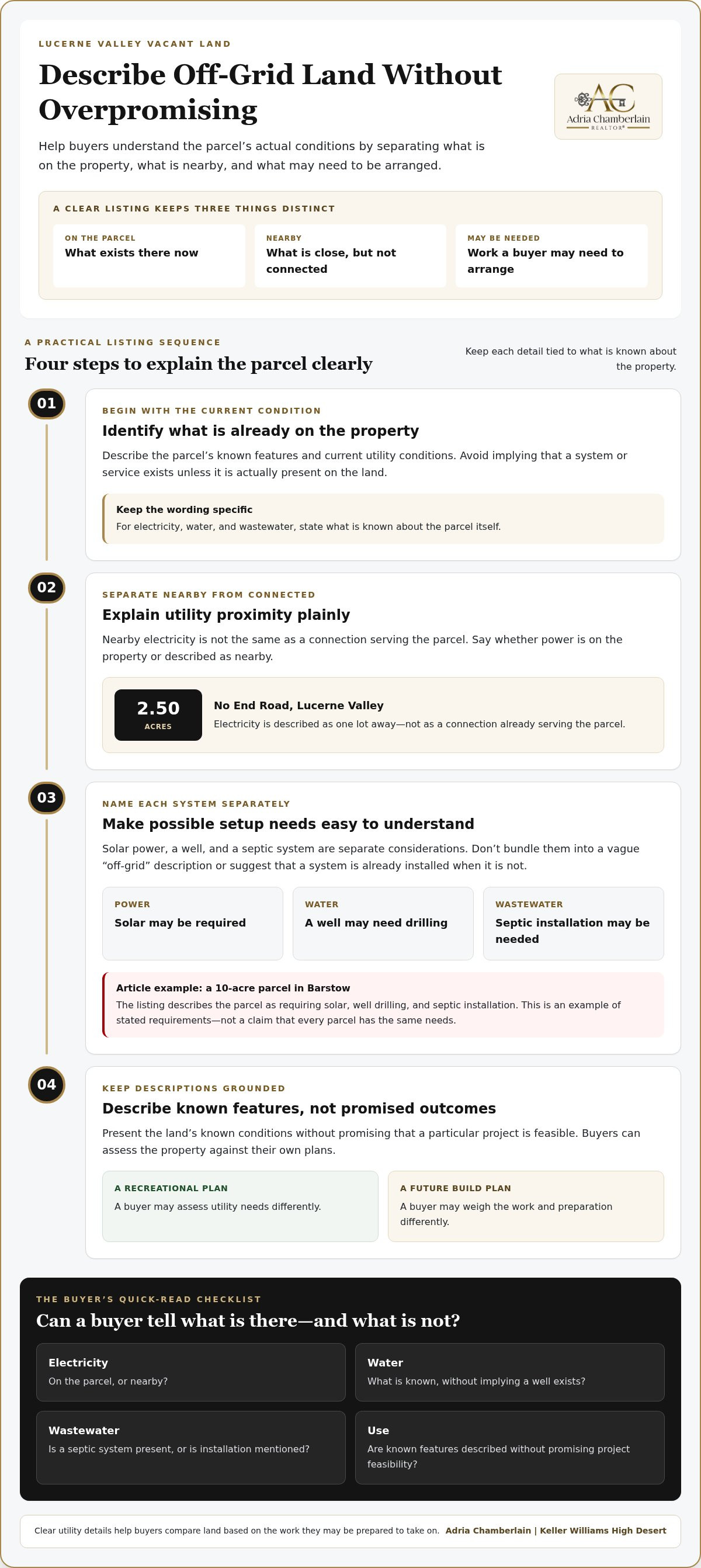
Off-grid buyers look beyond acreage to the practical work of using a parcel. In Lucerne Valley, a 2.50-acre parcel on No End Road has electricity one lot away. That detail can help explain the setting, but nearby electricity is not the same as a connection already serving the property. Describe the distinction plainly so buyers understand what the listing does and doesn’t establish.
For a vacant parcel without utility connections, buyers may weigh the systems and preparation they would need. Solar power, a well, and a septic system are separate considerations, not one interchangeable “off-grid” feature. A 10-acre parcel in Barstow, for example, is described as requiring solar, well drilling, and septic installation. That example illustrates why listing language should identify known requirements instead of implying the land is ready for immediate use.
Build a clear property description around the parcel’s actual conditions. Separate what is on the property from what is nearby and what a buyer may need to arrange. For example, state whether electricity is on the parcel or nearby, and don’t describe nearby utility access as an existing connection. Apply the same care to water and wastewater: distinguish existing infrastructure from a system a future owner may need.
- Electricity: Explain whether power is present on the parcel or described as nearby, as with No End Road.
- Water: Describe the known water situation without suggesting that a well already exists.
- Wastewater: Distinguish an existing septic system from installation work mentioned for a parcel.
- Use: Present the land’s known features without promising that a particular project is feasible.
These distinctions help buyers compare land based on the work they’re prepared to take on. Someone seeking a simple recreational parcel may assess utility needs differently from someone planning a future build. Clear details let buyers decide whether the property suits their plans without turning a nearby utility or possible improvement into a promise.
What risks should sellers consider, including liens, unpaid property taxes, and buyer financing? Liens or unpaid property taxes can affect the amount due at closing, while a buyer’s financing terms can influence whether a transaction proceeds. Review title and tax information, and understand the offer’s financing conditions before agreeing to a sale.
Before listing, organize the information that describes the parcel’s current condition, including utility details and any known system requirements. A thoughtful land listing plan can help present those details in a clear, buyer-friendly way.
Price per acre
Price per acre offers a quick way to compare asking prices across parcels of different sizes. Treat it as a broad comparison point, not a ready-made price for every property. It combines listings with different locations, access conditions, acreage, and features. When selling vacant land in Lucerne Valley, CA, use this figure for context, not as a substitute for a parcel-specific comparison.
To calculate a parcel’s asking price per acre, divide its listed price by its acreage. Equal acreage makes differences in asking prices easy to see.
These examples show that parcels of the same size can have different per-acre asking rates. They compare listings, not completed sales, and don’t establish a parcel’s eventual value. If you’re selling vacant land in Lucerne Valley, CA, compare the details behind each figure before setting your pricing approach.
Use the calculation as a first step, then assess property characteristics that may affect buyer interest. One listing describes agricultural zoning, while another identifies a road location. Access, nearby utilities, views, terrain, and intended use can distinguish parcels even when their acreage matches. A lower per-acre figure doesn’t automatically make land more appealing if buyers see additional work or limitations.
A larger parcel may have a lower asking price per acre than a smaller one. The total price is spread across more land, and buyers may value usable access or a particular location more than additional acreage. Compare parcels with similar characteristics before drawing conclusions. Nearby land is most useful as a reference when its features and conditions resemble yours.
- Record the asking price and acreage for each comparison parcel.
- Divide price by acreage to calculate its asking price per acre.
- Note differences in location, access, zoning, views, and utilities.
- Keep listing prices distinct from sale prices when assessing the comparison.
This approach shows how a proposed asking price relates to nearby listings. Pair the per-acre calculation with property-specific details instead of presenting an average as a benchmark. A clear comparison gives buyers context and keeps the pricing discussion focused on the land itself.
Property acreage
Acreage tells buyers how much land a parcel contains, but it doesn’t describe how useful every part may be. In Lucerne Valley, a 2.5-acre lot and a 20-acre parcel can attract different buyers, even when both are vacant. The right comparison depends on what the parcel offers alongside its size.
Current listings show varied combinations of acreage and asking price. These asking prices demonstrate that acreage alone doesn’t explain a listing’s price.
Make acreage more meaningful by describing the parcel in practical terms. Explain its location, visible access, shape, terrain, and any known features buyers may consider. If a parcel has views or sits near a road, identify those details accurately. Don’t imply that every acre is equally accessible or useful unless the property information supports that description.
For a simple comparison, divide the asking price by acreage. These calculations compare listing prices, not completed sales, and don’t account for differences between parcels.
Use a consistent comparison process when reviewing nearby land:
- Match acreage first. Compare a 10-acre parcel with other parcels near that size before drawing conclusions.
- Review the setting. Note road access, views, terrain, and nearby utilities as separate characteristics.
- Describe what buyers can see. Use clear property details rather than broad claims about potential uses.
- Keep the math in context. Price per acre is a comparison aid, not a complete valuation.
That listing differs substantially from the 10-acre Greastwood Lane example. The contrast is a reminder to look beyond parcel size and consider what each listing says about its location and features.
For your property, state the acreage clearly and pair it with useful details. Buyers can then assess whether the parcel’s size and characteristics suit their plans. A thoughtful description also keeps acreage from becoming the only point in a pricing conversation.
Where can I list vacant land for sale in Lucerne Valley, California?
Vacant land can be offered through a real estate listing, a direct owner sale, or both. The right channel depends on how much buyer communication and transaction coordination you want to handle. A listing can present the parcel’s location, acreage, access, known utilities, and asking price together. With a direct sale, you manage those details from the first inquiry.
These are distinct listings, despite having equal acreage. A useful listing makes the differences visible rather than relying on parcel size alone. Describe the setting and known features accurately, and keep advertised possibilities separate from established facts.
Before publishing, prepare a concise set of property information. Include the parcel’s street or road reference, assessor parcel number if available, acreage, and a clear description of access. Add known zoning and utility details, along with available records that clarify boundaries or easements. For example, buyers need to distinguish electricity on the parcel from electricity nearby. Clear wording helps prevent misunderstandings in early conversations.
Choose a listing route based on how involved you want to be. Adria Chamberlain provides residential property listing services, managing the listing process and buyer inquiries. A direct sale gives you control over where and how you share the opportunity, but you’ll also handle questions, offer discussions, and transaction coordination. Either way, use consistent parcel facts in every description.
Lucerne Valley’s listing examples also show why a tailored description matters. That example differs in both acreage and asking price from the 5-acre Cochise Trail listing. Avoid treating either as a template. Instead, make the location and known property characteristics clear so interested buyers can judge relevance for themselves.
- Prepare parcel details: Use consistent acreage, location, and access information.
- Describe known features: Separate existing services from nearby utilities or future possibilities.
- Select your approach: Decide how much buyer communication and sale coordination you want to manage.
- Review the presentation: Check that each version accurately describes the same parcel.
If you’d like help preparing a Lucerne Valley land listing, discuss your property listing options with a local real estate professional.
Adria Chamberlain | Keller Williams High Desert: Home Valuation & Comparative Market Analysis (CMA)
Adria Chamberlain | Keller Williams High Desert can help you assess your land’s asking price and next steps through a Home Valuation & Comparative Market Analysis (CMA) and Residential Property Listing Services. A CMA compares relevant property information to support a pricing discussion; it isn’t a promise of a sale price.
Turn to Adria when you’re weighing nearby listings, parcel features, acreage, and how to present your property to buyers. She can help you organize the details that matter, from location and access to known utilities, before you decide how to proceed with a listing.
If you’re considering a land sale in Lucerne Valley, contact Adria Chamberlain | Keller Williams High Desert for personalized guidance, or visit adriachamberlain.com.
Take the next step with a clear plan
Selling vacant land in Lucerne Valley, CA starts with identifying what matters most to you: a straightforward process, a particular asking strategy, or support handling buyer conversations. Clarifying that priority can help you choose your next move and prepare for questions about the parcel.
Before moving ahead, gather the property details you can readily access and note anything you’d like help understanding. A focused conversation can turn those questions into a practical plan for presenting your land and considering offers. You remain in control of the decisions, with guidance as you work through them.
Adria Chamberlain | Keller Williams High Desert offers Property Valuation & Comparative Market Analysis (CMA), Land Property Listing Services, and Dedicated Client Representation. For guidance tailored to your property and goals, contact Adria Chamberlain | Keller Williams High Desert. Your next step can be a calm, informed one.
Frequently Asked Questions
What is the current market price per acre for vacant land in Lucerne Valley, CA?
There isn’t one per-acre price that applies to every Lucerne Valley parcel. Before using a figure to guide your asking price, distinguish active listings from completed sales and compare properties with similar intended uses and characteristics. Listings can change, so note when you reviewed them and whether each parcel is still available. That gives you clearer context for discussing your own land.
How do I determine the value of a vacant lot in Lucerne Valley?
Start with the parcel’s identifying details and gather information that helps describe its condition and potential use. Then compare it with relevant local properties, paying attention to differences rather than relying on a single nearby example. A comparative market analysis can help organize that information for a pricing discussion. When selling vacant land in Lucerne Valley, CA, use the analysis as a guide, not a promise of the final sale price.
Are water, electricity, septic, and road access available for vacant land in Lucerne Valley?
Conditions differ by parcel, so no area-wide answer applies to every lot. For a specific property, gather any records or correspondence you have about utility connections, prior service work, and access arrangements. Identify which details describe the parcel itself and which relate to nearby properties. This helps prospective buyers understand the information you can provide without implying that a connection or system is already in place.
How long does it typically take to sell vacant land in Lucerne Valley?
No fixed timeline applies to every land sale. Buyer interest and the transaction process can vary with the parcel, offer terms, financing, and the time needed to review property records. To be prepared, keep ownership and parcel documents organized and respond promptly to questions about the land. When selling vacant land in Lucerne Valley, CA, plan for a process that may not follow the same schedule as a home sale.


