

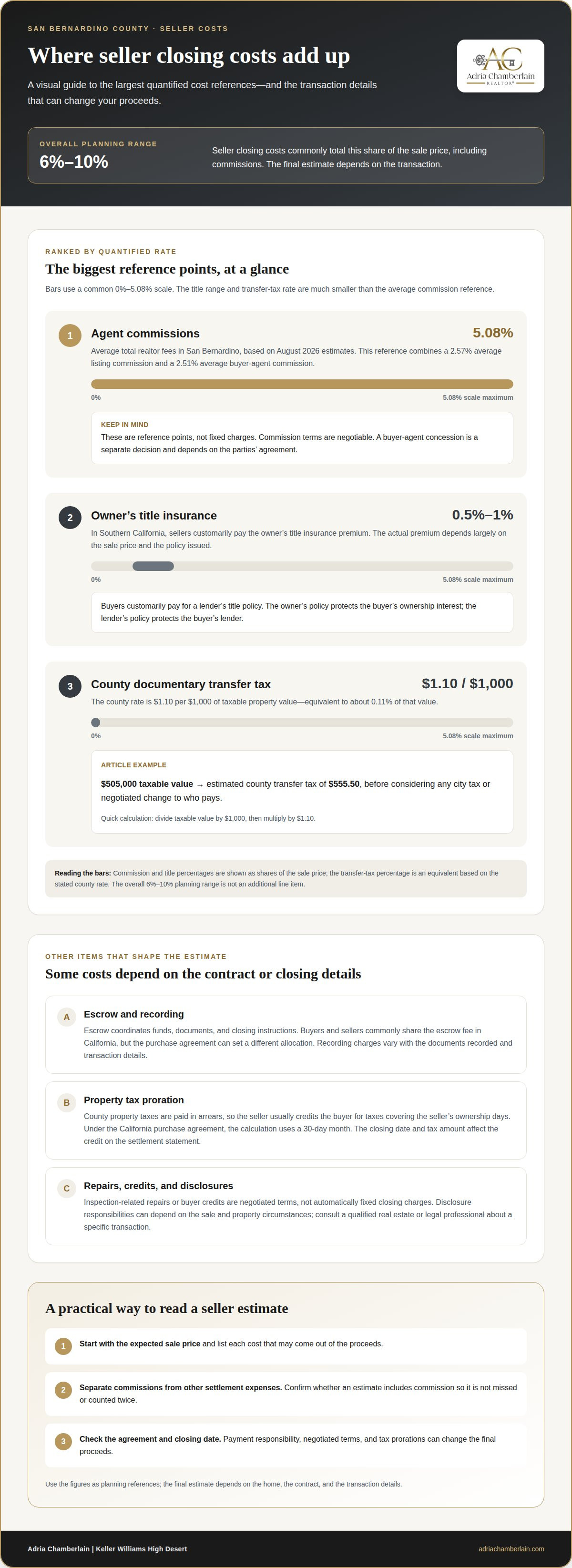
Your sale price isn’t the amount you’ll take home. Closing costs for home sellers in San Bernardino County commonly total 6%-10% of the sale price, including commissions, though the final estimate depends on the transaction. A calculator can give you a useful starting point, but the costs behind the estimate matter just as much as the total.
It’s reasonable to want a clearer picture before making plans. This guide explains how to estimate closing costs for home sellers in San Bernardino County, including title insurance, escrow, and property tax prorations. It also covers how commissions, negotiated terms, and the closing date can affect your proceeds, so you can build a more useful estimate.
Key Takeaways
- Build your estimate around the sale price and the costs that may come out of your proceeds, rather than treating the sale price as your take-home amount.
- Separate agent commissions from other closing expenses, and understand that commission terms are negotiable.
- Include the county documentary transfer tax in your estimate; the amount is tied to taxable property value.
- Account for property tax prorations, which allocate taxes between seller and buyer based on the closing date and ownership period.
- Use the estimate as a planning tool, then consider how your home’s details and sale terms affect the final proceeds.
Does the seller pay title insurance in California?
Often, yes. In Southern California, sellers customarily pay the owner’s title insurance premium, while buyers customarily pay for a lender’s title policy. Title insurance helps protect against covered title problems tied to ownership history. The owner’s policy protects the buyer’s ownership interest; the lender’s policy protects the buyer’s lender.
Across Southern California, the customary seller-paid premium is typically 0.5%-1% of the purchase price. The actual premium depends largely on the property’s sale price and the policy being issued. Include this estimate as its own line in the seller’s closing-cost calculation.
Escrow is the neutral settlement process that coordinates funds, documents, and closing instructions. In California, buyers and sellers commonly share the escrow fee, including in San Bernardino County. The purchase agreement can set a different allocation.
Recording costs cover filing documents, such as the deed or a mortgage release, in public records. Exact settlement charges depend on which documents are recorded and the transaction details. Separating recording costs from title insurance and escrow makes an estimate easier to review.
Property tax prorations also affect the seller’s final proceeds. County property taxes are paid in arrears, so the seller usually credits the buyer for taxes covering the seller’s ownership days. Under the California purchase agreement, the calculation uses a 30-day month. The closing date and tax amount therefore influence the credit shown on the settlement statement.
California’s disclosure framework addresses Natural Hazard Disclosure Statements under Civil Code Section 1103. Sellers may have disclosure responsibilities related to a property’s hazard status; how those obligations apply depends on the sale and property circumstances. For guidance on a specific transaction’s disclosure duties, consult a qualified real estate or legal professional. Inspection-related repairs or buyer credits are separate negotiated terms, not automatically fixed closing charges.
Agent commissions can also be part of seller closing costs. The average total realtor fees due at closing in San Bernardino are 5.08% of the sale price, based on the 2026 estimate. Commission terms are negotiable, and a buyer-agent concession depends on the parties’ agreement. Eligible sellers of a primary residence may exclude up to $250,000 of gain from federal capital gains tax, or $500,000 if married filing jointly, according to the Internal Revenue Service. This exclusion concerns potential gain, not escrow charges or settlement amounts.
Is commission included in closing costs?
Yes. Agent commissions may be included in a seller’s closing costs and deducted from sale proceeds at settlement. For San Bernardino County sellers, the amount depends on negotiated commission terms and whether the seller agrees to a buyer-agent concession.
Agent Commissions
A real estate commission is compensation for representation in a home sale. It can make up a substantial part of the amount deducted from the seller’s proceeds. The listing agreement sets the listing agent’s compensation, while any payment toward a buyer’s agent depends on the transaction terms. The escrow company includes agreed charges in the closing statement.
Listing and Buyer’s Agent Rates
In San Bernardino, the average listing commission is 2.57%, and the average buyer’s-agent commission is 2.51%, based on August 2026 estimates. Together, they equal 5.08% when a seller offers a buyer-agent concession at those average rates. These figures are reference points, not fixed charges. Commission is negotiable, and the seller and listing agent agree on the listing rate directly.
Changes following the National Association of Realtors settlement took effect in August 2024. Since then, sellers negotiate commission rates directly with their listing agent. A buyer-agent concession is a separate decision, not an automatic addition to the listing fee. That example shows how a percentage-based charge moves with the sale price.
Estimates Excluding Commission
Some closing-cost estimates exclude commission and show only other settlement expenses. When comparing estimates, confirm whether commission is included so you don’t omit it or count it twice.
Low-commission real estate companies typically charge a reduced commission of 1% to 2% or a flat rate. A lower rate changes the commission calculation, but the seller should also understand what representation and agreed services cover. The rate alone doesn’t show the full arrangement. Compare the written terms and the total charges that will appear at settlement.
To prepare a useful estimate, separate the listing commission, any buyer-agent concession, and other closing costs. Then apply the negotiated terms to the expected sale price. A home-selling discussion can help organize the figures for a planned listing; explore residential listing support as you consider your next steps.
How To Use San Bernardino County, California Closing Cost Calculator?
For an initial estimate, enter the property’s taxable value and identify its location in San Bernardino County. Sellers typically pay California’s documentary transfer tax, but the purchase contract can negotiate who pays it.
County Documentary Transfer Tax
The county documentary transfer tax is a charge on transferring property ownership, calculated from its taxable value. California’s county rate is $1.10 per $1,000 of taxable property value. For a $505,000 sale, the San Bernardino County tax estimate is $555.50. This gives sellers a specific line item to include in a calculator, separate from commissions, escrow, and title costs.
For a quick calculation, divide the taxable value by $1,000, then multiply by $1.10. At $505,000, that means 505 units of $1,000, multiplied by $1.10. The resulting $555.50 is the county tax estimate before considering any city tax or a negotiated change to payment responsibility.
County and City Transfer Taxes
California documentary transfer tax is levied by the county, and some cities also impose an additional tax. The total can therefore vary by property location, even within the same county. A calculator needs the city or locality as well as the taxable value to account for a possible city charge. Entering only “San Bernardino County” may not capture every applicable tax.
Keep county and city amounts as separate lines in your estimate. For example, the $555.50 county estimate on a $505,000 sale does not include a possible city tax. Location determines whether that additional line applies. A realtor or escrow company can help interpret the location and contract details reflected in a settlement estimate.
Who Pays the Transfer Tax
In California, sellers typically pay the documentary transfer tax, though the purchase contract can negotiate a different allocation. That means the tax may appear in the seller’s estimated costs, but the contract determines the agreed responsibility for the transaction. Include it as a seller expense for an initial estimate, then account for any negotiated change when reviewing the settlement figures.
For sellers, the tax calculation and the payment allocation are separate questions. The taxable value determines the county amount; the contract determines who pays it. Buyers and sellers can negotiate this term alongside other transaction costs. A lender’s charges and the escrow company’s settlement figures are separate entries.
Use a calculator as a planning tool, not as a single final number. Add the property’s taxable value, select its location, and keep county tax distinct from any city tax. Then review the contract’s allocation so the estimate reflects who agreed to pay. For instance, a $505,000 property starts with a $555.50 county tax estimate, before any city charge or negotiated adjustment.
To prepare a practical estimate, compare the calculator’s transfer-tax line with the sale contract and settlement statement. A difference may reflect a city tax or a negotiated allocation, rather than an error in the county-rate calculation. Keeping these details separate helps you understand both the initial estimate and the amount assigned at closing.
Property tax prorations
At closing, property taxes and HOA dues are allocated between buyer and seller based on ownership time. The mortgage payoff is handled separately, while the closing statement shows tax and dues credits.
Property Tax Bills and Prorations
A property tax proration divides the applicable bill according to the period each party owned the home. San Bernardino County’s property tax fiscal year runs from July through June, with installments due November 1 and February 1. Because taxes are paid in arrears, a seller may credit the buyer for taxes covering the seller’s ownership days. That credit helps account for a bill not yet paid.
California purchase agreements use a 30-day month to calculate prorations. The closing date matters because it determines the ownership period charged to each party. Under Proposition 13, the property tax bill follows the seller’s assessed value, not the home’s sale price.
Proration at Closing
The closing figures allocate the buyer’s and seller’s tax and HOA responsibilities. Outstanding property taxes and HOA dues must be settled before closing. These entries are separate from commissions and the mortgage payoff, so account for each one distinctly when estimating seller proceeds.
The mortgage payoff is not a property tax proration. It is the amount needed to satisfy the seller’s loan and is handled separately in the closing figures. For a clear estimate, distinguish the loan payoff from credits for taxes or dues. This prevents treating an existing debt as a shared expense between buyer and seller.
Timing can affect whether a tax installment has already been paid when the property transfers. San Bernardino County installments are due November 1 and February 1, while the fiscal year begins in July. If the seller has paid an installment covering days after closing, the settlement calculation can reflect the buyer’s share. If taxes remain outstanding, the closing figures must account for the seller’s responsibility.
In San Bernardino County, supplemental property taxes are billed to the buyer after closing. That later bill is distinct from the regular tax proration shown at settlement. Sellers can separate the closing-date allocation from a supplemental bill that arrives afterward. This distinction matters when estimating proceeds because a closing credit and a future supplemental assessment are different entries.
For a listing estimate, organize the settlement figures into three groups: property taxes, HOA dues, and mortgage payoff. Use the closing date to determine the ownership period for taxes and dues, then keep the lender payoff separate.
Estimated seller closing costs
A useful estimate separates selling expenses from mortgage payoff and calculates net proceeds. In San Bernardino, seller closing costs commonly total 6%-10% of the sale price, including agent commissions. The percentage is a planning range, not a single fee: the commission agreement, transfer tax, escrow, title, prorations, and negotiated credits all shape the settlement.
That spread reflects how estimates can include different costs, such as commissions, buyer concessions, and other transaction expenses. Compare the line items, not just the percentage, before using an estimate to plan your next move.
Build the estimate from the expected sale price, then account for the expenses attached to the transaction. Keep the mortgage payoff separate: it reduces proceeds, but it isn’t the same as a closing cost. Interest can accrue through the payoff date, so the lender’s payoff figure depends on when the sale closes. The remaining amount estimates proceeds before any additional obligations.
- Commission: Apply the negotiated listing rate and any agreed buyer-agent concession to the sale price.
- Title and escrow: Include the seller’s owner’s title policy and the seller’s share of escrow charges.
- Transfer tax and recording: Account for the county documentary transfer tax and applicable recording charges.
- Prorations and credits: Include property tax and HOA allocations, plus buyer credits agreed during negotiations.
- Loan payoff: Subtract the lender’s payoff separately when estimating the amount due to the seller.
This example shows why sale price alone can mislead homeowners. A higher sale price doesn’t reveal what remains after costs and debt are paid. A personal estimate needs the expected sale amount, contract terms, mortgage payoff, and closing-date prorations.
The median sale price is not a substitute for a property-specific estimate. Homes differ in condition, location, loan balance, HOA obligations, and negotiated terms. A listing estimate can account for the likely sale price and expected transaction costs together. If you’re preparing to sell, request a home-selling consultation to discuss an estimate tailored to your property and plans.
Adria Chamberlain | Keller Williams High Desert: First-Time Homebuyer Representation
Adria Chamberlain | Keller Williams High Desert can help connect your sale plan with your next real estate decision. If you’re preparing to sell, a Home Valuation & Comparative Market Analysis (CMA) can help you understand your property’s potential market value, while Residential Property Listing Services support the selling process. Together, these services help you consider expected proceeds alongside the costs and timing of a sale.
If your next step is buying your first home, First-Time Homebuyer Representation can guide you through the purchase. For homeowners weighing a sale, a move, or a first purchase, Adria can help clarify which path fits your plans. Contact Adria Chamberlain | Keller Williams High Desert to talk through your next steps.
Put Your Sale Estimate to Work
An estimate can help you plan what comes next, not just anticipate closing. Consider how your preferred timing, moving plans, and priorities fit together before deciding on a path forward. This context can make a conversation about a potential sale more focused and useful.
Closing costs for home sellers in San Bernardino County are one part of a larger decision about your property and next chapter. Adria Chamberlain | Keller Williams High Desert can help you discuss your plans and resolve questions before moving ahead.
Contact Adria Chamberlain | Keller Williams High Desert to discuss your plans. A clear next step can make the process feel more manageable.
Frequently Asked Questions
What Are California Closing Costs and Who Pays Them?
California closing costs are charges and adjustments recorded as a property sale settles. The purchase agreement and type of charge help determine which party pays each item. On the final settlement statement, debits show amounts owed and credits show amounts applied in a party’s favor. Reviewing these entries separately from the mortgage payoff makes it easier to understand how sale proceeds are calculated.
What taxes will I owe when I sell?
Taxes from a home sale depend on whether the transaction creates a taxable gain and whether an exclusion applies. The relevant amount isn’t simply the gross sale price or the proceeds remaining after closing costs. An eligible primary-residence seller may qualify for a federal gain exclusion, and California treats capital gains as ordinary income. A tax professional can assess how the seller’s purchase and ownership circumstances affect a particular return.
How are property taxes handled at closing?
The closing statement assigns property-tax responsibility based on the sale date and the period covered by the tax bill. This allocation is separate from determining a home’s market value: under Proposition 13, the property-tax bill follows the seller’s assessed value rather than the sale price. A later supplemental tax bill is a separate matter from the regular tax adjustment shown in the closing figures.
How much is the documentary transfer tax in California?
The county documentary transfer tax is calculated from taxable property value, and a city may add a separate transfer tax. For an estimate, both the property’s taxable value and location matter. A county-only calculation may differ from the total tax for a property in a city that imposes an additional charge. The purchase agreement also determines whether the seller or buyer is responsible for the agreed payment.
Should sellers pay the buyer's agent's commission?
A seller’s payment toward a buyer’s agent is not automatic; it depends on the parties’ agreement. Treat it as a separate contract term from the listing agent’s compensation. This prevents an estimate from assuming the seller will pay a buyer-agent amount without an agreement. Before settlement, the agreed responsibility should appear in the transaction paperwork and corresponding closing figures.
What closing costs do home sellers pay in San Bernardino County, California?
Seller expenses depend on the home, its contract, and any obligations tied to the property. In addition to transaction charges, an HOA may have dues or document-related charges, and a seller may agree to a buyer credit during negotiations. These items differ from the outstanding mortgage balance. For a clearer estimate, separate contractual expenses, property-related charges, and loan payoff rather than combining them into one fee.
What are San Bernardino County recording fees and transfer taxes for home sellers?
Recording fees and transfer taxes are different charges. Recording fees cover filing transaction documents in public records, while documentary transfer tax applies to the transfer of property ownership. The documents being recorded and the property’s location affect which entries appear. Keeping these items distinct on an estimate explains why recording charges and transfer taxes shouldn’t be treated as one combined fee.
How much does a seller typically pay for escrow and title services in San Bernardino County?
Seller escrow and title expenses vary with the sale and the allocation written into the contract. Escrow charges cover settlement handling, while an owner’s title policy is a separate title-related expense. For a useful estimate, keep these entries separate and identify the seller’s share rather than treating every escrow or title charge as the seller’s responsibility. The settlement statement shows the final allocation.


