

Could your next home in San Bernardino County come with a very different property tax assessment, even if you’re moving from a home you’ve owned for years? It’s a reasonable concern, and the answer depends on which Prop 19 pathway fits your circumstances. A San Bernardino County property tax transfer Prop 19 may allow some eligible homeowners to transfer a tax base to a replacement primary residence, but that portability rule is separate from the rules for transferring a home to a child or grandchild.
This guide explains the two pathways and helps you identify what to ask before coordinating a sale and purchase. You’ll learn which eligibility details and records to discuss with the San Bernardino County Assessor, why an inherited home follows different rules, and where to check current requirements. Prop 19 can affect both moving plans and family decisions, so don’t rely on a tax outcome until the assessor and a qualified tax or legal professional review your situation. A real estate professional can help coordinate transaction timing, while the assessor determines tax eligibility.
Key Takeaways
- A San Bernardino County property tax transfer Prop 19 involves separate rules for moving your own primary residence and transferring property within a family.
- Use the portability criteria as a starting checklist, then confirm how your age, disability status, disaster circumstances, and replacement home apply with official sources.
- Before contacting the assessor, gather relevant ownership, sale, purchase, occupancy, and property identification records.
- Ask the assessor which forms and filing steps apply to your situation, and consult a qualified tax or legal professional for personalized advice.
- Coordinate your High Desert sale and purchase around your housing needs and transaction timing. Don’t build your budget around unconfirmed tax savings.
What Does a Prop 19 Property Tax Transfer Mean in San Bernardino County?
If you’re planning a move, “transfer your property taxes” can sound as though your current bill simply follows you to the next home. That isn’t quite what it means. A property tax base transfer is a possible transfer of assessed value to a replacement home, not a guarantee that your future tax bill will stay the same. The San Bernardino County property tax transfer Prop 19 rules depend on the pathway and the details of the people and properties involved.
Prop 19 addresses two different situations: eligible homeowners moving to a replacement primary residence, and certain transfers of a family home between parents and children or grandparents and grandchildren. The California Proposition 19 (2020) overview explains the proposition’s background, but it can’t determine how the rules apply to a specific property. For that, check current requirements and valuation treatment with the San Bernardino County Assessor.
Property tax base transfer versus a new property assessment
An assessed value is the value the county uses to calculate property taxes. It may differ from a home’s current market value, or what the property might sell for under current conditions. When a home is purchased or ownership changes, the county may review whether an assessment is required. The outcome depends on the facts of the transfer and any applicable exclusions, so don’t assume the old assessed value will automatically carry over.
For example, someone selling in Victorville and buying in Apple Valley needs to consider two separate questions: how the new property would otherwise be assessed, and whether the homeowner qualifies to transfer a tax base under Prop 19. This comparison is a starting point, not a prediction of the resulting tax bill. The assessor can explain how the relevant values and rules apply.
Prop 19 portability and family transfers are different pathways
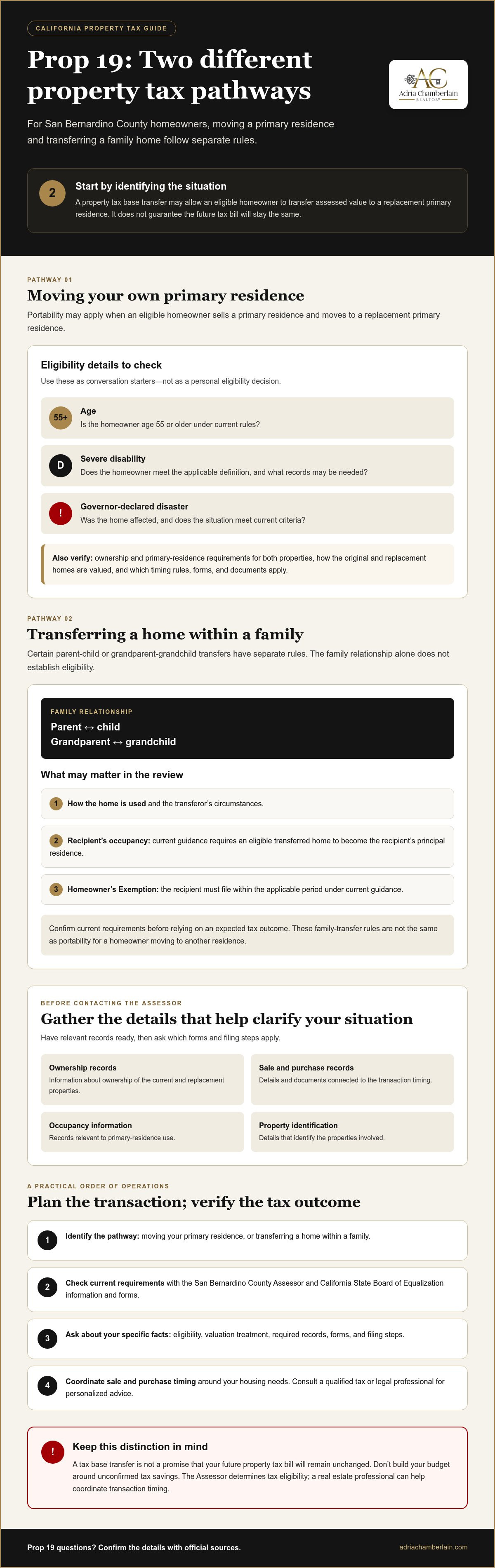
Portability refers to qualifying homeowners transferring the tax base of a primary residence to a replacement primary residence. Prop 19 includes eligibility pathways for homeowners who are 55 or older, severely disabled, or affected by a governor-declared disaster. Confirm the conditions, including how the original and replacement properties are valued, with the assessor and current California guidance.
Family transfers follow different rules for certain parent-child or grandparent-grandchild property transfers. The relationship alone doesn’t establish eligibility. The home’s use, the transferor’s circumstances, and the recipient’s occupancy may matter. For example, current guidance requires the recipient to make an eligible transferred home their principal residence and file for the Homeowner’s Exemption within the applicable period. Verify the details before relying on an expected tax outcome.
In either pathway, property location, ownership, use, timing, and valuation details can affect the review. Separate tax eligibility from sale and purchase planning, then confirm the tax questions with the San Bernardino County Assessor before making decisions based on assumed savings.
How Prop 19 Portability May Apply to a San Bernardino County Move
Portability is worth checking if you’re selling a primary residence and considering another home. Use this screening list to prepare for a conversation, not to decide eligibility on your own. Confirm current definitions, limits, and documentation requirements with the San Bernardino County Assessor or a qualified tax professional.
Who should check whether portability applies?
- Age: Is the homeowner age 55 or older under current rules?
- Disability: Does the homeowner meet the applicable definition of severe disability, and what records may be required?
- Disaster: Was the home affected by a governor-declared disaster, and does the situation meet current criteria?
- Properties and occupancy: Do the original and replacement homes meet applicable requirements for ownership and primary-residence use?
- Timing and paperwork: Which filing window, forms, and supporting documents apply to this sale and purchase?
These questions can help focus your inquiry, but they aren’t a ruling on eligibility. The California State Board of Equalization provides official Prop 19 information and forms. Check with the county assessor about how that guidance applies to your circumstances.
How property value and timing can affect the review
The original home’s assessed value and the replacement home’s value may both matter to the assessment review. The replacement property may also be in a different location or have a different value. For example, moving from Victorville to Hesperia or Apple Valley is a real estate choice, not a separate Prop 19 rule. A move within the county doesn’t guarantee the same assessed value or tax bill.
Before setting a sale or purchase schedule around a presumed transfer, ask the assessor to confirm current timing rules and how the dates of both transactions may affect the review. A real estate professional can help coordinate sale and purchase planning, but tax eligibility and valuation questions belong with the assessor or a qualified tax professional.
| Question | Homeowner portability | Family property transfer |
|---|---|---|
| What starts the review? | A qualifying homeowner’s move to a replacement primary residence. | A qualifying transfer of property between certain family members. |
| What should you clarify? | Homeowner category, property use, values, location, and timing. | Relationship, property use, occupancy, and transfer details. |
| Who can verify? | Ask the San Bernardino County Assessor about current requirements; consult a qualified tax professional for individual advice. | Ask the San Bernardino County Assessor about current requirements; consult a qualified tax professional for individual advice. |
If you’re planning a move in the High Desert, Adria can help organize the real estate side of the sale and replacement-home search. Discuss your High Desert move plans, and verify any expected Prop 19 treatment with the appropriate tax authority.
Prop 19 Portability or Family Property Transfer: Which Situation Fits?
Start with the event that prompted your question. Are you selling your own home and buying another, or is a home being transferred from a parent or grandparent to a family member? Those situations involve different Prop 19 pathways. Inheriting a home doesn’t automatically mean you can carry the previous owner’s tax base to another property.
| Question | Homeowner portability | Qualifying family property transfer |
|---|---|---|
| What triggers the review? | A homeowner sells a primary residence and acquires a replacement primary residence. | A home is transferred between a parent and child or grandparent and grandchild. |
| Who and what should you check? | Whether the homeowner meets a qualifying age, disability, or disaster-related category, and whether both homes meet current requirements. | Whether the family relationship and transfer qualify, how the property was used, and whether the recipient will meet applicable occupancy conditions. |
| What comes next? | Ask how the sale and purchase sequence, property values, and filing requirements affect the review. | Ask how the transfer, the recipient’s intended use, and the property’s history affect the review. |
When a homeowner is moving to a replacement property
Portability may be relevant if you’re moving from one primary residence to another and meet a qualifying category under current rules. For homeowners who are 55 or older or severely disabled, current guidance allows up to three transfers; disaster-related transfers follow a separate rule. Confirm the criteria and any limits with official sources before relying on them.
The original home’s assessed value, the replacement home’s value, and the timing of the transactions may affect the assessor’s review. A real estate agent can help coordinate sale and replacement-purchase planning, but can’t determine whether you qualify or predict your tax assessment.
When property is passing between family members
A family transfer is not the same as a homeowner moving a tax base to a new residence. Under current guidance, the original property generally needs to have been the transferor’s principal residence, and the child or grandchild must make it their principal residence and file for the Homeowner’s Exemption within one year of the transfer. Other conditions may apply. Don’t assume rental or vacation property qualifies for the same treatment.
If an inherited home is part of your family’s situation, Adria’s High Desert probate and inherited-property guide offers related real estate context. For the San Bernardino County property tax transfer Prop 19 question, first identify whether you’re exploring portability or a family transfer. Then verify current requirements with the San Bernardino County Assessor and a qualified tax or legal professional.
What San Bernardino County Homeowners Should Verify Before Filing
Before submitting a Prop 19 claim, organize the facts and confirm the process for your situation. The San Bernardino County Assessor-Recorder-County Clerk is a local starting point, but ask which department handles your question and whether another office or state resource should guide you. The California State Board of Equalization’s Prop 19 materials can also help you check current state forms and guidance.
A step-by-step verification sequence
- Identify the pathway. Tell the assessor whether you’re asking about moving your own primary residence or transferring property between family members. Ask which current claim process applies to your circumstances.
- Describe the properties and timeline. Provide the addresses and relevant sale, purchase, or transfer dates. Explain how each property was owned and used, including occupancy details that may matter to the review.
- Ask what evidence is needed. Confirm which records support your specific claim. Depending on the situation, useful records to have available may include deeds, sale and purchase documents, proof of occupancy, and property identification details.
- Confirm filing instructions. Ask which form to use, where and how to submit it, what deadline applies, and whether additional supporting evidence is required. Check that forms and instructions are current and apply to your county.
- Get advice on individual tax consequences. The assessor can address the county’s process and property assessment questions. A qualified tax professional can discuss how the decision may affect your individual tax situation.
Questions to have ready
Property history can matter, so explain any changes in ownership, occupancy, or use rather than assuming the county already has the full picture. Ask how those details affect your claim and whether the assessor needs records beyond the documents you’ve gathered. If you’re unsure which department to contact, ask the Assessor-Recorder-County Clerk resource to direct you to the appropriate office.
Quick checklist: Identify the pathway, gather relevant property and transaction records, then confirm the current form, filing method, deadline, and evidence requirements with the county. All filing details require current official confirmation.
For a San Bernardino County property tax transfer Prop 19 question, treat this sequence as preparation, not a determination of eligibility. Adria can help coordinate the real estate side of a sale and replacement-purchase plan, while tax eligibility and individual tax advice should be confirmed with the appropriate professionals. Discuss your home sale or purchase plans if you’d like local transaction guidance.
Plan a High Desert Sale or Purchase Without Assuming a Prop 19 Outcome
A smoother move starts with two conversations that serve different purposes. First, confirm Prop 19 questions with the San Bernardino County Assessor and, for personal tax advice, a qualified tax professional. Separately, plan the real estate steps for selling your current home and finding a replacement. Keeping those discussions distinct helps you avoid building a purchase decision around tax treatment that hasn’t been confirmed.
Coordinate your home search with verified tax guidance
Before relying on an expected assessment or tax benefit, ask the appropriate official source how current rules may apply to your facts. Then evaluate replacement homes by practical considerations such as location, layout, condition, and fit for your household. A home in Apple Valley, Victorville, or Hesperia may suit your needs for reasons unrelated to its tax treatment.
Sale and purchase timing can also affect your plans. Discuss your preferred sequence with your real estate professional, and check relevant Prop 19 timing requirements with the assessor before treating a proposed schedule as workable. For additional planning ideas, see the High Desert relocation planning guide.
Get local real estate guidance for the next step
Adria can help you plan the real estate side of a move, including preparing to sell, considering a home’s market value, or searching for a replacement property. Her home valuation, listing, and relocation services can help keep property needs and transaction timing in view while you seek official answers about eligibility. Adria doesn’t determine tax treatment or provide legal or tax advice; those questions belong with the assessor and qualified professionals.
Whether you’re moving within the High Desert or considering a move beyond it, use confirmed information rather than assumed savings. Adria works with clients in Apple Valley, Hesperia, Victorville, Adelanto, Oak Hills, Helendale, Barstow, Phelan, Pinon Hills, and Lucerne Valley. Once you’ve identified questions for the assessor, discuss the sale, purchase, valuation, or relocation aspects with Adria. Talk with Adria about your High Desert move.
Make Your Next Move With Clearer Questions
The main takeaway from the San Bernardino County property tax transfer Prop 19 rules is to first identify the pathway that matches your situation. Moving your own primary residence and transferring a home to a family member follow different rules, so don’t assume one applies because the other does. Before relying on a tax outcome, confirm eligibility, filing steps, and timing with the San Bernardino County Assessor and a qualified tax professional.
Then coordinate your real estate plans around confirmed information, your housing needs, and the practical timing of a sale and purchase. Adria can help with the transaction side, including home valuation, listing, and relocation planning, but tax and legal determinations should come from qualified sources.
Adria Chamberlain is a licensed REALTOR® affiliated with Keller Williams High Desert, DRE 02032478, and has served High Desert and Inland Empire communities since 2017. Talk with Adria about your High Desert real estate plans. With the right questions and guidance, you can approach your next move with greater clarity and confidence.
Frequently Asked Questions
Can I transfer my property tax base to another home in San Bernardino County under Prop 19?
Possibly, if you meet the requirements for Prop 19 portability. Eligible homeowners may transfer the tax base from a primary residence to a replacement primary residence, including another home in San Bernardino County. Qualifying status, property use, values, timing, and filing requirements can affect the review. Before relying on a particular assessment or tax bill, confirm how current rules apply with the San Bernardino County Assessor.
Who may qualify for a Prop 19 property tax transfer in California?
Portability may be available to homeowners who are age 55 or older, severely disabled, or whose home was affected by a governor-declared disaster. Current rules generally allow up to three transfers for people in the first two categories and one transfer per disaster for disaster victims. The transfer must be completed within two years of the original property’s sale. Verify current definitions, limits, and documentation with the assessor.
How does Prop 19 work when a parent transfers a home to a child?
A parent-child transfer may qualify for different treatment from homeowner portability, but not every inheritance or family transfer qualifies. The home generally must have been the parent’s principal residence, and the child must make it their principal residence and file for the Homeowner’s Exemption within one year of the transfer. The exclusion is capped. Ask the assessor about current limits and have a qualified tax professional review your circumstances.
Does the replacement home have to be in San Bernardino County?
No. Under Prop 19 portability, an eligible homeowner may transfer a tax base to a replacement primary residence anywhere in California, not only within San Bernardino County. A move from Victorville to Hesperia or from Apple Valley to another California county may still be worth discussing with the assessor. Location alone doesn’t establish eligibility, so confirm the applicable conditions and filing process before planning around a transfer.
What happens if my replacement home is worth more than my current home?
A higher-value replacement home doesn’t automatically rule out portability, but the difference in value may affect the replacement property’s assessment. The outcome depends on applicable valuation rules and the details of both properties. Don’t assume the original assessed value will transfer unchanged or calculate a future tax bill from a general example. Ask the San Bernardino County Assessor to explain how current rules apply to your sale and purchase.
What forms do I need to file a Prop 19 claim in San Bernardino County?
The form depends on the pathway you’re asking about. California forms include BOE-19-B for transfers involving people age 55 or older, BOE-19-D for severe disability, BOE-19-V for disaster victims, and BOE-19-P for parent-child transfers. BOE-266 is the Homeowner’s Exemption form. Confirm the correct current form, supporting records, submission method, and filing deadline with the San Bernardino County Assessor before submitting a claim.
Can a REALTOR® tell me whether I qualify for Prop 19 tax savings?
A REALTOR® can’t determine Prop 19 tax eligibility or guarantee tax savings. A real estate professional can help coordinate sale and purchase planning, while the assessor addresses property assessment and claim questions and a qualified tax professional can discuss individual tax consequences. For real estate guidance in Apple Valley, Hesperia, Victorville, Adelanto, Oak Hills, Helendale, Barstow, Phelan, Pinon Hills, or Lucerne Valley, keep those roles clear as you plan your move.


