
What if the property that looks ready for horses in photos doesn’t fit the way you plan to use it? A search for equestrian properties for sale Apple Valley CA may turn up inviting barns, open land, and sturdy-looking fences, but listing descriptions can leave important questions unanswered. Usable space, access, water, utilities, and the rules that apply to a specific parcel all deserve a closer look before you decide.
The right fit depends on your horses and your plans, not just the features named in a listing. This guide explains what to assess on the land, which facility details to examine in person, and what parcel-specific information to research or have reviewed by appropriate professionals. Adria Chamberlain, a local REALTOR® who provides buyer representation in Apple Valley and nearby High Desert communities, can help you organize your search around your intended horse use and compare properties with care. With a clear process, you can approach each viewing with practical questions and make a more informed decision.
Key Takeaways
- Start with your horse count, daily-care routine, riding plans, and household needs to shape a focused property search.
- Look beyond listed acreage by assessing usable land, fencing, gates, shelter, barns, and storage in person.
- Compare equestrian properties for sale Apple Valley CA by how well each parcel’s layout and facilities fit your priorities, not by size alone.
- Use a step-by-step buying process to identify property details that need further research or review by qualified professionals.
- Buyer representation can help you organize your search, compare options, and move through the purchase process with greater clarity.
Equestrian Properties for Sale in Apple Valley, CA: Start With Your Horse Plans
A rural-looking home may offer open land and a barn, but that doesn’t automatically make it suitable for every horse or riding plan. A focused search for equestrian properties for sale Apple Valley CA starts with how you’ll use the property day to day, then compares those needs with what each parcel actually offers. Acreage is one factor, not a measure of usable turnout, safe movement, or fit for your routine.
Before comparing listings, separate must-haves from preferences. You might need space for a certain number of horses, secure fencing, or room to store feed and equipment. A preferred home layout or extra guest space may be flexible. Writing these priorities down helps you weigh trade-offs without letting an appealing feature distract from a practical need.
Turn your intended horse use into property criteria
Start with the number of horses you plan to keep, their turnout needs, and the daily care routine you expect to follow. Map out how horses would move between shelter, water, and turnout areas. Consider where you would feed them, store equipment, and bring supplies onto the property.
Clarify whether the property is for personal use or whether you’re considering boarding, training, or another use. Those plans can affect the amount and arrangement of space you need, as well as which details require further research. Turn your answers into a simple list of land, home, and facility priorities. Use it to screen listings and guide each property tour.
What makes an equestrian property different from a rural home?
Horse suitability depends on the parcel, its facilities, and your intended use together. A rural home may have a large lot, yet its layout might not provide the movement areas, shelter, fencing, or storage that fit your routine. During a property visit, look at how gates connect different areas, whether the fence layout suits your plans, and where supplies and equipment could go.
Features and permitted uses can vary by parcel, so don’t assume that a rural setting or existing horse facilities answer every question. The Town and county may have different requirements depending on the property’s location and designation. For geographic background, see Apple Valley, California. As you compare homes, consider intended use and parcel-specific research alongside the visible features.
How to Assess Apple Valley Horse Property Land and Facilities
A listing’s acreage tells you the parcel’s total size, not how much land works for your horse plans. The shape and layout of the property, existing structures, access, and areas you can practically use all matter. Equestrian suitability depends on intended use and parcel-specific features. As you view equestrian properties for sale Apple Valley CA, compare what you can observe with the needs you’ve already defined, then note details that require further research.
Inspect fencing, shelter, barns, and riding areas
Walk the property, where permitted, and follow how fences meet gates and divide the land. Note visible damage, gaps, and whether the layout supports the way you expect horses to move between areas. Check the location and apparent condition of shelters, barns, and other outbuildings, but don’t assume a structure is suitable just because it’s present.
Compare arenas, turnout areas, and storage with your plans. If you expect to ride at home, consider whether a designated riding area appears usable for that purpose. Think through where equipment and supplies could be stored, and whether gates and paths allow practical movement around the property. Record concerns by location so you can follow up on specific features later.
Research water, utilities, access, and parcel details
Some details can’t be established from a showing or listing photos. Find out what water source serves the property, which utilities are available, and what records describe any septic system. Review how the parcel is accessed and whether the route works for your expected day-to-day needs. The Utah State University Extension guide to costs and logistics of horse ownership can also help you think through the practical responsibilities of keeping a horse at home.
Keep a written list of questions that require records or technical assessment. Research parcel-specific land-use and system details through appropriate records, and direct technical questions about water, septic, structures, and utilities to qualified professionals. A buyer’s review can help organize follow-up, but it does not replace specialized evaluation.
For each property, note what you observed, what remains unverified, and how open questions relate to your intended use. Adria Chamberlain provides buyer representation and can help organize a residential property search around your priorities and compare options. Learn more about buyer guidance for Apple Valley properties.
Compare Equestrian Properties in Apple Valley Without Overlooking Trade-Offs
Two properties can look similar in listing photos yet work very differently for your routine. A larger parcel may have less conveniently arranged usable space, while a smaller one may have facilities that better match your priorities. For equestrian properties for sale Apple Valley CA, compare each home against the same needs rather than letting acreage or one prominent feature decide the choice.
Use a buyer comparison table to clarify trade-offs
After each tour, record what you observed, how important it is to you, and what still needs follow-up. Keep observations separate from assumptions. This table is a decision aid for organizing comparisons, not a substitute for due diligence or professional advice.
| Comparison area | Observed condition | Buyer priority | Follow-up needed |
|---|---|---|---|
| Intended horse use | How the current layout appears to function | Personal use, riding, or another plan | Research whether the intended use is permitted |
| Usable land | Visible open areas, layout, and access between them | Space and arrangement needed for your routine | Clarify parcel details and usable boundaries |
| Fencing and gates | Visible condition and gate placement | Enclosure and movement needs | Assess condition and suitability further |
| Shelter and storage | Structures and storage areas visible during the tour | Protection and equipment-storage needs | Review condition and intended functionality |
| Home needs | Room layout and visible features | Household priorities alongside horse care | Research relevant property details |
| Access and research status | Visible entrances and routes around the property | Practical access for your routine | Verify access, records, and technical questions |
Separate listing claims from verified property information
Photos and marketing descriptions can help you decide which homes to view, but they don’t provide a complete assessment of land, facilities, or parcel details. Treat a feature described in a listing as a point to examine, not proof that it meets your needs. During a tour, note what you can directly observe, such as gate placement, and list questions that require records, an inspection, or qualified advice.
Use the same comparison categories for every property, then review where each option has a clear fit, a trade-off, or an unanswered question. This makes it easier to see whether a parcel’s layout supports your daily plans, even if its total acreage is appealing. For broader context on the purchase process, read the Apple Valley first-time home buyer guide.
Apple Valley Equestrian Property Due Diligence: A Practical Buyer Checklist
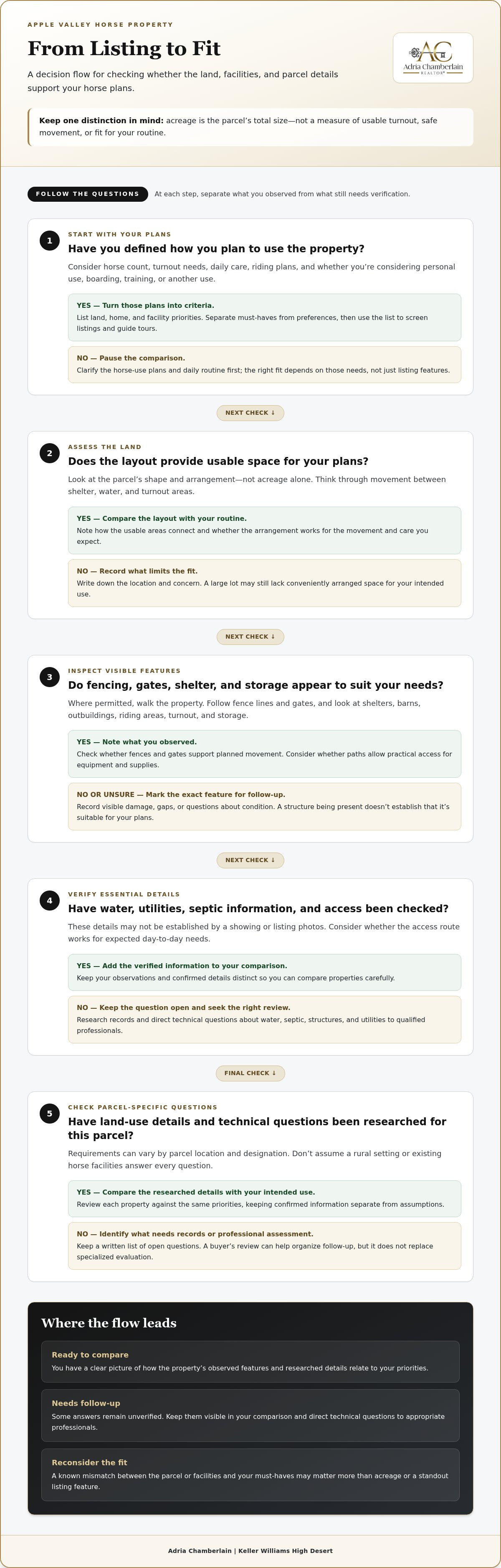
A clear process helps turn a promising listing into an informed decision. For equestrian properties for sale Apple Valley CA, move from your needs to property-specific research in stages, keeping a record of what you know and what still needs an answer.
What to review before and during a property tour
- Define your needs. Record intended horse use, household priorities, and the land and facilities you consider essential.
- Shortlist properties. Compare listing details with your priorities, treating descriptions as preliminary rather than verified information.
- Tour with a consistent checklist. Note the visible land layout, fencing, gates, shelter, storage, and access. Write down questions as they arise.
- Compare your observations. Use the same categories for each property so differences are easier to see and evaluate.
A tour lets you make observations, not a technical assessment. Record what you can see, such as a gate’s location or an outbuilding’s apparent condition, without assuming that a system or facility is sound or suitable. Keep unanswered questions separate from observations. That distinction helps prevent a listing description from becoming an untested assumption.
What to verify after finding a promising property
Once a property stands out, organize follow-up around its specific parcel and your intended use. Review available property records and identify questions about the parcel’s land-use designation, the agency with jurisdiction, water source, utilities, septic details, access, and existing facilities. Requirements and systems can vary from one property to another, so avoid drawing conclusions from the address or from features shown in photographs.
Use qualified professionals for technical evaluations of systems and structures, and consult appropriate legal or tax professionals for questions in those areas. Keep a simple tracker with three columns: question, who or what can answer it, and status. That way, details still needing verification stay visible as you consider next steps.
If you’re moving to the High Desert, the High Desert relocation guide offers additional context for planning a move to the area. Adria Chamberlain provides residential buyer representation to help organize your search around your priorities and compare options through the buying process. Discuss your Apple Valley property search with Adria.
Find Equestrian Properties for Sale in Apple Valley With Local Buyer Guidance
A clear set of priorities can make a property search more useful than browsing listings by acreage alone. For equestrian properties for sale Apple Valley CA, begin with your intended horse use, the features you need, and the trade-offs you’re willing to consider. Then compare each option against those criteria, keeping property-specific questions visible as you decide which homes to tour or research further.
Shape the property search around your real priorities
Share the practical details that will guide your choice: how you plan to use the property, your must-have facilities, your household needs, and which features are preferences rather than requirements. For example, a buyer who values convenient daily care may prioritize the parcel’s layout and access, while another may place greater importance on room for a particular riding setup. Clear priorities make listing comparisons more purposeful and help tours focus on what matters to you.
Suitable options depend on current listings and your specific criteria. A property’s description can help identify possibilities, but it can’t establish whether the land, facilities, or permitted use fit your plans. As you review candidates, keep a record of what aligns, what may involve a trade-off, and what needs verification. That gives you a consistent basis for narrowing the search without assuming that one appealing feature settles the decision.
Move forward with a local buyer representative
Adria Chamberlain is a licensed REALTOR® affiliated with Keller Williams High Desert. She has served High Desert and Inland Empire communities since 2017 and provides residential buyer representation in Apple Valley and nearby communities, including Hesperia, Victorville, Adelanto, Oak Hills, Helendale, Barstow, Phelan, Pinon Hills, and Lucerne Valley. She offers personalized guidance as you organize priorities, compare properties, and move through the buying process.
A focused search can help you spend more time considering properties that align with your intended use and less time sorting through options that don’t fit your needs. Adria can help keep the search centered on your criteria and think through next steps as questions arise. Contact Adria to discuss your Apple Valley property search.
Move Forward With a Clearer Apple Valley Property Search
A thoughtful search for equestrian properties for sale Apple Valley CA starts with your intended horse use and the features that support your daily routine. Compare properties by usable land, facilities, household needs, and access, then keep listing claims distinct from details that still require research or qualified review. That steady approach can help you recognize a promising fit without relying on acreage or photos alone.
Adria Chamberlain is a licensed REALTOR® affiliated with Keller Williams High Desert, DRE 02032478, and has served High Desert and Inland Empire communities since 2017. She provides personalized buyer guidance as you shape your search, compare options, and consider next steps. Contact Adria to discuss your Apple Valley property search.
Your horse plans and household priorities can guide the process, one informed decision at a time. With clear criteria and local buyer support, you can move ahead with greater confidence.
Frequently Asked Questions
Can I keep horses on any property in Apple Valley?
No. A rural setting or an Apple Valley address alone doesn’t establish whether horses or a particular horse-related use are allowed. Requirements can depend on the parcel’s location, designation, and proposed use. Before relying on a property, identify whether it falls under Town or county jurisdiction, research parcel-specific land-use information, and consult the appropriate local authority or qualified professional. Treat listing language as a starting point, not a legal determination.
How much land do I need for horses in Apple Valley?
There isn’t one acreage figure that suits every buyer or horse property. The amount and arrangement of usable land you need depend on the number of horses, your care plan, facilities, and intended use. A parcel’s total acreage may not show how its space functions day to day. Compare the layout and existing features with your plans, and seek qualified guidance on animal-care needs and parcel-specific questions.
What should I look for when buying an equestrian property?
Start with your intended use, then assess usable land, fencing, gates, shelter, barns or storage, access, and the visible condition of existing facilities. Consider whether water, utilities, and other parcel details may affect your plans. During a tour, note what you can observe and record what still needs verification. Listing descriptions and photos can help you shortlist equestrian properties for sale Apple Valley CA, but they don’t replace an in-person review or property-specific research.
Are equestrian properties in Apple Valley suitable for boarding horses?
Not automatically. Whether a property suits boarding depends on its parcel, facilities, intended operation, and applicable land-use requirements. A listing that describes a home as a horse property doesn’t establish that boarding is permitted or practical there. Define the operation you have in mind, research the specific parcel, and consult the appropriate local authorities and qualified professionals before relying on a property for that use.
What happens if a horse property needs repairs or facility upgrades?
First, separate visible condition from concerns that need professional evaluation. Record apparent repairs, then identify which features are essential for your intended use and which may be preferences. Seek qualified assessments for technical issues before drawing conclusions about the work involved. Compare the property with alternatives using the same criteria, and avoid assuming the scope, timing, or financial impact of repairs until the relevant details have been evaluated.
How can a REALTOR® help me find an equestrian property in Apple Valley?
A buyer representative can help clarify your priorities, organize a property search, compare available homes, and guide you through the purchase process. Adria Chamberlain is a licensed REALTOR® serving buyers in Apple Valley, Hesperia, Victorville, Adelanto, Oak Hills, Helendale, Barstow, Phelan, Pinon Hills, and Lucerne Valley. She can help focus the search around your plans; parcel suitability and technical details still call for appropriate research and professional review.
Should I buy a property with existing horse facilities or add them later?
Compare existing facilities with your intended use, paying attention to their apparent condition and usefulness rather than assuming they meet your needs. If a property lacks a feature you want, research whether adding it may be feasible before making a decision. Parcel conditions, land-use requirements, and project details vary. Listing photos alone can’t establish feasibility, so consult qualified professionals about proposed changes and technical questions.


