
A bigger acreage doesn’t always mean a higher asking price in Lucerne Valley.
Comparing price and acreage is a useful start, but access, payment terms, and intended use also help determine whether a parcel fits your plans. This article explains how listing prices vary, what acreage examples show, and why payment terms and access conditions deserve careful attention before you proceed.
You’ll also learn how to assess the difference between a remote parcel and one with more practical access, and how professional representation can help you evaluate land options.
Key Takeaways
- Compare acreage and listing details together; parcel size alone won’t explain differences between asking prices.
- Understand the payment terms and deposit before deciding whether a cash purchase or financing fits your plans.
- Distinguish land with practical road access from land described as landlocked or accessible only by ATV or off-road vehicle.
- Use listing examples to see how location, acreage, and stated features vary across Lucerne Valley parcels.
- Consider how zoning and minimum lot-size rules may affect the ways you can use a parcel.
Land listing prices and acreage
Lucerne Valley listings span small lots and large tracts, with asking prices that vary widely. Nearby High Desert comparisons are most useful when parcels have similar acreage, access, and stated features.
Median Prices and Recent Sales
A median can serve as a broad market reference, not an estimate for a vacant off-grid parcel. It combines properties with different features, so it can’t show what a particular parcel or access arrangement is worth.
Home sales describe housing activity, not vacant-land transactions, and should not be read as a count of land sales. According to the U.S. Census Bureau, Lucerne Valley had a population of 5,331 in 2020. These details give context about the community, but they do not determine an individual parcel’s asking price.
To compare Lucerne Valley with nearby High Desert areas, first match parcels by acreage and access. Then compare asking prices alongside each listing’s stated features. A small parcel with road access isn’t directly comparable to a much larger remote tract. This like-for-like approach makes regional comparisons more meaningful without treating a broad median as a guaranteed land value.
Parcel Size, Price, and APN
Listing examples show why acreage alone doesn’t explain price. Those are asking prices for different properties, not evidence that every acre has a fixed value.
Larger parcels also vary considerably. The difference between these examples shows why buyers should consider each parcel and its listing details, not acreage in isolation.
Its APN, or Assessor’s Parcel Number, is 0417-152-11-0000. The listing’s legal description references Section 17, Township 7 North, Range 1 West, San Bernardino Base and Meridian. Keeping the APN beside the acreage and price helps distinguish this listing from other 10-acre properties.
Cash purchase, deposit, and financing
A Lucerne Valley land offer needs clear payment terms, whether you’re using cash, a lender, or an arrangement with the seller. Treat that as a detail of the specific listing, not a standard deposit for other parcels. The written offer should state the purchase price, deposit, payment schedule, and conditions.
With a cash purchase, the buyer doesn’t arrange a property loan as part of the transaction. The offer still needs to state the agreed price, deposit, deadlines, and any conditions. Cash describes the payment method, not the parcel’s access, boundaries, or suitability for your intended use. Those property details remain separate questions, even when the offer isn’t contingent on financing.
Financing introduces additional terms. A lender’s approval process and requirements for the land affect timing and documentation. Vacant land isn’t the same as a home with an established residence, so understand how the lender treats the specific parcel. The offer’s financing language should match your loan plan and its approval timeline.
Seller financing is another possible arrangement, subject to terms agreed between buyer and seller. The agreement should explain the payment schedule, interest, and consequences of missed payments. These are financial and legal terms, not details to infer from an asking price. Your real estate representative can help organize the offer terms and transaction steps, while qualified financial and legal professionals provide specialized advice.
For any Lucerne Valley parcel, pay close attention to the deposit. Confirm that the written offer states its amount, where it will be held, and how the contract treats it. The full agreement provides that context.
- Cash: Match the offer’s payment timing to available funds and transaction deadlines.
- Lender financing: Align financing terms and approval timing with the parcel purchase.
- Seller financing: Put the complete payment arrangement in writing before proceeding.
- Deposit: Read its amount and treatment in the offer, not as an isolated listing detail.
Before signing, compare the purchase price with the total payment structure, not just the initial deposit. Make sure each term is stated clearly, including the balance due and the timing of payments. If you’re weighing a cash offer against financing, a guided land purchase review can help organize the questions and keep the offer aligned with your plans.
Landlocked status and off-road-only access
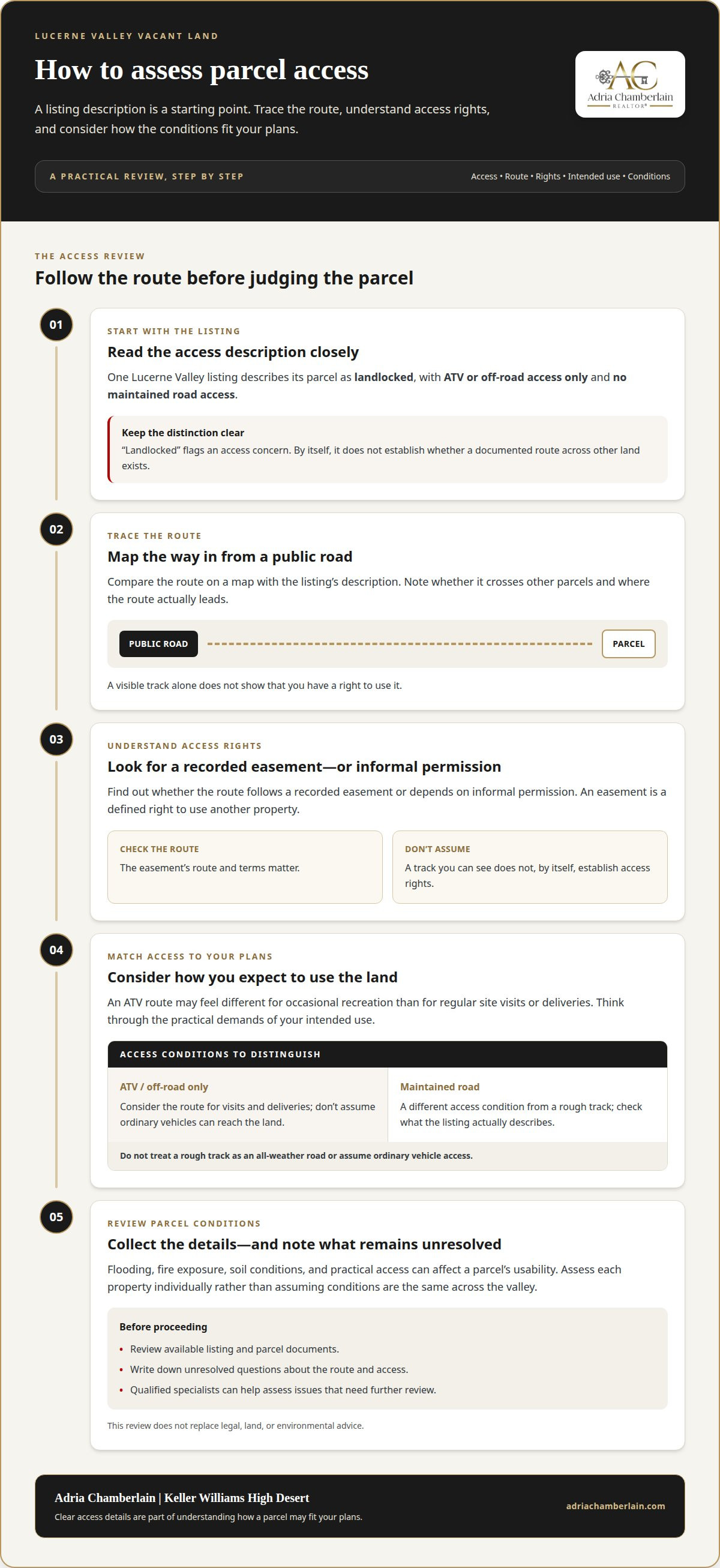
A Lucerne Valley listing describes a parcel as landlocked, with ATV or off-road access only and no maintained road access. Flooding, fire exposure, soil conditions, and practical access can affect a parcel’s usability. Assess each property individually rather than assuming land across the valley has the same conditions.
“Landlocked” signals an access concern that deserves close attention. It doesn’t, by itself, tell you whether there’s a documented route across other land. A listing’s access description is a starting point, not a substitute for understanding the route and any recorded access rights. On the parcel described as off-road-only, an ATV route differs from a maintained road for routine visits, deliveries, and emergency response.
Before making an offer, review available listing and parcel documents and note any unresolved access questions. Qualified specialists can help assess issues that need further review. This doesn’t replace legal, land, or environmental advice.
What Access Means on the Ground
Map the route from a public road to the parcel, then compare it with the listing description. Find out whether it crosses other parcels, follows a recorded easement, or depends on informal permission. An easement can give someone a defined right to use another property. Its route and terms matter: a visible track alone doesn’t establish those rights.
If access is ATV-only, consider how the route affects your intended use. A buyer planning occasional recreation may assess the trip differently from someone expecting regular deliveries or frequent site visits. The listing’s “no maintained road access” description is material: don’t treat a rough track as an all-weather road or assume ordinary vehicles can reach the land.
Parcel Conditions and Due Diligence
Flooding, fire, and soil conditions require parcel-specific assessment. Drainage paths, low areas, slope, vegetation, and the ground’s ability to support planned improvements are useful subjects for professional review. These factors can affect access, construction plans, and the feasibility of an off-grid setup. Listing details alone don’t establish whether a particular parcel faces a specific hazard.
Consider how the parcel description, access documents, and intended use relate to one another. For example, ATV-only access may conflict with frequent supply trips, or a proposed building plan may raise questions about soil conditions. Qualified specialists can assess technical findings, while legal professionals interpret access rights and agreements.
Keep your review focused on the specific parcel, not assumptions about Lucerne Valley as a whole. A documented route, actual terrain, drainage, vegetation, and soil all shape the decision. If a key access or site condition remains unclear, resolve it as part of your purchase decision before committing.
Lucerne Valley land listings
Listings for Lucerne Valley off grid land for sale can describe different features and potential uses. One listing mentions utilities believed to be available near a 2-acre parcel, while advising buyers to consider connection costs, zoning, land use, and development requirements. Those details are specific to that listing, not a guarantee about other properties.
Whether you can build a home or cabin depends on the parcel’s zoning, intended use, site conditions, and applicable approvals. Permit requirements depend on the proposed project. Septic rules and costs also vary with site suitability, system design, and approvals, so a listing alone can’t establish whether a particular plan is allowed or affordable.
Property taxes, assessments, and ongoing expenses also vary by parcel. One Lucerne Valley listing shows taxes of $108.00, but that figure applies to that listing and shouldn’t be treated as the tax amount for other land. A buyer’s ongoing budget may include applicable property taxes and assessments, utility connections, and maintenance for off-grid systems.
Well Availability and Drilling
Well availability, permitted use, depth, and drilling costs are parcel-specific questions in Lucerne Valley. A listing doesn’t establish whether a well can serve a particular site or what drilling would cost. Location, water access, site conditions, intended use, and applicable approvals all affect feasibility and expense.
A buyer planning a cabin with regular water use, for example, needs a different assessment from someone considering occasional visits. A real estate professional can organize parcel information and identify questions for specialist review. That review can address whether a well is practical, its expected depth and water quality, and site-related costs.
Solar, Water Storage, and Off-Grid Utilities
For Lucerne Valley off grid land for sale, utility details deserve careful attention. A listing says utilities are believed to be available near a 2-acre parcel and advises buyers to consider availability and connection costs. Nearby utilities don’t establish that a connection reaches the property. Solar, water storage, and other systems depend on intended use, site layout, and equipment needs.
Solar planning starts with the electricity needs of the proposed cabin or residence. Water storage planning depends on intended use and how water will reach the parcel. Compare those needs with the listing details, then have qualified specialists assess system design and installation requirements.
Keep the APN and listing description together as you compare properties. This makes it easier to connect questions about taxes, water, utilities, and construction plans to the specific parcel. As you evaluate Lucerne Valley off grid land for sale, distinguish stated listing features from project-specific requirements. A parcel’s location and utility access can call for a different plan from another property, even when both are marketed as off-grid land.
What are Lucerne Valley zoning rules and minimum lot sizes for vacant land?
A Lucerne Valley listing identifies a parcel as Recreational zoning. That label is a useful starting point, but it doesn’t establish whether a home, cabin, or other proposed use is allowed on the parcel. Consider zoning and minimum lot-size requirements alongside the specific property and intended project.
For a vacant parcel, separate three questions: what the zoning designation describes, what you plan to do, and what site work that use requires. A recreational designation may sound suitable for a getaway, but you still need to understand how applicable land-use rules address the planned structure or activity. “Off-grid” isn’t a zoning category or permission to build.
Minimum lot size matters when you’re evaluating whether a parcel can support a proposed use or future division. The acreage shown in a listing doesn’t establish that either is allowed. For example, the listing’s Recreational zoning label doesn’t state a minimum lot size. Compare the parcel’s legal boundaries with the requirements that apply to its intended use.
Connect the Zoning Label to Your Plans
Write down your intended use before comparing parcels. A seasonal cabin, a full-time home, and recreation without a building are different plans. For each, identify the structure or activity, access needs, and planned utilities. Then compare the zoning designation and applicable land-use requirements with that specific plan, rather than relying on the listing label alone.
Keep the parcel identification and listing description together during your review. A property’s APN can help distinguish it from nearby parcels with different zoning or boundaries. If a listing says “Recreational,” record that wording accurately, then identify the land-use questions to resolve before making a purchase decision. Don’t treat a nearby parcel’s use as proof that yours has the same permissions.
Understand Minimum Lot Size Before You Commit
Minimum lot size isn’t interchangeable with the acreage advertised for sale. The allowed use, parcel boundaries, and requirements for a specific proposal all matter. A large parcel isn’t automatically eligible for division, while a smaller parcel’s suitability depends on its intended use and applicable rules. Keep these questions distinct during your purchase review.
A clear decision process starts with the intended use, matches it to the parcel’s zoning information, and identifies any unresolved land-use or lot-size questions. That sequence can help prevent assumptions based on acreage or a short listing description. If zoning is central to your plans, discuss your Lucerne Valley land search as you compare properties.
Adria Chamberlain | Keller Williams High Desert
Adria Chamberlain, REALTOR® with Keller Williams High Desert, is a local contact for questions about property searches. If you’re considering an off-grid parcel as an investment or buying your first home, start by clarifying your priorities and the questions you need answered. Adria can discuss your goals and offer personalized guidance as you consider your next steps.
Bring the details that matter to your plans, such as preferred acreage, intended use, access needs, and payment approach. These priorities can help you compare available properties and consider questions that come up during your search. If you already own a property and are preparing to sell, you can contact Adria to discuss your plans and possible next steps.
For guidance with your land search or to discuss your next step, contact Adria Chamberlain, REALTOR® with Keller Williams High Desert.
Make your next move with a clear plan
As you consider Lucerne Valley off grid land for sale, let your intended use guide your next step. Decide which property qualities matter most, then use those priorities to assess specific parcels. A focused plan can help you weigh trade-offs and avoid being drawn to acreage or listing language that doesn’t fit your goals.
A land purchase may also connect to a larger housing decision, such as a first purchase or a move within the High Desert. Adria Chamberlain, REALTOR® with Keller Williams High Desert, can help you explore your property search. If your plans shift toward selling a home, you can contact Adria to discuss your options.
Ready to talk through your next step? Contact Adria Chamberlain | Keller Williams High Desert to discuss what matters in your search for Lucerne Valley off grid land for sale. A thoughtful conversation can help you move forward with greater clarity.
Frequently Asked Questions
What off-grid land parcels are currently for sale in Lucerne Valley, California?
Listing examples include a 5-acre parcel on Joshua Road described as suitable for off-grid living with solar power, a remote 10.39-acre property on Harod Road, and a 2.5-acre parcel on Green Rock Mine Road. These examples offer different combinations of acreage, location, and stated features. Compare each listing’s parcel details and intended-use fit rather than relying on the “off-grid” label alone.
What are the asking prices, acreage, and price per acre for Lucerne Valley land listings?
These calculations compare asking prices only. They don’t establish market value or account for differences between parcels.
Which Lucerne Valley parcels have road access, legal access, and clear title?
One listed parcel is described as landlocked, with ATV or off-road access only and no maintained road access. That description doesn’t establish legal access or clear title for other parcels. For a specific property, title records and recorded access documents are central to understanding ownership and any access rights. A listing’s road description alone can’t answer both questions or establish title status.
How do Lucerne Valley off-grid land prices compare with nearby High Desert areas?
Lucerne Valley listing prices vary widely, so compare nearby High Desert parcels with similar acreage, access, and stated features.
Can you build a home or cabin on off-grid land in Lucerne Valley, and what permits are required?
Whether you can build depends in part on the parcel’s zoning and minimum lot-size rules. Confirm zoning, land use, and development requirements for the specific parcel before proceeding.
What property taxes, assessments, and ongoing costs apply to Lucerne Valley land?
The featured Lucerne Valley parcel is listed with taxes of $108.00.


