

Could a homebuyer assistance program lower your upfront costs but still be unavailable for the home you want? The first-time homebuyer programs High Desert buyers can explore vary by location, eligibility, funding status, and loan requirements. Finding a program is only the first step. For example, CalHFA Dream For All was closed to new applications as of September 2026.
Program terms can be confusing, and assistance that looks promising may not work with your loan or a particular property. Before building your purchase plan around assistance, verify the current details with the program administrator and a participating lender.
This guide outlines options to investigate, questions to ask, and property requirements to check. It also explains how to connect your assistance search with a realistic home search in Apple Valley, Hesperia, Victorville, Adelanto, Oak Hills, Helendale and Silver Lakes, Barstow, Phelan, Pinon Hills, or Lucerne Valley. Adria can help you explore homes and coordinate property questions with your lender. Lenders and program administrators determine loan qualifications and assistance approval.
Key Takeaways
- Compare assistance types, then confirm current funding, terms, and application status with each program administrator.
- For first-time homebuyer programs High Desert buyers are considering, check that the program fits the intended home, location, and loan.
- Ask how each program defines first-time buyer status and what it requires for income, purchase price, occupancy, education, and lender participation.
- Before you shop, speak with a participating lender, prepare your questions, and verify application timing and required steps.
- Set location priorities across communities such as Apple Valley, Hesperia, Victorville, Adelanto, Oak Hills, Helendale, Barstow, Phelan, Pinon Hills, and Lucerne Valley. Adria can provide real estate representation while lenders and program administrators handle loan and assistance decisions.
Which First-Time Homebuyer Programs May Apply in the High Desert?
Program names, funding, application windows, and requirements can change. Treat these options as a research starting point, not confirmation of eligibility. The details below reflect information reported as of September 2026. Before relying on assistance, check current terms with the official administrator and a participating lender. For broader context, Wikipedia provides an overview of the homeownership rate in the United States.
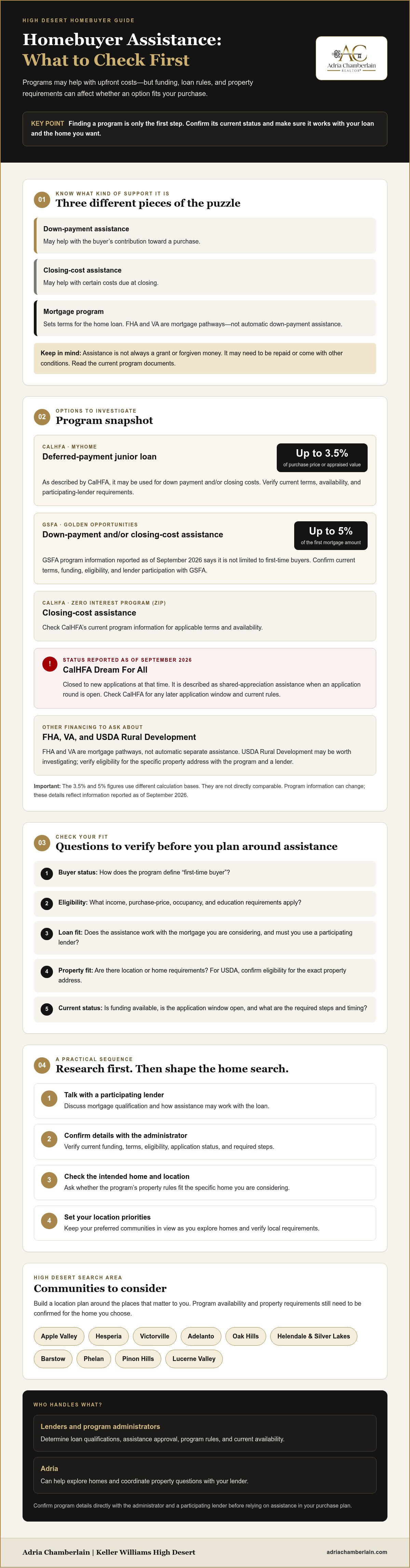
First, distinguish the kinds of support. Down-payment assistance may help with the buyer’s contribution toward a purchase. Closing-cost assistance may help with certain costs due at closing. A mortgage program sets terms for the home loan itself. Assistance is not always a grant or forgiven money. It may need to be repaid or come with other conditions, so read the current program documents.
What kinds of homebuyer assistance should you look for?
Some assistance is paired with a mortgage program. Other options have separate eligibility rules and application steps. As of September 2026, CalHFA describes MyHome as a deferred-payment junior loan of up to 3.5% of the purchase price or appraised value for down payment and/or closing costs. CalHFA describes its Zero Interest Program (ZIP) as closing-cost assistance. Check the California Housing Finance Agency’s current program information for applicable terms and availability. The administrator’s documents determine repayment and other conditions.
Which program names are worth checking first?
For California-focused options, review current offerings from the California Housing Finance Agency (CalHFA) and the Golden State Finance Authority (GSFA). According to GSFA program information available as of September 2026, Golden Opportunities offers up to 5% of the first mortgage amount for down payment and/or closing costs and is not limited to first-time buyers. Confirm current terms, funding, and lender participation directly with GSFA. CalHFA Dream For All was closed to new applications as of September 2026. Check CalHFA for any later application window rather than assuming it is open.
FHA and VA are mortgage pathways, not automatic down-payment assistance. USDA Rural Development may also be worth investigating, but confirm eligibility for the specific property address with the program and a lender. Buyers considering homes in Victorville, Apple Valley, Hesperia, Adelanto, or nearby communities can ask the relevant city or program administrator about local options. Verify current property requirements before relying on them.
How Do California Homebuyer Assistance Programs Work?
Think of assistance and mortgage approval as related but separate parts of a purchase. The program administrator sets the assistance rules. The lender evaluates the mortgage and confirms how assistance may work with it. The comparison below reflects program information available as of September 2026. Use it to plan your questions, then check current documents directly with each administrator.
| Program | Administrator | Assistance type | Eligibility source and what to verify |
|---|---|---|---|
| CalHFA programs | California Housing Finance Agency | Assistance options paired with eligible mortgage programs | Review CalHFA’s program information and verify current eligibility, terms, and participating-lender requirements. |
| GSFA Golden Opportunities | Golden State Finance Authority | Down-payment and/or closing-cost assistance | GSFA’s official Golden Opportunities program information, as of September 2026, describes current program terms. Confirm availability, eligibility, funding, and lender participation with GSFA. |
| FHA, VA, or USDA Rural Development financing | Relevant federal agency and participating lender | Mortgage pathways, not automatic separate assistance | Ask the lender about loan qualification, then confirm with each assistance administrator whether its rules allow the proposed combination. |
| CalHFA Dream For All | California Housing Finance Agency | Shared-appreciation assistance when an application round is open | CalHFA’s status reported as of September 2026 was closed to new applications. Check the agency’s current program page for any later application window and rules. |
How do grants, deferred loans, and shared-appreciation assistance differ?
A grant may not require repayment, while a deferred loan postpones repayment under stated conditions. Shared-appreciation assistance may connect repayment to the home’s value when repayment is due. These are general descriptions, not a substitute for program documents. Ask the administrator about repayment triggers and other obligations, then ask a qualified lender how the assistance could affect your financing.
Can you combine assistance with FHA, VA, or USDA financing?
Possibly, but compatibility depends on the assistance program’s current rules, lender requirements, and your circumstances. Having an FHA, VA, or USDA loan does not automatically qualify you for separate assistance. Confirm the proposed combination with both the program administrator and a participating lender before including it in your purchase plan.
A program name does not establish eligibility or guarantee funds. Keep the administrator’s written guidance separate from the lender’s mortgage decision. Revisit both if your loan type or target property changes.
Who Qualifies, and What High Desert Buyers Should Verify
“First-time buyer” does not have one definition that applies to every assistance program. Each administrator sets its own rules, and eligibility can depend on more than whether you have owned a home before. Income, household members, the property, and the loan may all matter. Only the current program administrator and a participating lender can confirm your eligibility.
Does “first-time homebuyer” mean the same thing in every program?
Not necessarily. A program may use a specific prior-ownership lookback period or apply its definition differently to co-borrowers and other household members. Ask the administrator for the current written definition and how it applies to everyone included in the purchase or loan. This can matter if a co-borrower has owned a home before or if household members will not all be on the mortgage.
When reviewing a program’s criteria, ask which requirements apply and whose information the program considers:
- Income: Which household members’ income counts, and what current limit or calculation does the program use?
- Purchase price: Is there a maximum, and how does the program calculate it?
- Occupancy: Must the home be your primary residence, and what occupancy conditions apply?
- Education: Is a homebuyer education course required, and which courses meet the program’s rules?
- Lender participation: Must you use an approved lender, and can that lender work with your intended loan type?
These are points to verify, not universal requirements. Rules and documentation differ by program. The U.S. Department of Housing and Urban Development offers general federal homebuying assistance and homebuying information, but only the relevant administrator and lender can confirm what applies to your situation.
How can location and property type affect High Desert eligibility?
Some programs use geographic boundaries that can vary by address. If you are exploring USDA Rural Development financing, check the specific property address through official program resources and with a lender. Do not assume every home in Apple Valley, Victorville, Hesperia, or Barstow qualifies under the same rules.
Ask whether the program accepts the type of home you are considering, whether your occupancy plans meet its criteria, and whether the purchase price falls within any current limit. A property may suit your needs but still fail to meet a particular program’s requirements.
For first-time homebuyer programs High Desert buyers are considering, keep your household details and prospective property address handy when asking questions. This gives the administrator and lender information to review, so you can plan around confirmed requirements instead of assumptions.
How to Research and Apply for Assistance Before You Shop
Check the details before you begin touring homes so your search can reflect options that have been confirmed. Prepare questions, speak with a lender who participates in the programs you are exploring, and verify current details with the program administrator. Then plan your home search around the guidance you receive.
What questions should you ask a lender or program administrator?
Ask for current answers instead of relying on an old article, flyer, or estimate. Confirm which programs are accepting applications, whether funding or application windows are limited, and what steps must happen before you make an offer.
- What are the current eligibility rules, and how does the program define household income and first-time buyer status?
- Does the assistance have to be repaid? If so, what conditions or events trigger repayment?
- Must you use a participating lender, and can the program work with the loan type you are considering?
- Is homebuyer education required? If so, which course or provider meets the program’s requirements?
- Which documents should you prepare, and how does the assistance affect the loan process or timing?
Ask the administrator to confirm program availability, rules, application timing, education requirements, and funding. Ask the lender how those terms relate to your mortgage application. If you are considering different communities or property types, raise that early. Address-level or property requirements may affect whether a specific home fits.
What should you prepare before searching in the High Desert?
Gather your household, income, savings, and financing information for discussion with qualified professionals. You do not need to share sensitive details broadly. Ask the lender and administrator what they require and how to provide it. Keep a written record of answers, the date you received them, and any follow-up questions. That makes it easier to check whether program details have changed before you act.
Next, sketch out your location priorities. Compare Apple Valley, Hesperia, and Victorville with Adelanto, Oak Hills, Helendale or Silver Lakes, Barstow, Phelan, Pinon Hills, and Lucerne Valley. Consider the property types you want and practical needs such as your commute. Share your shortlist with your lender so financing and assistance questions can be considered alongside the homes you may search for.
For broader purchase-planning context, see Adria’s First Time Home Buyer Apple Valley guide. If you want help connecting your location priorities with local home options, contact Adria about first-time buyer representation. A real estate search can be coordinated with your lender’s guidance, while loan terms and assistance approval remain with the responsible professionals.
Your Next Steps Toward Buying a High Desert Home
Turn your research into a practical home-search plan. Verify program details with the administrator, discuss financing with a participating lender, set priorities for where and what you want to buy, and then look at properties that fit those priorities.
Keep each person’s role clear. Adria Chamberlain provides real estate representation and can help you explore property options and navigate the real estate transaction. She is not a mortgage lender, program administrator, or financial adviser. The lender handles mortgage terms and qualification decisions. The program administrator confirms assistance eligibility and approval.
How can a local agent support your home search?
Share the guidance you receive from your lender, along with your preferred locations, home type, and other property criteria. This helps shape a focused search without asking your real estate agent to interpret loan terms or promise assistance approval. Adria represents first-time buyers in Apple Valley, Victorville, Hesperia, and surrounding High Desert communities. She can help you compare available home options in the places you are considering.
If Hesperia is on your list, browse Hesperia residential property listings to explore the local search. Use listings to refine what matters to you, then ask your lender or program administrator whether a specific home meets applicable financing and assistance requirements before relying on that option.
For buyers researching first-time homebuyer programs in High Desert communities, a clear plan connects program checks with a more focused property search. It also leaves room to adjust if program rules, funding, or your priorities change.
What is a simple first step if you are not ready to buy yet?
Start with a conversation with a participating lender. Ask which financing pathways may be worth exploring and what information would help you understand your readiness. You do not need to rush into a property search before you feel prepared.
Program availability and requirements can change, so revisit official information before taking action. If you want personalized guidance connecting your search priorities with local home options, contact Adria about home-search guidance.
Take Your Next Step Toward a High Desert Home
A thoughtful purchase plan starts with verified information. Check each program’s current terms and availability, then speak with a participating lender about your financing and whether assistance may fit. After that, narrow your search by community, property type, and priorities. Program administrators and lenders make assistance and loan decisions, so a program name alone does not confirm eligibility or funding.
Researching first-time homebuyer programs High Desert options can feel like a lot to manage, but you can take it one step at a time. Adria Chamberlain | Keller Williams High Desert is a licensed REALTOR® with DRE 02032478 and has served High Desert and Inland Empire communities since 2017. Adria provides first-time homebuyer representation and can help you explore homes in the communities you are considering, while your lender handles mortgage guidance.
When you are ready to discuss your location priorities and home search, contact Adria to talk through your High Desert home search. Start with a clear plan and verified information, then take the next step that fits your readiness.
Frequently Asked Questions
What first-time homebuyer programs are available in the High Desert in 2026?
As of September 2026, buyers can investigate CalHFA programs, GSFA Golden Opportunities, and Victorville’s city assistance program, but should confirm current availability with each administrator. CalHFA’s official program information describes MyHome and the Zero Interest Program. GSFA’s official Golden Opportunities information lists its program terms. The City of Victorville administers its local program. CalHFA Dream For All was closed to new applications as of September 2026.
Can I get down-payment assistance to buy a home in Victorville or Apple Valley?
Possibly, depending on the program, your eligibility, and the property. The City of Victorville’s Mortgage Assistance Program information, as reported in September 2026, describes up to $55,000 in assistance as a deferred loan with 3% interest, subject to program requirements and purchase-price limits. Apple Valley buyers can check CalHFA and GSFA options. Ask each administrator and a participating lender to confirm current funding, terms, and property eligibility.
Do first-time homebuyer programs in California have income limits?
Some programs do, and limits vary by program and household rules. CalHFA’s San Bernardino County 2026 income-limit information, effective June 30, 2026, lists a $210,000 limit for most CalHFA first-mortgage and subordinate-mortgage programs. CalHFA listed a $168,000 limit for Dream For All when that program was active. It was closed to new applications as of September 2026. Confirm how income is counted with CalHFA or a participating lender.
Can I combine down-payment assistance with an FHA or VA loan?
It may be possible, but FHA or VA financing does not automatically qualify you for separate assistance. Compatibility depends on the assistance program’s current rules, lender requirements, and your circumstances. Ask a participating lender whether the loan and assistance can be combined, then verify the answer with the program administrator. Adria represents first-time buyers, including those using FHA or VA loans, but lenders and administrators make loan and assistance decisions.
Does USDA Rural Development cover homes in the High Desert?
Eligibility depends on the specific property address and current program rules. Check the address using USDA Rural Development’s official eligibility resources, then ask a lender familiar with the program to confirm borrower and property requirements. Do not assume every home in Apple Valley, Victorville, Hesperia, Barstow, or another High Desert community qualifies alike. Confirm the address before building your search or financing plan around USDA eligibility.
Do I have to repay first-time homebuyer assistance?
Repayment depends on the program’s written terms and type of assistance. Some assistance is structured as a loan, and repayment may be deferred or triggered by specific conditions. Shared-appreciation assistance may link repayment to the home’s value when repayment is due. Before accepting assistance, review the administrator’s current documents and ask what events trigger repayment, whether interest applies, and what other obligations may continue.
When should I apply for homebuyer assistance before making an offer?
Start checking early, before you rely on assistance in a home search or offer plan. Ask a participating lender and the program administrator about current application timing, funding, education requirements, documents, and steps to complete before making an offer. Program windows and requirements can change, so confirm them again as you get closer to buying. Also ask whether a specific property address and type meet program rules.


