
A parcel that looks perfect online may not support the plans you have in mind. A road on a map or a nearby utility line does not confirm legal access or a service connection. When considering buying land in Phelan CA what to know starts with the details behind the listing, not just the view or acreage.
Zoning, water, septic, power, and site constraints can feel like a lot to untangle. Whether you hope to build, hold the parcel, or evaluate an investment, this guide explains how to investigate the details using parcel records, county information, and relevant service providers. You’ll learn how to organize your findings, compare properties, and focus your questions. Adria Chamberlain works with land buyers in Phelan and can help you compare parcels with your plans.
Key Takeaways
- Start with your intended use, whether you plan to build, hold the parcel, or invest, so you can compare land against a clear goal.
- For buying land in Phelan CA what to know includes checking parcel records, zoning, and documented legal access instead of relying on a listing description.
- Investigate water, wastewater, electricity, and site conditions separately. Confirm parcel-specific service details with the relevant sources.
- Keep a due-diligence record noting each answer, its source, and any questions that remain before you proceed.
- Personalized buyer guidance can help you organize your research and compare Phelan parcels with your plans.
Buying Land in Phelan, CA: Start With Your Intended Use
Before comparing parcel sizes, views, or asking prices, decide what you want the land to do. Are you hoping to build soon, hold the property, or acquire it as an investment? Your answer shapes which details matter most and helps you avoid a parcel that looks appealing but doesn’t suit your plans. For buyers, understanding buying land in Phelan CA what to know begins with a clear purpose.
A listing can help you identify a property, but it isn’t verified information about that specific parcel. Photos and marketing language don’t establish what uses are allowed, how the land can be reached, or whether services are available. For background on the community’s geography and history, the Phelan, California Wikipedia page offers a general orientation. Parcel decisions require parcel-specific research.
Clarify what you want the Phelan property to do
Separate immediate plans from longer-term goals. If you hope to build, consider the access, services, privacy, and usable site area your intended layout requires. If you plan to hold or invest, decide what would make the parcel practical for that purpose and which uncertainties you’re prepared to research. Suitability depends on your plan and parcel-specific verification.
- Build: Identify the kind of project you have in mind and the site features it would require.
- Hold: Consider how long-term ownership fits your plans and which parcel details you need to understand first.
- Invest: Set out the factors you’ll use to compare opportunities instead of relying on a listing’s presentation alone.
Make your needs specific. “Room for a future home” is a starting point; access, services, privacy, and usable area turn that goal into questions you can investigate. An open-looking parcel doesn’t tell you which uses may be allowed.
What does vacant-land due diligence mean?
Due diligence means gathering and reviewing information before deciding whether to proceed. For land, it means comparing what you learn about a particular parcel with your intended use, rather than assuming it will work because it looks suitable online. Some answers may come from public records, while others require a site visit or input from a qualified specialist.
Think of due diligence as an organized review, not a single document or yes-or-no answer. Key areas include parcel identity and records, permitted uses, access, water and wastewater, electricity, and physical site conditions. Each question may have a different source, so note what you’ve verified and what remains unresolved. The sections below take these checks one at a time to help you assess how a Phelan parcel aligns with your plans.
Check Phelan Zoning, Parcel Records, and Legal Access
Once you know what you want the land to do, check whether records and documented conditions support that plan. In Phelan, zoning is governed by the San Bernardino County Development Code and administered by the County’s Land Use Services Department. Zoning rules can affect how land may be used. They’re a starting point for research, not a guarantee that a particular project will be allowed.
A parcel’s advertised use is not proof that every intended use is allowed. A listing may describe land as suitable for a home, agricultural use, or investment, but those descriptions don’t replace current county records or parcel-specific review. Confirm the details that matter to your plans with the appropriate county office and, when needed, a qualified land-use professional.
How to research parcel number, boundaries, and zoning
Start with the parcel’s Assessor’s Parcel Number, or APN. This identifier helps you locate county information for the specific property and distinguish it from nearby lots that may look similar on a map. Use San Bernardino County Assessor-Recorder-Clerk resources to look up parcel records, then consult Land Use Services for current zoning and planning information. Verify agency tools and procedures directly with the County, since records and online services can change.
Parcel maps are useful for orientation, but an online outline isn’t a surveyed boundary. Compare the APN and legal description in available property documents with county records. If an exact boundary or proposed building area matters to your decision, ask a qualified surveyor or other relevant professional to interpret or verify it. Record which information you reviewed, the date, and any outstanding questions.
Why road access and easements matter
A visible road and a documented right to reach a parcel are different things. An easement is a recorded right to use someone else’s land, such as a route across it. San Bernardino County describes legal access in terms of a road with a dedicated right-of-way or a public or private easement. Long-standing road use alone doesn’t establish documented legal access.
Review available title materials and recorded access information, and discuss unclear documents with a qualified real estate or legal professional. Keep three questions separate: Can you physically reach the parcel today? Who handles or shares responsibility for road maintenance? What recorded documents describe access rights? One answer doesn’t automatically settle the others, and this article isn’t a legal determination.
When researching buying land in Phelan CA what to know, keep zoning, parcel identity, boundaries, and access evidence together. This makes gaps easier to spot before moving forward. Adria can help you compare parcels with your plans and organize questions for follow-up. For personalized land-buying guidance, connect with Adria Chamberlain.
Investigate Water, Septic, Power, and Phelan Site Conditions
A parcel may appear close to utility infrastructure without having a confirmed connection. Nearby infrastructure does not confirm that a parcel can connect to it. Service boundaries, connection requirements, and site conditions are specific to the property, so verify them before treating a listing description as settled fact.
Use the table below to organize questions for the relevant provider, county office, or qualified professional. In Phelan, the Phelan Pinon Hills Community Services District (PPHCSD) provides water service, and Southern California Edison (SCE) provides electricity in the area. Confirm which providers serve the particular parcel and what service arrangements apply.
| Area | Questions to investigate |
|---|---|
| Water | Does the provider serve this parcel? What connection details, capacity, or other requirements apply? If a well is being considered, what parcel-specific evaluation is needed? |
| Wastewater | Is there an existing system, or would a septic system need to be evaluated? What site review and county requirements apply? |
| Electricity | Which provider serves the parcel? What is required to establish service, and where is the nearest relevant infrastructure? |
| Physical site | How do access, slope, drainage, and usable area relate to the intended project? Are there environmental or hazard questions that need further review? |
Confirm water and wastewater options for the parcel
Ask PPHCSD whether the parcel falls within its service area and what connection details apply. A nearby water line doesn’t establish that service is available to a particular lot. If the property may rely on a well, investigate that as a separate option. Don’t assume a well exists or that it will meet your plans.
Wastewater also needs parcel-specific review. San Bernardino County Environmental Health Services handles septic-system records and requirements. Whether a septic system can be installed depends on the parcel’s conditions and applicable local requirements. A listing or neighboring property isn’t proof of feasibility. Keep written notes on who provided each answer and what still needs evaluation.
Assess power, terrain, and environmental records
Confirm the parcel’s electric service details directly with SCE, including the steps and requirements for a new connection if needed. A line visible from the property isn’t the same as confirmed service. Record the provider’s answer alongside any information about connection location or next steps.
Walk the site where access is available, and consider how slope, drainage, and usable land may affect your intended layout. Online maps can help frame questions, but they don’t replace parcel-specific review. For environmental or hazard concerns, consult current official mapping and qualified professionals who can assess the issue in context.
For buying land in Phelan CA what to know, compare each answer with your intended use instead of treating utilities as a simple yes-or-no feature. A written record can help clarify which parcels merit further consideration and what questions to resolve before proceeding.
Use a Practical Phelan Land-Buying Checklist Before Proceeding
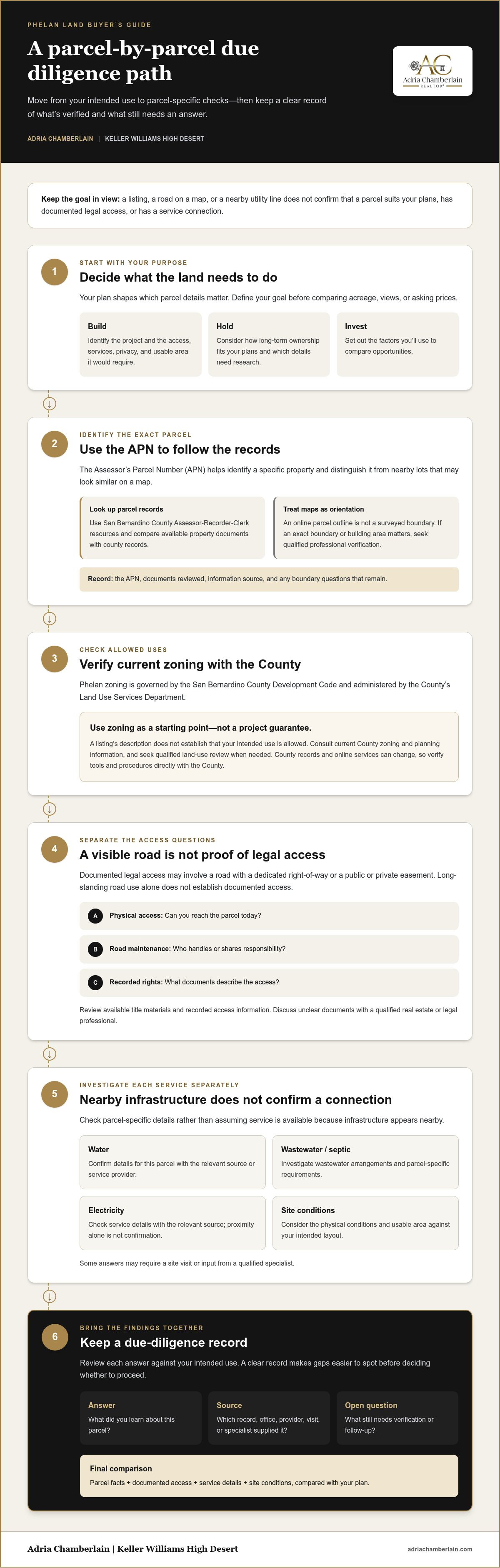
Research is easier to use when you ask the same questions about each parcel. This checklist turns what you’ve learned into a clear record, helping you compare properties without confusing a listing claim with a verified answer.
- Define your intended use. Write down whether you’re considering building, holding the property, or investing, along with the features your plan depends on.
- Identify the parcel. Record its address or location and Assessor’s Parcel Number (APN), then make sure your research refers to the same property throughout.
- Verify records. Note what you find about zoning, parcel information, boundaries, and documented access, along with the county source you used.
- Investigate services and site conditions. Track water, wastewater, electricity, access, terrain, and other site questions that could affect your plans.
- Compare the findings. Decide which answers support your intended use, which need professional review, and which remain unresolved.
For each answer, record the source, the date you checked it, and any next question. Simple status labels such as “verified,” “listing description,” or “unresolved” help keep information clear. For example, if a listing says utilities are nearby, keep that claim separate from a provider’s parcel-specific response about service. The distinction makes follow-up more focused.
Compare parcels using the same questions
A side-by-side comparison can reveal trade-offs that get lost when you review properties one at a time. Use the same categories for each parcel: intended use, access, zoning, water, wastewater, electricity, and site constraints. Separate documented facts from marketing language and unanswered questions in every category. A gap isn’t automatically a reason to walk away, but it’s information to weigh before deciding how to proceed.
If you’re assessing land as an investment, the Victorville investment properties guide offers related context for considering investment properties in another High Desert community. For Phelan land, ground your comparison in the individual parcel and your own goals.
Know when to involve qualified professionals
Some questions call for expertise beyond listing and county records. A planning professional may help interpret land-use questions; a title professional can review recorded documents; a surveyor can address boundary concerns; and engineering or septic expertise may be relevant to site or wastewater questions. Direct legal, tax, and financial questions to appropriately qualified professionals.
Unresolved access or infrastructure details can affect how you assess a parcel, especially if your plans depend on a specific route or service. Organize your notes before discussing the property with your representative. If you’d like help comparing Phelan parcels with your goals, connect with Adria about your land search. A clear list of findings and open questions gives the conversation a useful starting point.
Find and Evaluate Phelan Land With Local Buyer Guidance
Land listings show what’s available, but a search is more useful when it reflects what you need. A buyer representative can help organize the search, compare parcels with your stated goals, and keep key questions in view as you consider your options. You make the decision with a clearer picture of what you’ve learned and what still needs attention.
Turn your land goals into a focused property search
Before discussing specific listings, outline your intended use, preferred location, and essential parcel requirements. Note whether you’re considering a future build or investment, how important a particular type of access or service is to your plans, and which site features are deal-breakers versus preferences. These priorities help focus the property search without assuming that any parcel will meet every need.
If buying land is part of a broader move, the High Desert relocation guide can help you think about the wider transition alongside the land search. Keeping your location preferences and parcel requirements in view can make conversations about your options more focused.
Discuss parcel questions with Adria
Bring the listing details you’ve gathered, along with notes on what’s verified and what remains uncertain. Adria Chamberlain is a licensed REALTOR® affiliated with Keller Williams High Desert. Her work includes land sales and investment property acquisitions, including in Phelan, and she has served the High Desert and Inland Empire since 2017.
Adria’s local buyer guidance can help you compare available parcels with your plans and organize next steps. It doesn’t replace county records, provider responses, or advice from qualified specialists, but it can help keep your property search focused on the questions that matter to you.
If you’re considering buying land in Phelan CA what to know, a useful conversation starts with your goal, not a promise about what a parcel can deliver. Share the properties you’re considering and the questions you’ve gathered, then discuss how they relate to your priorities. Reach out to Adria to discuss your Phelan land search when you’re ready. You don’t need to have every answer in hand before asking for guidance.
Choose Your Next Step With Confidence
Choose the open question that matters most to your plans. You may need clarity about a service connection, a document, or whether a parcel’s layout works for your intended use. Write down the question and identify what kind of answer would help you decide. This keeps your search focused on the information you need rather than a listing’s urgency.
As you research buying land in Phelan CA what to know, remember that a thoughtful decision doesn’t require having every answer immediately. It does require knowing what you’ve learned, what remains uncertain, and who can help address each question. A local buyer conversation can help you organize priorities and compare parcels without assuming in advance that any one property is the right fit.
If you’re ready to talk through your plans or current options, talk with Adria about your Phelan land search. Bring the questions you have so far and take the next step with a clearer sense of what matters to you.
Frequently Asked Questions
Can I build a home on any vacant land in Phelan?
No. Before planning a particular home, describe the project clearly enough for the County to address the use you have in mind. For example, note whether you’re considering a primary residence, a manufactured home, or a home with additional structures. Those details can affect which questions you need answered. Avoid investing in design work or making plans around a listing phrase until you understand the parcel-specific requirements.
How do I check zoning for land in Phelan, California?
Check the parcel’s current zoning using its identifying information, then describe the specific activity you’re considering. Rather than asking only whether the land is “residential,” explain the proposed use and ask the County which development standards or other parcel-specific designations you should review. Keep the response with your property records. That’s more useful than viewing a zoning label without the context of your plans.
Does vacant land in Phelan have access to water and electricity?
Some parcels may have service available, while others may require further steps or evaluation. For a specific property, ask the providers whether an existing meter or connection actually serves that parcel, rather than relying on nearby homes or lines. Keep provider responses with the parcel file, noting whether the information describes present service or a possible future connection. That distinction helps you avoid treating a nearby utility as an established service arrangement.
What should I check before buying land in Phelan?
Start with the facts that could change your decision, then gather the documents or responses needed to assess them. If a listing’s stated acreage differs from the parcel information you find, for example, don’t simply choose one figure. Record the discrepancy, note where each figure came from, and ask the appropriate professional how to resolve it. For buying land in Phelan CA what to know, careful follow-up on inconsistencies can be as useful as collecting more information.
Do I need a survey before buying land in Phelan?
Whether to obtain a survey depends on the questions you need answered. It may be worth discussing if you’re relying on a particular boundary for a planned layout, fence, or access route. Before arranging one, clarify the survey’s purpose and the area or features you need examined with a qualified survey professional. A focused request can help ensure the work addresses your concern.
Can vacant land in Phelan use a septic system?
Possibly, but the answer depends on the parcel and proposed project. When discussing an evaluation, explain where you hope to place the home or other planned improvements, and ask whether those plans matter to assessing a wastewater option. Keep preliminary feedback separate from any later agency decision or approval. This helps you understand what an early assessment does and doesn’t establish before relying on it in your planning.
Is buying land in Phelan a good investment?
It can make sense for some buyers, but there’s no universal answer. Consider how long you expect to hold the property, what future use you’re counting on, and what ongoing ownership obligations may apply. Review current, relevant land-sale information carefully, since a small set of comparable properties may not represent every parcel or future outcome. Discuss financial or tax implications with a qualified professional before making a decision.


