

If the home you love has solar panels, you’ll want to understand any contract attached to them before you commit. When buying a home with solar lease transfer High Desert, look beyond the panels themselves: review the remaining term, payment obligations, and what happens if the lease can’t be transferred.
It’s reasonable to wonder whether taking over the agreement will affect your budget or complicate closing. A leased system may be part of a home’s appeal, but don’t base your decision on assumed utility savings or promises that aren’t supported by the documents.
This guide explains how to review the solar agreement, compare a transfer with a seller buyout and other documented options, and identify approvals or paperwork that could affect your purchase. You’ll also learn how to coordinate questions with your transaction team and assess the solar contract separately from the home. Whether you’re looking in Apple Valley, Victorville, Hesperia, Adelanto, Barstow, Helendale, or Phelan, a document-led review can make this part of the purchase easier to manage.
Key Takeaways
- When buying a home with solar lease transfer High Desert, treat the solar contract as a separate decision from the home itself.
- Review the executed agreement to understand who owns the equipment, which payments and duties may apply, and how the electricity arrangement works.
- Compare taking over the lease, a seller buyout if the contract allows one, and continuing your home search. Base the decision on documented terms and your comfort level.
- Request transfer details and system records early. Approval steps and timing depend on the agreement and solar lessor.
- Organize questions with your transaction team and consult qualified specialists where needed before deciding how to proceed.
Buying a High Desert Home with Leased Solar: What the Agreement Means
Solar panels can look like a straightforward benefit, but the equipment and the agreement attached to it are separate parts of a home purchase. With a solar lease, the solar company generally owns the panels while the homeowner makes payments under a contract. With an owned system, the property owner owns the equipment, though a loan may still be involved. The documents for the specific home, not general assumptions about solar agreements, determine what applies to you.
Solar power describes how sunlight can be converted into electricity. It doesn’t tell you who owns a particular system or how its contract works. Equipment ownership, contract rights, payment duties, and electricity billing are related but distinct questions. The presence of panels alone doesn’t establish whether you would make lease payments, pay for generated power, or own the system after closing.
A lease transfer means accepting only the obligations stated in the executed agreement. Review the signed contract, amendments, and transfer paperwork to understand what may carry over. Production estimates or claimed utility savings don’t establish your future electricity costs. Those costs can depend on system output, household use, utility billing, and the terms that apply to the property. Before deciding whether the arrangement fits, review the documents for the High Desert home you’re considering.
Lease, loan, power purchase agreement, or owned system?
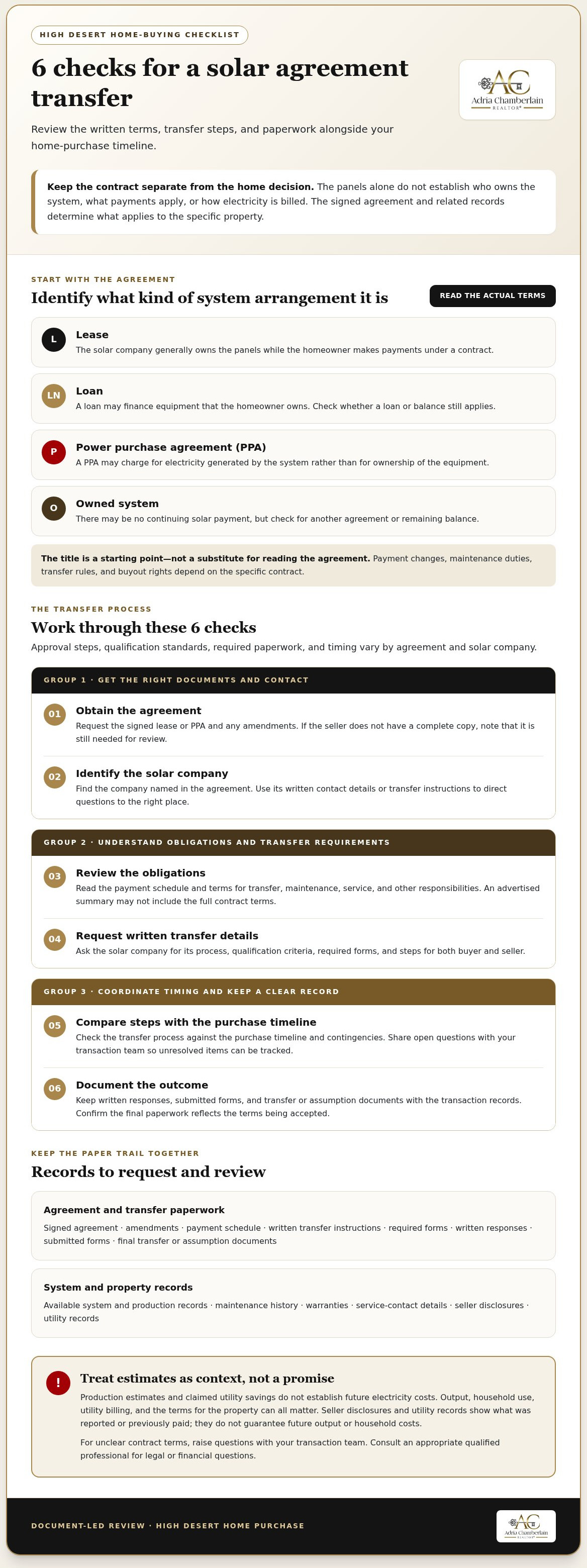
Start with the agreement’s title and parties. A loan may finance equipment the homeowner owns, while a lease may leave ownership with the solar company. A power purchase agreement, or PPA, may charge for electricity generated by the system rather than for ownership of the equipment. An owned system may have no continuing solar payment, but check whether another agreement or balance applies.
Don’t assume every contract has the same payment increases, maintenance responsibilities, transfer conditions, or buyout rights. Read the executed agreement and related records to identify the terms for this system. The title is a useful starting point, not a substitute for reviewing the obligations.
Why the agreement matters in Apple Valley, Victorville, and Hesperia
A home’s location in Apple Valley, Victorville, Hesperia, or another High Desert community doesn’t determine its utility charges, solar production, or transfer requirements. Compare the agreement and seller-provided information with system records and your plans for the home. A household that uses electricity differently from the seller may have different utility costs.
Keep the decision grounded in three steps: understand the written obligations, compare the documented options for this property, and decide whether to proceed. Raise unclear terms with your transaction team. For legal or financial questions, consult an appropriate qualified professional. This approach keeps the agreement in view without treating projected benefits as guaranteed results.
How a Solar Lease Transfer Works During a High Desert Home Purchase
A solar transfer can involve several people and documents. Start early enough to compare the written process with your purchase timeline and contingencies. A contingency is a condition in the purchase agreement that must be met for the transaction to move forward as planned. Transfer approval, buyer qualification standards, required paperwork, and timing vary by agreement and solar company. The executed agreement and written transfer terms are the starting point for reviewing a solar lease transfer.
For High Desert buyers considering a home with leased solar, a clear sequence helps surface unanswered questions before they become last-minute issues.
- Obtain the agreement. Request the signed lease or power purchase agreement and any amendments. If the seller doesn’t have a complete copy, note that it’s still needed for review.
- Identify the lessor. Find the company named in the agreement. Use the written contact details or transfer instructions to direct questions to the right place.
- Review the obligations. Read the payment schedule and terms for transfer, maintenance, service, and other responsibilities. An advertised summary may not include the full contract terms.
- Request transfer details. Ask the lessor for its written process, qualification criteria, required forms, and steps for the buyer and seller.
- Coordinate the timing. Compare those steps with the purchase timeline and contingencies. Share open questions with your transaction team so they can track what remains unresolved.
- Document the outcome. Keep written responses, submitted forms, and transfer or assumption documents with the transaction records. Confirm the final paperwork reflects the terms being accepted.
Documents to request before making a decision
Along with the signed agreement, request amendments, the payment schedule, and written transfer instructions. Available system and production records, maintenance history, warranties, and service-contact details can provide context about the equipment. Review seller disclosures and utility records separately. They may show what the seller reported or previously paid, but don’t guarantee future output or household costs. SEIA’s Solar Consumer Protection resources offer additional background on solar consumer considerations.
Who coordinates the transfer before closing?
The buyer’s and seller’s representatives can help organize document requests and communication among the parties, escrow, and solar company. They can track outstanding written answers or forms, while the lessor handles its own process and qualified professionals provide advice in their areas. Discuss any possible effect on mortgage qualification directly with your lender, who can explain how the agreement may factor into its financing review.
If you’re considering a property while gathering these details, talk with Adria about your High Desert home search. Buyer representation can help organize property questions and transaction communication as you review the documented terms.
Assume the Solar Lease, Request a Buyout, or Reconsider the Home?
There isn’t one right answer for every buyer. Compare the options using the property’s written terms, your plans, and the purchase timeline. A seller buyout or contract termination isn’t automatically available. The agreement must allow the proposed path, and the terms should be confirmed in writing. Rather than relying on projected savings or panel value, compare documented costs and responsibilities. Consult your lender or other qualified advisers where appropriate.
| Option | Payment duties and approvals | Maintenance and timing | Buyer comfort |
|---|---|---|---|
| Assume the agreement | Review the payment schedule, remaining term, and written transfer conditions. Approval or buyer qualification may be required, depending on the agreement and lessor. | Confirm which maintenance duties apply. Compare transfer steps with the purchase timeline. | May suit a buyer comfortable with the documented obligations and process. |
| Seller buyout, if available | Get written buyout terms and confirm how the seller and buyer will handle them. Availability depends on the contract. | Clarify what happens to the agreement and equipment responsibilities after the documented transaction. | May be worth discussing if assuming ongoing payments isn’t a fit, provided the option is permitted and agreed. |
| Continue the search | No transfer of this property’s solar agreement, but any costs or obligations tied to another home must be reviewed separately. | There’s no transfer process for this property to coordinate; a different purchase has its own timeline and documents. | Can be reasonable if material terms remain unresolved or the available paths don’t fit your plans. |
When assuming the agreement may fit
Assumption may be worth considering if you understand the full payment schedule, remaining term, and conditions that would apply after transfer. Make sure the written process fits the purchase timeline, while recognizing that an application or approval may not be routine. Review available system records alongside your plans for the home, but don’t treat past production or the seller’s experience as a promise of future utility savings.
For buyers buying a home with solar lease transfer High Desert, confidence comes from understanding what the contract requires, not from broad expectations about solar. A lender can explain financing questions, while a qualified legal or tax professional can address questions in their area.
When a buyout or another property may deserve consideration
If you’re considering a buyout, get the contract-specific terms in writing and make sure the seller and buyer agree on how it would be handled. Identify unresolved fees, transfer conditions, or system responsibilities before making a commitment. If material obligations remain unclear after appropriate review, pausing or reconsidering the property may feel more comfortable than proceeding on assumptions.
Tax-credit references shouldn’t be mistaken for lease-transfer terms. The U.S. Department of the Treasury’s information on the 45L credit concerns qualifying new energy-efficient homes. It doesn’t establish whether this solar contract can be bought out, transferred, or terminated.
High Desert Solar Lease Due Diligence Before You Make an Offer
Before making an offer, separate the solar contract from other parts of the property review. The lease or power purchase agreement explains contractual obligations. It doesn’t establish the roof’s condition, the equipment’s current condition, future utility bills, or what a home inspection may find. Review each separately. For buyers buying a home with solar lease transfer High Desert, a property-specific checklist can keep these questions organized, whether the home is in Apple Valley, Victorville, Hesperia, or another High Desert community.
Use the checklist to distinguish what’s documented from what still needs an answer. A seller’s summary or verbal assurance can provide context, but it isn’t a substitute for written terms and records.
- Agreement: Obtain the complete executed lease or power purchase agreement, amendments, payment details, and any documents describing the current agreement holder.
- Transfer: Request the written transfer process, conditions, buyer requirements, and any response or submission steps from the solar company.
- System history: Gather available production records, service and repair history, warranty information, and service-contact details. Check what the documents say about coverage rather than assuming a warranty applies to every issue or future owner.
- Utility information: Review available utility records as historical information. Bills reflect past use and circumstances, not a guarantee of future charges or savings.
- Transaction planning: Note which answers or documents are outstanding and compare the steps for addressing them with the purchase timeline and any relevant contingencies.
Broader purchase preparation matters, too. Buyers planning a transaction can review Adria’s First Time Home Buyer Apple Valley CA guide alongside this solar-specific review.
Questions to resolve with the seller and solar company
Ask who currently holds the agreement, what steps a transfer involves, and which payments or other obligations would remain. Request written answers about the transfer process and any proposed changes. If the seller mentions a buyout, revised terms, or another arrangement, get the applicable terms in writing and understand how the change will be documented before relying on it.
Also request available service, warranty, production, and repair records. The records may vary, so distinguish documented history from assumptions about future system performance or coverage.
Coordinate contract, lender, escrow, and property review
Share relevant documents and open questions with your real estate and escrow professionals so they can help track transaction details and contingencies. Ask your lender directly how the documented solar agreement factors into its loan review. Solar paperwork doesn’t replace a separate review of the roof, system condition, utility billing, or inspection findings. For legal, tax, or financial questions, consult a qualified professional in that area.
Adria can help organize property questions and transaction communication as you assess a High Desert purchase. Discuss your home search with Adria when you’re ready for buyer guidance.
Make a Confident Decision with a High Desert Buyer Advocate
A leased solar system doesn’t have to decide the purchase for you, but it deserves a careful, document-led review. First, understand the written terms. Then compare the transfer and other documented options. Bring questions to the right specialists, including your lender for financing questions. Once you understand the obligations and how they fit your plans, you can decide whether to proceed, pause, or focus on another property.
That sequence can be especially helpful when buying a home with solar lease transfer High Desert. The right decision depends on the specific property and agreement, not just the presence of panels. Adria’s buyer representation can help organize property questions and transaction communication among the buyer, seller, escrow, lender, and solar company. Legal, tax, and financial questions belong with qualified professionals in those fields.
A practical go, pause, or walk-away framework
Proceed when you understand the written payment duties and other applicable obligations, and the documented transfer path fits your circumstances and the purchase process. Pause if key documents, payment responsibilities, transfer conditions, or written answers remain unresolved. Use that time to identify what needs clarification and who can address it. Consider another property if you’re uncomfortable with obligations you can’t change or accept after appropriate review.
This isn’t about finding a guaranteed financial outcome. It’s about making a decision with a clear view of the agreement and your choices. If solar is only one part of a wider home search, compare properties on their own merits, including condition, location, and fit for your needs. Buyers considering homes in the area can use Adria’s Hesperia residential property listings buyer guide as another resource for evaluating options.
Get local guidance for your home search
Adria serves buyers in Apple Valley, Victorville, Hesperia, and surrounding High Desert communities. For a useful discussion, bring the property details and any solar paperwork you have, such as the agreement, payment schedule, transfer instructions, or written answers from the solar company. Having those materials together can help focus your questions and identify what still needs attention during the transaction.
Whether you’re weighing one home or comparing several, you don’t have to sort through property questions alone. Discuss your High Desert home search with Adria for buyer guidance tailored to the home you’re considering.
Move Forward with Clarity on Your High Desert Purchase
A solar agreement doesn’t have to define your entire home search, but your comfort with its written terms should inform your next move. If you’re buying a home with solar lease transfer High Desert, decide what you need resolved before committing and keep your questions organized as the transaction progresses. A clear decision helps you focus on whether the home fits your plans, not just whether its panels look appealing.
Adria Chamberlain is a licensed REALTOR® affiliated with Adria Chamberlain | Keller Williams High Desert, DRE 02032478. Her buyer representation serves High Desert communities including Apple Valley, Victorville, and Hesperia. She can help organize property questions and communication as you consider a specific home. For legal, tax, or financial advice, consult a qualified professional in that field.
Bring the property details and any solar paperwork you have to a conversation about your options. Discuss your High Desert home search with Adria, and take your next step with a clearer sense of what matters to you.
Frequently Asked Questions
Can I buy a house if the solar panels are leased?
Yes, a home with leased panels can be purchased, but the solar agreement needs its own review as part of the transaction. The seller’s documents should clarify which agreement is in place and what transfer paths may be available. If the lessor requires an application from the incoming buyer, for example, that step may affect your decision. Don’t assume the panels automatically become yours or that the lease automatically transfers with the home.
What happens if I do not want to take over the solar lease?
You can discuss alternatives with the seller, but the options depend on the written agreement and what the parties are willing and able to arrange. A seller buyout or contract termination isn’t automatic. Request the lessor’s written terms for any proposed alternative and make sure the purchase documents reflect the agreed plan. If no workable option is documented and you’re uncomfortable with the lease, consider whether to continue pursuing the property.
How does a solar lease transfer work when buying a home?
The buyer and seller generally need to follow the transfer process set out by the solar company and the specific agreement. That may involve providing information, completing forms, and receiving written confirmation of the resulting arrangement. Before relying on a transfer, clarify whose name will appear on the account, when responsibility is intended to change, and what records confirm completion. For buying a home with solar lease transfer High Desert, keep those details aligned with the purchase documents.
Is a leased solar system a problem when selling or buying a home?
Not necessarily. It can add paperwork and coordination, but the effect depends on the agreement, available transfer options, and how clearly the parties document their plan. In Apple Valley, Hesperia, Victorville, Adelanto, Oak Hills, Helendale, Barstow, Phelan, Pinon Hills, and Lucerne Valley, review each property’s contract rather than assuming the same terms apply throughout the High Desert. Unresolved responsibilities are a reason to ask more questions, not to assume an outcome.
Can a seller pay off a solar lease before closing?
Possibly, if the contract provides a buyout option and the seller chooses to pursue it. The seller should obtain current written terms from the solar company and clarify how the payment and any related agreement changes will be documented in the sale. Don’t rely on a verbal promise or general estimate. The buyer’s and seller’s transaction professionals can help keep the proposed arrangement visible in the purchase paperwork.
How much will I pay for a home's leased solar system?
There isn’t one amount that applies to every home. Your potential payment depends on the agreement’s terms, including its payment schedule and any conditions that apply after a transfer. Request the current written schedule and distinguish solar-contract payments from utility charges, which are separate. If a proposed payment or obligation is unclear, ask the lessor to explain it in writing before using it to assess your household budget.
Will a solar lease transfer delay closing?
It might affect the transaction timeline if required information, a decision, or written paperwork remains outstanding, but a delay isn’t certain. The process and timing depend on the contract, the lessor, and how the transfer fits alongside the rest of the purchase. Tell your real estate and escrow professionals about unresolved solar steps early, and discuss financing questions directly with your lender. Don’t assume transfer approval or documentation will be completed by a particular date.
What solar documents should I review before making an offer?
Start with the signed lease or power purchase agreement, all amendments, the payment schedule, and any available written transfer instructions. Also request records that may explain the system’s history, such as production, service, repair, or warranty documents. Seller disclosures and utility bills can offer additional context, but they don’t guarantee future costs or equipment performance. Keep missing records on your question list so you can decide what needs clarification before proceeding.


