

If you’re researching how to sell a home during divorce High Desert CA, the first step may not be setting a price. It’s clarifying which decisions need legal direction and which belong to the real estate plan. You may have questions about when a listing can move forward, how to discuss sale terms, and where you’ll live next. A clear process can make those decisions easier to organize.
A real estate agent can help with the transaction, including a Comparative Market Analysis (CMA) to inform an asking-price discussion. Your attorney can guide you on divorce-related rights and decisions. Neither role replaces the other, so keep legal, tax, and financial questions with the appropriate qualified professionals.
This article covers the main options for the home, steps involved in preparing and listing it, and ways to keep communication focused on practical next steps. Local context matters across Apple Valley, Victorville, Hesperia, Adelanto, Oak Hills, Helendale, Barstow, Phelan, Pinon Hills, and Lucerne Valley, where relevant comparable properties and buyer activity can differ by area.
Key Takeaways
- For how to sell a home during divorce High Desert CA, clarify who has authority to proceed before making listing decisions.
- Compare selling, having one spouse keep the home, or postponing a decision by considering agreement, financing, timing, expenses, and professional advice.
- Organize the sale into manageable steps, from agreeing on logistics and preparing the property to reviewing offers.
- Use a localized valuation to support an asking-price discussion, while remembering that it doesn’t guarantee a sale price.
- Adria Chamberlain provides High Desert listing and valuation support to help organize the real estate process while qualified advisers address legal, tax, and financial questions.
Selling a Home During Divorce in the High Desert: Start With the Right Questions
A home sale can add a long list of practical decisions to an already emotional transition. Before discussing a listing date, asking price, or moving plans, clarify who can authorize next steps and what each person understands has been agreed to. This article offers real estate education, not legal, tax, or financial advice. Ownership, court orders or agreements, and financing arrangements may affect the sale plan, so treat them as questions to resolve rather than assumptions.
That distinction is central to how to sell a home during divorce High Desert CA. A real estate professional can help organize property-related tasks and discuss a valuation, but can’t determine ownership rights or interpret a court order. Bring legal questions to a qualified family law attorney, and seek tax or financial advice from the appropriate professional.
What should you clarify before discussing a home sale?
Start by gathering information, not making commitments. Review available ownership paperwork and written agreements or court documents, then ask your attorney how they affect the proposed next steps. A preparation list can include:
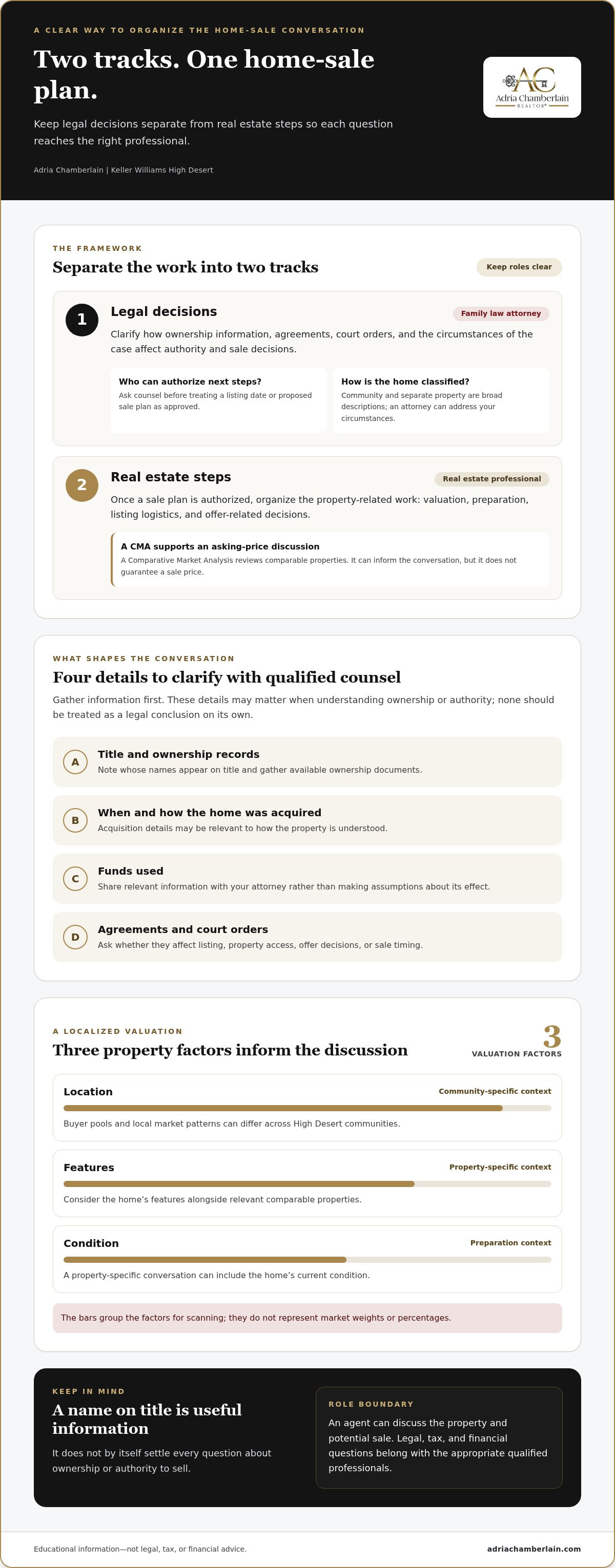
- Title and ownership records: Note whose names appear on title and collect available ownership documents. The names are important information, but may not answer every legal question about the home.
- Orders and agreements: Ask your family law attorney whether existing orders or agreements affect listing, property access, decisions about offers, or the timing of a sale.
- Housing expenses: List ongoing costs tied to the home, such as mortgage payments, utilities, insurance, and maintenance. Discuss how each expense will be handled while the home is occupied or being prepared for sale.
- Financing details: Gather relevant loan information and flag financing questions, especially if keeping the home is under consideration. An agent can help identify sale-related questions, while financing advice belongs with a qualified professional.
Write down unanswered questions before meeting with your attorney or discussing a listing. This helps separate matters that need legal direction from choices about preparing and selling the property.
How does the High Desert location shape the real estate plan?
Local context matters. A home in Apple Valley may attract a different buyer pool than a property in Victorville or Hesperia, and nearby communities can have their own market patterns. Broad regional impressions can provide context, but they don’t establish what a particular home may attract in the current market.
For general background, California is a community property state, but that overview isn’t a substitute for guidance about your circumstances. For the real estate side, a property-specific valuation discussion can consider location, features, condition, and relevant local market information. A Comparative Market Analysis, or CMA, reviews comparable properties to inform an asking-price conversation. It can support a shared discussion without guaranteeing a sale price.
Before setting a timeline, bring ownership and expense questions to the appropriate advisers and identify what both parties can agree on. With those basics clearer, the real estate plan can focus on practical steps for the specific home and community.
California Divorce and a Home Sale: Separate Legal Decisions From Sale Steps
A home sale involves two connected but different tracks. The legal track concerns how the property is classified, who has authority to make decisions, and how its value or proceeds may be handled in the divorce. The practical track covers assessing the home, preparing it for listing, setting logistics, and responding to offers. Keeping these tracks clear helps prevent a real estate conversation from being mistaken for a legal agreement.
What do community property and separate property mean?
In plain terms, community property generally refers to property acquired during marriage, while separate property generally refers to property belonging to one spouse under applicable rules. These are broad descriptions, not a way to classify your home from a distance. Title, when and how the home was acquired, the funds used, and other circumstances may matter. Review the California Courts Self-Help Guide to property and debt for general information, then ask a family law attorney about your situation.
A name on title is useful information, but it doesn’t by itself settle every question about ownership or authority to sell. An agent can discuss the property and its potential sale, but can’t decide whether it is community or separate property, interpret an agreement, or determine what a court order allows. Ask counsel to explain those issues before treating a proposed listing date or sale plan as approved.
Who can decide whether and when the home is sold?
That depends on the relevant ownership information, agreements, court orders, and circumstances of the case. Don’t assume that one spouse can act alone, or that both spouses must follow the same steps in every situation. Have an attorney clarify what authority applies before taking action. Once a sale plan is authorized, a real estate professional can help organize valuation, preparation, listing, and offer-related decisions.
It can help to keep the work in two columns:
- Legal and financial questions: Who may authorize the sale? What do existing orders or agreements require? How might the property or proceeds be addressed in the divorce? Which tax questions need professional advice?
- Real estate tasks: What information is needed to assess value? What preparation is practical? How will access, communication, and offer discussions be coordinated?
For tax questions, the IRS’s guidance on selling a home during divorce can offer general background, but it doesn’t replace advice about your filing situation. To plan how to sell a home during divorce High Desert CA, get legal direction on authority first, then use a defined real estate plan to handle the property. Adria can help organize the real estate side through a home-sale valuation discussion, while qualified advisers address legal and tax decisions.
Selling or Keeping the Home: Compare the Practical Paths Without Guesswork
There isn’t one path that fits every divorcing household. Selling, having one spouse explore keeping the home, or postponing a decision can each be a discussion scenario. Compare the practical questions: what’s authorized, what each person needs next, and whether the costs and timing are workable. If you disagree, clear legal and financial guidance becomes more important. The table below is a planning aid, not a recommendation or a way to determine either spouse’s rights.
| Factor | Selling the home | One spouse keeping it | Postponing a decision |
|---|---|---|---|
| Agreement | Can the parties agree on a sale plan and its terms? | Is there agreement to explore a transfer or buyout? | What decision, if any, is agreed to for now? |
| Financing | What loan details need review as part of a possible sale? | Can the proposed plan be assessed with a qualified lending or financial professional? | How will existing housing costs be handled while the decision is delayed? |
| Timing | How might preparation, listing, and a move fit each person’s plans? | What steps and timing would the proposed arrangement involve? | When should the parties revisit the question? |
| Expenses | How will mortgage, upkeep, insurance, and other costs be addressed? | Can the person staying plan for ongoing expenses? | How will shared costs be tracked and managed? |
| Professional input | What legal, tax, and real estate guidance is needed? | Which advisers can address legal, financing, and tax questions? | What guidance can help clarify the options before deciding? |
When might selling the home be a practical option?
A sale may be worth discussing if it fits the parties’ authorized plans and helps each person move toward their next housing arrangement. Consider the whole process, not just a possible sale price. Mortgage payments, insurance, upkeep, preparation needs, and moving logistics can all affect planning. Any estimate of proceeds depends on property-specific and transaction-specific factors, including the eventual sale terms and costs. A real estate valuation can inform discussion, but it isn’t a promise of what the home will sell for.
What should be considered if one spouse wants to keep the home?
Keeping the property may sound straightforward, but a proposed buyout isn’t the same as a completed transfer or refinance. The parties may need advice about financing, affordability, title, and any agreement required for their circumstances. A real estate professional can discuss property value; an attorney and qualified financial or lending professionals can address legal and financing questions. A buyout isn’t necessarily available or suitable in every case.
If conversations are stuck, don’t treat silence or disagreement as permission to move ahead. Ask counsel to clarify the next decision that can be made, then focus the real estate discussion on that defined step. This keeps the options visible without assuming a particular outcome.
A Practical High Desert Home-Sale Plan From Preparation to Closing
Once the legal authority to proceed is clear, a simple sequence can keep the real estate work organized. Each spouse may have separate housing plans and schedules, so agree on how decisions and updates will be handled before the listing process gets busy. An agent can coordinate property-related steps without interpreting court orders or deciding what either party is entitled to.
- Clarify authority. Follow your attorney’s direction about whether and how the property may be listed. Share relevant written instructions with the real estate professional as appropriate, but leave questions about their meaning to counsel.
- Assess the property’s value. Discuss a current Comparative Market Analysis (CMA), which reviews relevant comparable properties to inform an asking-price conversation. Adria can prepare a property-specific valuation discussion, but it isn’t a guarantee of the eventual sale price. For more background on the valuation process, see professional home valuation in Victorville.
- Agree on logistics. Set practical expectations for access, showing requests, communication, upkeep, and how time-sensitive questions will be shared. Written arrangements can reduce confusion, while legal questions about what an agreement requires belong with your attorney.
- Prepare and list. Gather property details, known repair information, and relevant sale documents. Discuss which preparation tasks make sense, then review the listing information and proposed plan before the home is placed on the market.
- Review offers and move toward closing. Consider the full offer terms, not only the proposed price. Coordinate decisions with the appropriate advisers and track documents and agreed transaction milestones.
How do you prepare the property and set a listing plan?
Start with a shared record of the home’s features, updates, known repair needs, and details that may help answer buyer questions. Decide how each person will receive updates and who can arrange access for showings. If one spouse still lives in the home, discuss practical routines for keeping it accessible and cared for during the listing period. A clear plan can make day-to-day coordination less stressful.
Set a price discussion around the specific property and current market information, not a broad estimate for the High Desert. A CMA can help frame the asking-price conversation, while the final decision should follow any applicable legal direction or agreement.
How should spouses handle offers and closing logistics?
An offer includes more than price. It may also contain proposed timing, contingencies, and other terms. The agent can explain these real estate terms in plain language and help organize questions, but legal decisions and interpretation of agreements or orders should remain with the parties and their counsel.
Choose a practical method for sharing offer updates and documents, and note the milestones the parties have agreed to track. An organized, responsive process can help keep the transaction moving, though no sale price or closing date can be promised. For a property-specific valuation and help organizing the real estate steps, discuss a home-sale plan with Adria.
Work With a High Desert REALTOR® for Steady, Neutral Sale Guidance
A divorce-related sale can involve many small real estate decisions, from arranging access to reviewing an offer’s terms. A REALTOR® can organize those transaction details and keep the property sale process distinct from decisions about the divorce itself. Adria Chamberlain has served High Desert and Inland Empire communities since 2017, supporting homeowners with residential listings and home valuation discussions.
If you’re considering how to sell a home during divorce High Desert CA, it helps to know what an agent can handle and where other professional advice is needed. Adria provides real estate guidance. Legal questions about ownership, agreements, or property division belong with a qualified attorney, and tax questions should go to a qualified tax professional.
What can a local real estate agent help organize?
Adria can help with the property-focused work of a sale: discussing a Comparative Market Analysis, planning listing preparation, presenting offers, and coordinating transaction steps. A CMA uses relevant property information to inform an asking-price discussion; it doesn’t promise a particular sale price. Once the sale plan is authorized, a clear list of responsibilities and agreed instructions can help both parties understand what needs attention.
For example, spouses may agree on a practical method for receiving showing requests, sharing updates, and reviewing offer information. The agent can explain real estate terms and keep transaction details organized, while leaving legal interpretations and decisions to the parties and their advisers. This is real estate support, not mediation or a promise that disagreements will be resolved.
What are useful next steps for High Desert homeowners?
Before a sale-planning conversation, gather information that will make it more focused. Note what you know about the property, your questions, and which issues need an attorney’s guidance. Include the home’s community, since local context helps make a valuation discussion more relevant. Comparable-property research for a home in Apple Valley may differ from research for a home in Victorville, Hesperia, Adelanto, Oak Hills, Helendale, Barstow, Phelan, Pinon Hills, or Lucerne Valley.
- For the attorney: Write down questions about authority to sell, existing agreements or orders, and decisions that need legal guidance.
- For the REALTOR®: Gather property details, known repair information, and questions about valuation, preparation, listing logistics, and offers.
- For both conversations: Identify your preferred communication method and timing considerations that may affect planning.
You don’t need every answer before asking for real estate guidance. A focused conversation can clarify the property-related steps and information still needed to plan them. If you’re preparing to discuss a sale in Apple Valley, Victorville, Hesperia, Barstow, or a nearby community, contact Adria for personalized home-selling guidance. You can discuss the property and possible timeline without pressure to decide before you’re ready.
Take the Next Step at Your Own Pace
A thoughtful plan can begin with one manageable conversation, not a final decision. If you’re considering how to sell a home during divorce High Desert CA, bring the questions you’ve gathered and the property details you have available. That gives you a practical starting point for discussing the real estate side while you continue to rely on qualified professionals for legal, tax, and financial guidance.
Adria Chamberlain is a licensed REALTOR® with DRE 02032478. She can help you discuss the property, a valuation, and a possible sale timeline in a grounded, straightforward way. You don’t need every detail settled before asking what the next real estate step could look like.
Talk with Adria about a High Desert home sale when you’re ready to explore your options. With clear information and practical guidance, you can approach the next step with greater confidence.
Frequently Asked Questions
Can one spouse sell a house during divorce without the other spouse’s agreement?
That depends on the property, applicable court orders or agreements, and the circumstances of the case. Before signing anything, ask the attorney handling the divorce to explain what actions are authorized and whether conditions apply. It may help to request clear written guidance about the specific step being considered, such as signing a listing agreement or responding to an offer. A real estate agent can then help organize authorized transaction tasks.
Does a judge have to approve the sale of a home during a California divorce?
The answer depends on the case, and approval of property division doesn’t automatically answer every question about a particular sale. The California Courts Self-Help Guide explains the court’s role in property and debt division. Before scheduling transaction milestones, ask an attorney whether the proposed sale is connected to a pending division decision and whether any court-related step needs to happen first.
What happens if spouses disagree about the asking price?
Identify what’s driving the difference before debating a number. One person may be relying on a nearby sale, while the other is considering the home’s condition or likely buyer response. Write down the assumptions behind each view and agree on what information would help assess them. It can also help to distinguish the asking price from the amount either party may ultimately receive, which depends on transaction details.
Can one spouse keep the house instead of selling it?
It may be an option to explore, but a proposed buyout doesn’t by itself complete a transfer or change loan responsibilities. The spouse considering keeping the home can ask the lender to explain what loan options may apply and whether the other borrower would remain responsible under a proposed arrangement. An attorney can address the legal terms, while qualified financial professionals can help assess affordability before either spouse relies on the proposal.
What should happen if the mortgage balance is close to or higher than the home’s value?
Request current payoff information from the lender rather than relying only on the principal balance shown on a monthly statement. The amount needed to pay off a loan may differ. Compare that figure with a property-specific valuation and ask qualified advisers how the resulting estimate should affect planning. Keep the documents together, including the date of the payoff information, so everyone is discussing figures from the same point in time.
Does moving out affect ownership of the home during divorce?
Moving out alone doesn’t determine ownership, but it can create practical details to manage. Keep a record of when the move occurred, where property-related notices should be sent, and who is handling utilities or access. Save receipts for home expenses and share the information with your attorney. The California Courts Self-Help Guide offers general information about property classification, while an attorney can address how the facts and any existing orders apply.
How can spouses approach a listing price for a High Desert home during divorce?
For how to sell a home during divorce High Desert CA, agree on a process for discussing the proposed price, not just a number. Decide what information each person will review, how questions will be collected, and when the discussion will be revisited if new market feedback comes in. A written record of the reasoning can help keep later conversations focused, while any legal disagreement about the decision belongs with counsel.


