

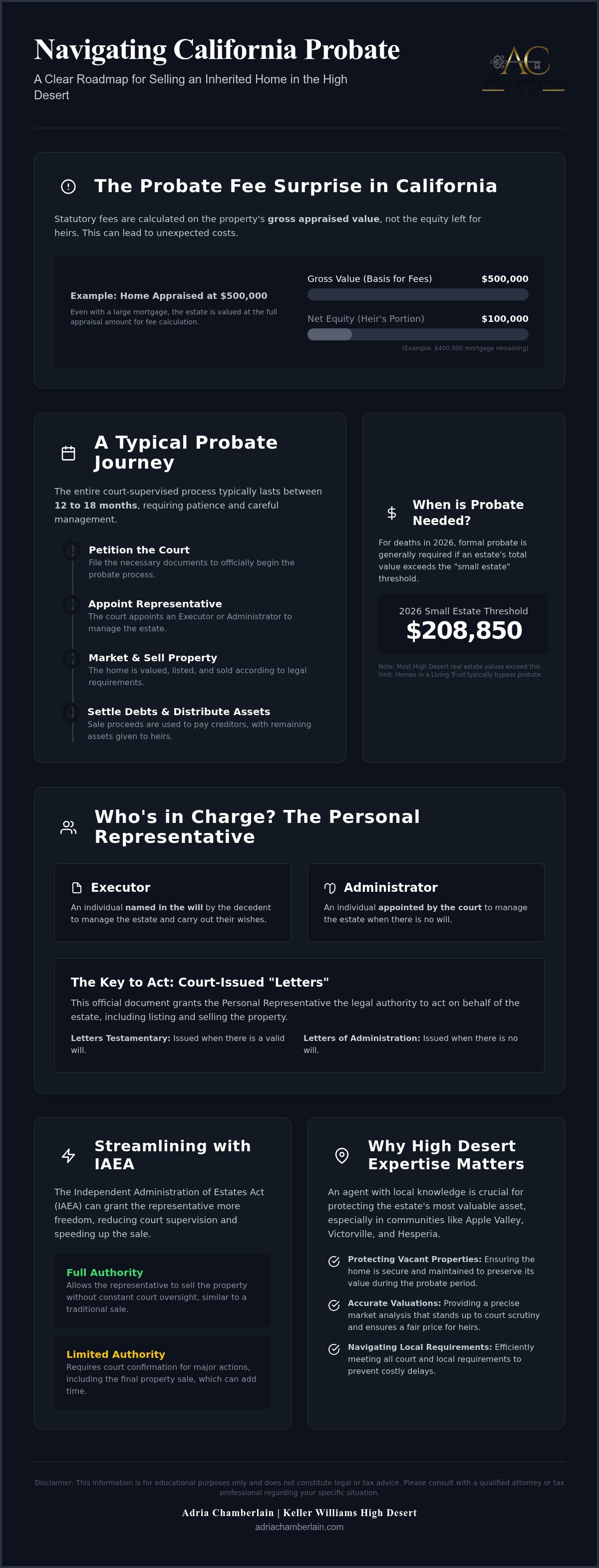
Did you know that in California, the statutory fees for settling an estate are calculated based on the gross value of the property, regardless of how much is still owed on the mortgage? This means a house appraised at $500,000 is treated as a $500,000 asset even if there is very little equity left for the heirs. When you are already dealing with the weight of grief, these financial surprises and the complex probate home sale process in California can feel like an impossible puzzle to solve.
I understand how stressful it is to balance your emotional loss with the fear of making a legal or financial mistake. You want to honor your loved one's legacy, but the terminology around court confirmation and administrator authority often feels like a different language. I want to help you replace that confusion with confidence. This guide provides a clear roadmap to help you navigate these requirements with ease. I will walk you through the typical 12 to 18 month timeline, explain the 2026 small estate thresholds, and help you determine how to move forward with your High Desert property.
Please note that while I am an experienced real estate professional, I do not provide legal or tax advice. You should always consult with a qualified attorney or tax professional regarding your specific situation.
Key Takeaways
- Understand how the court-supervised probate home sale process in California works and why real estate is often the most vital asset in an estate.
- Learn the difference between executors and administrators and how court-issued "Letters" authorize the sale of inherited property.
- Discover how the Independent Administration of Estates Act (IAEA) can streamline the transaction by reducing the need for constant court supervision.
- Follow a clear step-by-step roadmap for securing a High Desert home and getting an accurate valuation to ensure a smooth transition.
- Find out how localized expertise in communities like Apple Valley and Victorville helps protect vacant properties and meet court requirements.
What is the Probate Home Sale Process in California?
The probate home sale process California requires is a court-supervised path to settling an estate. At its core, What is the Probate Process is the legal method for validating a will, paying off debts, and ensuring assets reach the right people. Since a house is frequently the most significant asset involved, the sale of that property becomes a central part of the legal proceedings.
Many people assume that if a loved one left a will, they can avoid the courtroom. However, a will actually serves as a roadmap for the court rather than a way to bypass it. You must still lodge the will with the county and petition for a personal representative to be appointed. I provide this information to help you understand the framework, but please remember this is educational and not legal advice. Always consult with a probate attorney for your specific legal needs.
When is Probate Necessary for a California Home?
For deaths occurring in 2026, California sets a "small estate" threshold of $208,850. If the total value of the assets is below this amount, you might qualify for a simplified transfer. The reality for most homeowners in our area is that real estate values almost always exceed this limit. A primary residence worth up to $750,000 might qualify for a simplified petition, but most traditional sales will require formal probate oversight to legally transfer the title.
It's also vital to know if the property is a probate asset or a trust asset. If the home was held in a Living Trust, it generally bypasses the court entirely. If it was owned individually, the court must step in to clear the title. Even smaller pieces of real property that aren't a primary residence usually require a formal process or an affidavit if they are worth more than $69,625.
The Emotional and Financial Significance of the Sale
Managing the sale of an inherited home is often the most difficult task an executor faces. It's a deeply personal process that happens during a time of significant grief. I have seen how the weight of these decisions can feel overwhelming for families in Apple Valley and Victorville who are trying to do the right thing for their loved ones.
Financially, the sale is often the only way to create the cash needed to settle the estate's obligations. This includes paying for the final expenses of your loved one, settling with creditors, and eventually distributing the inheritance to family members. To keep this process moving smoothly and avoid costly delays, many families choose to partner with a probate real estate agent High Desert specialist. I act as a dedicated advocate to ensure the property is handled with the respect and professional care it deserves.
The Legal Framework: Executors, Administrators, and the Court
Once you begin the probate home sale process California requires, the court must officially designate a leader for the estate. This individual is known as the Personal Representative. It's a role built on a high level of responsibility called fiduciary duty. This means the representative must always act in the best interest of the beneficiaries, putting those needs ahead of any personal gain. If you find yourself in this position, I can help you understand the real estate requirements while your attorney handles the legal filings.
To give the Personal Representative the power to sell a home, the court issues a document called "Letters." If there is a will, these are called Letters Testamentary. If there isn't a will, they are called Letters of Administration. These documents are essentially your authorization to sign listing agreements and closing papers. You can find more detailed information about these legal steps on the official website for California's probate process.
Executor vs. Administrator: What is the Difference?
While the titles sound different, their duties regarding the home sale are nearly identical. An Executor is someone specifically named in a will to carry out the decedent's wishes. An Administrator is someone the court appoints when there is no will, or if the named executor cannot serve. Whether you are an executor in Apple Valley or an administrator in Hesperia, your goal is the same: to protect the home's value and ensure a fair sale for the heirs. Both roles have the same legal authority to move forward with the probate home sale process California mandates once they receive their court-issued Letters.
The Role of the Probate Referee
In California, you don't just pick a listing price based on a neighbor's opinion or a quick online estimate. The court appoints a Probate Referee to perform an official appraisal. This referee is an independent officer who values all non-cash assets, including the house. They charge a fee of 0.1% of the asset's value, which is part of the standard costs of the estate. This valuation is recorded on a form called the Inventory and Appraisal, which must be filed with the court.
This number is critical because of the "90% rule." Generally, the home must sell for at least 90% of the value set by the Probate Referee within one year of the appraisal. If the market shifts, we may need to request a reappraisal for sale purposes to ensure the price reflects current conditions. If you are feeling uncertain about how your property might be valued in today's market, you can reach out to me for a local market consultation to see how current High Desert trends compare to court expectations.
Full vs. Limited Authority: Understanding the IAEA
One of the most important factors in the probate home sale process California representatives face is the level of authority granted by the court. This authority is governed by the Independent Administration of Estates Act, commonly known as the IAEA. This act was created to streamline the settling of estates by allowing executors or administrators to take certain actions without having to get a judge's approval for every single step. When I work with families in the High Desert, I start by reviewing the Letters to see if they have "Full" or "Limited" authority, as this completely changes our marketing strategy and timeline.
The level of authority you are granted usually depends on what the will says or if any heirs object to the petition. You can find more details on how these levels are determined in the California Courts Self-Help Guide to probate. Regardless of the authority level, the goal of the IAEA is to balance efficiency with protection for the beneficiaries. I help my clients navigate these specific requirements so they don't have to worry about missing a legal deadline or procedure.
Full Authority Under the IAEA
If you have full authority, the probate home sale process California requires is much more similar to a traditional real estate transaction. You have the power to list the home, accept an offer, and close the sale without a court hearing. However, there is still a vital step called the Notice of Proposed Action, or NOPA. Once we have an accepted offer, your attorney sends this notice to all interested parties, giving them 15 days to object to the sale terms. If no one objects within that window, we can proceed to close. This route is generally much faster and allows for more flexibility with buyer contingencies and timelines.
Limited Authority and Court Confirmation
Limited authority is a more restrictive path that requires a process known as court confirmation. This means that even after we accept an offer, the sale isn't final until a judge approves it at a public hearing. During this hearing, the property is subject to the "overbid process." This is essentially a mini-auction in the courtroom where other buyers can show up and try to outbid the original buyer. For these types of sales, the original buyer must typically provide a 10% deposit, and the sale price must meet the 90% appraisal rule established by the Probate Referee. I make sure my clients are prepared for the unique rhythm of these hearings and help manage the expectations of all parties involved.
Step-by-Step: Selling a Probate Home in the High Desert
After you receive your court-issued Letters, the practical phase of the probate home sale process California requires begins in earnest. This is where the legal framework meets the local real estate market. The first and most critical task is to secure the property. In our High Desert climate, a vacant home in Apple Valley or Hesperia can quickly suffer from weather-related issues or unwanted attention if not monitored. Once the home is safe, I recommend performing a preliminary home valuation Victorville CA to establish a baseline for the estate.
Next, I work closely with your probate attorney to ensure every real estate decision aligns with court requirements. I then move into the marketing phase, where specialized disclosures and the correct purchase agreements are essential to protecting the estate. I guide you through the negotiation process, ensuring that the offer you accept meets the specific legal standards required for your level of authority.
Valuing and Preparing the Property
Establishing an accurate value is about more than just satisfying the Probate Referee. I provide a Comparative Market Analysis (CMA) that looks at the most recent 2026 sales data, such as the Victorville median sold price of $436,250. This helps the estate set a realistic asking price that encourages a timely sale. Most probate homes are sold "as-is," which is a significant relief for families who don't have the time or resources for major renovations. In the High Desert, I pay close attention to local features like the condition of swamp coolers, the integrity of desert landscaping, and how the property stands up to our seasonal winds.
Marketing to Probate Buyers
When I list a probate property, I use the California Association of Realtors (CAR) Probate Advisory. This form is vital because it clearly states that you, as the personal representative, have no personal knowledge of the home's history. Using this disclosure protects the estate from future liability regarding property defects you couldn't have known about. I manage the inspection process carefully, ensuring that buyers understand the unique nature of a court-supervised sale. Whether we are fulfilling NOPA requirements or preparing for a court confirmation hearing, I stay by your side through every negotiation.
If you are ready to begin this journey, you can contact me for a personalized probate home-selling consultation today.
Why Local Expertise Matters for High Desert Probate Sales
The probate home sale process California requires is already intricate, but managing a transaction in the High Desert adds specific local challenges that outsiders often overlook. For example, a vacant home in Apple Valley or Hesperia is at a higher risk for issues like unauthorized access or weather damage from our intense desert winds. Since I have been a local resident here since 2017, I know which neighborhoods require extra attention and how to help you protect the property while it sits in the court's queue. My role as your advocate means I am often your eyes and ears on the ground when you can't be there yourself.
I understand that every family situation is unique and often sensitive. Whether the property is in Victorville or a more rural area like Phelan or Adelanto, I approach every sale with a client-first mentality. I aim to provide a steady, calm presence that makes a complex legal process feel manageable and personal. You aren't just another transaction to me; you are a neighbor who needs help during a difficult transition.
Coordination with Legal Professionals
Successfully completing the probate home sale process California mandates requires seamless teamwork between your Realtor and your probate attorney. I focus on providing the precise documentation your attorney needs for their court filings, such as the listing agreement and the final purchase contract. I make sure our closing timelines are perfectly synchronized with the 15 day NOPA (Notice of Proposed Action) window. This proactive coordination prevents the kind of administrative delays that can cause a sale to fall through or lead to unnecessary court hearings.
Protecting the Estate's Equity
Protecting the equity in the home is my primary goal. This starts with strategic pricing that respects the 90% appraisal requirement set by the Probate Referee. In the 2026 market, where the Victorville median sold price is $436,250 and the High Desert average time to sell is 64 days, I use real-time data to position the home correctly. I market the property to reach our unique local buyer pool, which includes both growing families and seasoned investors looking for opportunities in Barstow or Helendale/Silver Lakes.
My commitment to integrity and community service is the foundation of my business. I will fight for the estate's best interests while ensuring that every step of the sale is transparent and legally sound. When you work with me, you are getting a dedicated advocate who truly understands the High Desert real estate market.
Taking the Next Steps for Your High Desert Inherited Property
Selling an inherited home is a significant responsibility that requires both legal precision and local market insight. By understanding the probate home sale process California mandates, you can better navigate the requirements of the court while protecting the estate's most valuable asset. This guide has covered the importance of identifying your authority level under the IAEA and the value of having a specialized advocate who understands the specific needs of Apple Valley and Victorville properties.
I have lived in the High Desert since 2017 and specialize in probate and trust sales as part of Keller Williams Victor Valley. It's my goal to handle the complex details so you can focus on what matters most to your family during this time. If you are ready to move forward with a partner who values integrity and personalized care, please contact Adria Chamberlain for a respectful probate home sale consultation. I am here to help you turn a challenging situation into a manageable and successful transition.
Frequently Asked Questions
How long does it take to sell a house in probate in California?
A typical formal probate process takes between 12 and 18 months to complete. This includes a mandatory four month period for creditors to file claims against the estate. While the house itself might go into pending status in about 64 days in the High Desert, the legal transfer of title and final distribution of funds must follow the court's schedule. I help you manage these expectations so you don't feel confused by the timeline.
Can I sell the house before the probate process is finished?
Yes, you can list and sell the home once the court issues your Letters and you have the authority to act. You don't have to wait for the entire 12 to 18 month probate period to end. However, the proceeds from the sale are usually held in the estate's bank account until the court approves the final distribution. This allows you to settle debts and stop ongoing maintenance costs early in the process.
Do I need to make repairs to a probate home before listing it?
Most probate homes are sold as-is, meaning you don't have to perform major renovations or cosmetic upgrades. Buyers in the High Desert often expect these properties to need some work. I usually suggest focusing on safety issues or simple cleaning rather than expensive remodels. This approach protects the estate's cash reserves while still attracting investors or families who are looking for a property they can personalize themselves.
What is a 'Notice of Proposed Action' in a real estate sale?
A Notice of Proposed Action, or NOPA, is a document sent to all beneficiaries informing them of the intent to sell the home. This is a critical step in the probate home sale process California requires for those with Independent Administration of Estates Act authority. Heirs have 15 days to object to the sale terms. If no one objects, the sale can proceed without a formal court hearing, which saves time and legal fees.
How much does a probate referee charge for an appraisal?
Court-appointed probate referees charge a fee of 0.1% of the value of the assets they appraise. For example, if a home in Victorville is valued at the 2026 median price of $436,250, the referee fee would be approximately $436. The law sets a minimum fee of $75 and a maximum of $10,000. This is a standard cost of the estate and is separate from any real estate commissions or closing costs.
Can a family member buy the house from the estate?
Yes, a family member can purchase the home, but the transaction must be transparent and fair to all other beneficiaries. The sale price typically needs to meet the 90% appraisal rule established by the Probate Referee to ensure the estate is receiving fair market value. I recommend consulting with your probate attorney to ensure the proper disclosures are signed, as this prevents any appearance of a conflict of interest or self-dealing among heirs.
What happens if a beneficiary objects to the sale price?
If a beneficiary objects to the NOPA within the 15 day window, the sale cannot proceed as planned. The Personal Representative may then have to petition the court for a formal hearing to confirm the sale. This often leads to the court confirmation process, where the property is subject to an overbid in open court. I work to provide clear market data early on to help all parties agree on a fair listing price.
Why should I use a probate-certified Realtor instead of a general agent?
A specialized agent understands the specific legal forms, court deadlines, and disclosure requirements that a general agent might miss. The probate home sale process California uses has unique rules around as-is sales and fiduciary duties. I have deep roots in Apple Valley and Victorville and coordinate directly with your attorney. This specialized knowledge helps prevent legal mistakes that could delay the distribution of assets or lead to personal liability for the executor.


