

What if an uncertain permit record doesn’t have to dictate your next move? If you’re selling a house with unpermitted additions San Bernardino County, start by finding out what records exist rather than assuming the addition must be removed or legalized. It’s understandable to worry that buyers might ask for more information, request changes, or renegotiate when an addition’s approval status is unclear.
First, establish what you know: whether permits were issued, whether final approvals appear in the records, and what documents you have. Then you can prepare for buyer questions and compare possible sale paths without assuming one answer fits every property. Disclosure and code-compliance questions can have legal or technical implications, so seek guidance from qualified professionals.
This article explains how to investigate permit history, organize useful records, and prepare for conversations with prospective buyers. It also covers how a property-specific valuation can account for documented features and condition. Whether your home is in Apple Valley, Victorville, Hesperia, or another High Desert community, a clear, fact-based plan can make the sale process feel more manageable.
Key Takeaways
- Selling a house with unpermitted additions San Bernardino County starts with identifying which local office may hold the property’s permit records.
- Missing paperwork alone doesn’t establish whether an addition is safe, approved, or likely to affect a sale.
- Compare researching records, seeking professional guidance, pursuing approvals, and selling without resolving the issue before choosing a path.
- Organize what’s documented, what’s missing, and what still needs a qualified professional’s input to prepare for buyer questions.
- Adria can help you organize property information and buyer-facing conversations while you weigh your sale options.
Selling a House With Unpermitted Additions in San Bernardino County: What It Means
An enclosed patio, converted garage, added room, or plumbing alteration can raise questions during a home sale, especially when permit records are incomplete. But uncertainty in the paperwork doesn’t establish whether the work is safe, whether approval was required, or how a buyer will respond. When selling a house with unpermitted additions San Bernardino County, start by separating what you can document from what remains unknown.
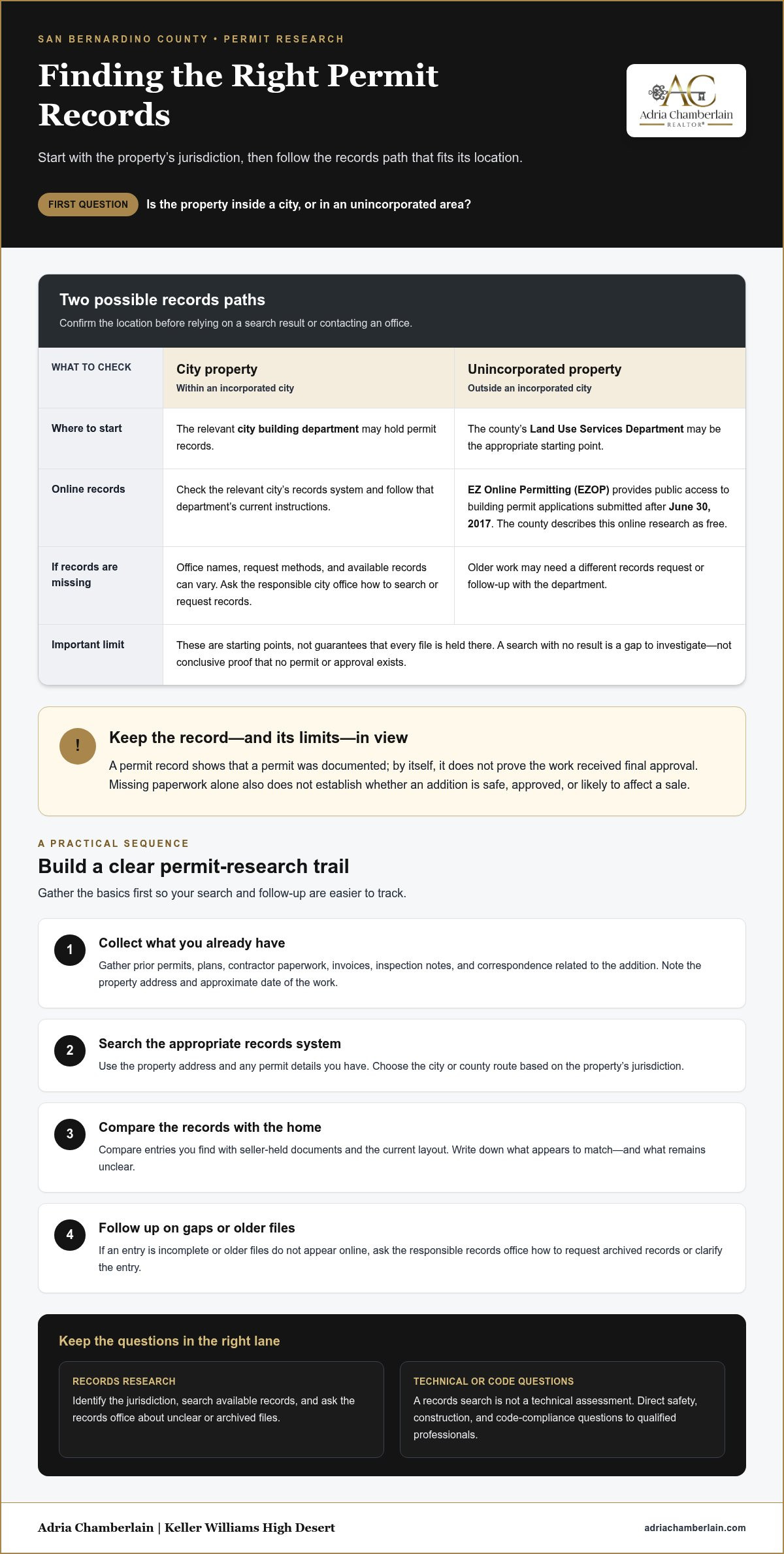
A permit record shows that a permit was documented; it doesn’t, by itself, prove the work received final approval. A final approval or sign-off, when applicable, is a separate record that may show the permitted work completed the required review. The records and approvals involved can vary with the work and property, so don’t treat one missing document as a complete answer.
What Counts as an Addition Without Permit Records?
An addition may be described as unpermitted when required permits or approvals can’t be established from available records. That’s different from knowing that work was done without required approval. Older work, changes made by a previous owner, and incomplete files can make the history difficult to establish. Also, not every alteration necessarily required the same permit or review, so the details of the work matter.
Examples that may prompt questions include a patio enclosed as living space, a garage converted into a room, an added bedroom, or plumbing changed during a renovation. These examples don’t establish that a permit was required in every case. Scope, location, timing, and applicable requirements may matter. A seller can describe what they know, but a missing record alone isn’t a technical assessment or a finding about compliance.
Why Buyers May Ask About the Addition
Buyers may want to understand how the space can be used, whether safety concerns need review, or whether the addition affects financing, insurance, or future renovation plans. Those are reasonable questions, not proof that a buyer, lender, or insurer will reject the property. The answer can depend on the addition, the buyer’s plans, the lender’s requirements, and the transaction details.
There can also be a difference between the home’s physical layout and the area represented as permitted living space. A buyer may ask what records support the stated square footage and how the addition is treated in the sale. Don’t assume every enclosed or finished area will be evaluated alike. Keep documented facts separate from estimates, and direct technical or code-compliance questions to qualified professionals.
Adria can help organize property information and prepare for buyer-facing conversations as part of a residential listing plan. A property-specific valuation can take documented condition and features into account, while permit, construction, and code questions remain with qualified professionals. For general background on California’s real estate licensing regulator, see the California Department of Real Estate. Agent licensing and property permit questions are separate matters.
How to Check Addition Permits in San Bernardino County
Before searching for permits, find out which jurisdiction handles the property. A home in Apple Valley, Victorville, Hesperia, Adelanto, Barstow, Helendale/Silver Lakes, or Phelan isn’t automatically under the county’s building-record system. Some properties are within incorporated cities, while others are in unincorporated areas. The responsible records office can depend on the property’s location, so confirm the jurisdiction before relying on a search result.
Which Department May Have the Records?
Start by identifying whether the address is within a city or an unincorporated part of San Bernardino County. For a city property, the relevant city building department may hold permit records. For an unincorporated property, the county’s Land Use Services Department may be the appropriate place to begin. These are starting points, not guarantees about where every file is held. Office names, request methods, and available records can vary, so follow the current instructions of the appropriate department.
For unincorporated county properties, San Bernardino County’s EZ Online Permitting portal, known as EZOP, provides public access to building permit applications submitted after June 30, 2017. The county describes this online research as free. Older work may require a different records request or follow-up with the department. Treat a search with no result as a gap to investigate, not conclusive proof that no permit or approval exists.
A Practical Permit-Research Sequence
Gather what you can before contacting an office. A focused request is easier to follow up on when you have the property address, an approximate date for the work, and any related records already in your possession.
- Collect prior permits, plans, contractor paperwork, invoices, inspection notes, and correspondence related to the addition.
- Search the appropriate city or county records system using the property address and any available permit details.
- Compare the entries you find with seller-held documents and the home’s current layout. Note what appears to match and what remains unclear.
- If an entry is incomplete or older files don’t appear online, ask the responsible records office how to request archived records or clarify the entry.
Keep a simple record of the date you searched, the department or portal used, and the results. Separate confirmed documents from unanswered questions. A permit application, for example, may show that a process began, but the file may not establish whether final approval was recorded. Don’t turn an incomplete online result into a conclusion about the addition.
If you’re still unsure what the work required or whether it meets applicable standards, direct those technical or code questions to qualified building professionals. For selling a house with unpermitted additions San Bernardino County, permit research gives you a clearer starting point for buyer conversations. Adria can also help organize the sale discussion around the property information you’ve gathered. Explore home-selling guidance as you consider your next steps.
Should You Resolve the Permit Issue or Sell the Home As-Is?
There isn’t one route that suits every property. You might research records further, consult qualified professionals, explore whether an approval process is available, or decide to sell without resolving the issue first. Each choice can affect how much is known and documented before buyers ask questions, but none guarantees a particular sale result.
The appropriate path depends on verified records, property facts, and seller priorities. Consider these options as steps to evaluate, not a checklist every seller must complete:
- Research records further. This may clarify what was permitted or which documents are missing. Older or incomplete records can leave questions unanswered, so allow for uncertainty.
- Seek qualified professional input. A building professional can help assess technical questions about the work. An assessment can inform a decision, but it doesn’t, by itself, establish permit approval.
- Explore possible approvals. Depending on the work and applicable requirements, a seller may investigate whether an approval path exists. The relevant department and qualified professionals can address what applies. Don’t assume approval is possible or guaranteed.
- Sell without resolving the issue first. This means resolution doesn’t have to be a prerequisite to considering a sale, but buyers may still ask about the addition, its documentation, and its condition.
When Further Review or Approval May Be Worth Exploring
Further review may help when the addition affects an important part of the home, available records conflict, or you want a clearer picture before setting a sale plan. A qualified building professional can address structural or other technical concerns, while the relevant building department can explain permit questions. The answers may help you understand your options, but don’t assume every addition can be approved or that a review will lead to a specific outcome.
Before committing to corrective work or an application process, clarify which questions need answers and what records are available. Depending on the property, additional review may involve uncertainty about requirements, documentation, or next steps. Leave technical and code-compliance decisions to qualified professionals, and use the information they provide to make a considered sale decision.
What an As-Is Sale Can, and Cannot, Answer
An as-is approach generally communicates that the seller isn’t agreeing to make repairs as a condition of the sale. It doesn’t explain whether the addition was permitted, establish its safety, or guarantee that a buyer will accept the property. It also isn’t a blanket answer to disclosure questions. Discuss your obligations and how to accurately describe known information with a qualified real estate or legal professional.
As you compare paths, weigh your preferred timing, comfort with unanswered questions, and the buyer concerns the addition may raise. A local listing plan can help organize property information and frame buyer conversations, while a property-specific valuation can account for documented condition and features. For selling a house with unpermitted additions San Bernardino County, the goal is not to force one solution, but to make an informed choice with a clear understanding of what remains unresolved.
Prepare Your San Bernardino County Home for Buyer Questions
A well-organized file can make conversations about an addition clearer. It won’t fill gaps in the record or settle technical questions, but it helps you distinguish what documents show from what still needs clarification. For a seller, that distinction supports more accurate discussions with a real estate professional, prospective buyers, and qualified legal or building professionals.
Build a Clear Property-Records Folder
Gather what you have in one place, whether in a paper folder or a digital file. Include permits, plans, dated photographs, contractor records, invoices, prior disclosures, and relevant correspondence. Records from a previous owner may offer useful context, but label their source and avoid presenting them as your own firsthand knowledge. Keep copies accessible so you can refer to the same information during listing discussions and buyer follow-up.
Organize documents by what they establish, not by what you hope they prove. For example, a plan may show a proposed layout, while a permit record may document an application or permit. Neither should be described as proof of final approval unless the available records support that conclusion. A short index can help:
- Verified: Information directly supported by a document or your own knowledge.
- Not located: Records you searched for but haven’t found.
- Unanswered: Questions that need clarification from a records office or qualified professional.
Prepare Honest, Careful Answers
Before buyer conversations begin, write down what you know about the addition, what you haven’t been able to verify, and which questions remain technical or legal. Avoid calling an area permitted living space unless records support that description, and don’t make safety claims without an appropriate assessment. If you’re unsure how to handle a disclosure question, consult a qualified California real estate or legal professional.
Disclosures are an important part of a home sale, and a document folder doesn’t replace completing them carefully. Requirements can depend on the facts and circumstances, so don’t rely on a generic checklist as legal advice. A qualified professional can help you understand how current California requirements apply to your situation. Keep copies of relevant prior disclosures and note what they say, but don’t assume they answer every question about the addition today.
Clear records can also help put the home’s documented features and condition into pricing context. Adria’s professional home valuation process in Victorville offers background on how a property-specific valuation can inform that conversation. A valuation isn’t a permit determination, so keep those questions separate.
For selling a house with unpermitted additions San Bernardino County, preparation means sharing verified information without overstating what it establishes. If you’d like help organizing the sale conversation and property details, connect with Adria about your home sale.
Plan the Sale With a Local High Desert Real Estate Guide
Once you’ve gathered available records and identified the questions that still need answers, bring that information into a practical sale discussion. Adria can help organize property details, consider listing decisions, and prepare for buyer-facing conversations. The aim isn’t to decide for you whether to seek approvals or proceed without resolving the issue. It’s to help you understand your sale choices in light of what’s documented and what matters to you.
How Local Listing Guidance Fits Into the Plan
A residential listing plan can connect the home’s documented condition and features with a property-specific valuation. That context can help you discuss how the addition fits into the broader picture of the property, without treating an estimated area or incomplete permit record as an established fact. Buyers may have their own questions, and their decisions can depend on their plans and transaction details.
Organized records also make it easier to keep conversations consistent. You can share what you know, point to documents that address specific questions, and distinguish those from matters still awaiting professional guidance. Adria can help you prepare for listing discussions and organize information buyers may ask about. For an overview of listing preparation, see the residential property listing guide for Hesperia and beyond.
Local context matters, too. Adria’s residential listing work serves sellers in Apple Valley, Hesperia, Victorville, Adelanto, Oak Hills, Helendale, Barstow, Phelan, Pinon Hills, and Lucerne Valley. Records and sale considerations are specific to each property, but local guidance can help you shape a plan around your home, documentation, and priorities.
Choose Your Next Step With Confidence
Before settling on a direction, consider what you want to clarify, how much uncertainty you’re comfortable carrying into a sale, and what questions a buyer may reasonably raise. You might begin with the records you already have, decide whether more review is useful, or discuss listing options while some questions remain open. There’s no need to assume one path is right for every seller.
For selling a house with unpermitted additions San Bernardino County, keep professional roles clear. Adria can help organize property information, discuss listing decisions, and connect the sale plan to a property-specific valuation. Permit status, building-code compliance, construction concerns, legal disclosure questions, and tax matters call for guidance from appropriately qualified professionals.
If you’re ready to talk through your property, the records you’ve gathered, and what you’d like to prioritize, contact Adria for personalized selling guidance. A calm conversation can help you identify useful next steps without promising a particular approval, price, timeline, or sale outcome.
Take the Next Step at Your Own Pace
You don’t need every answer before you begin planning. A useful next step is to decide what matters most to you, such as gathering more information, understanding how the addition fits into your sale plans, or moving forward while some questions remain unresolved. For selling a house with unpermitted additions San Bernardino County, let verified information guide the conversation, and leave technical and legal decisions to qualified professionals.
Adria Chamberlain is a licensed REALTOR® affiliated with Keller Williams High Desert, DRE 02032478, and has served High Desert and Inland Empire communities since 2017. Her residential listing and home valuation guidance can help you consider your property’s documented features and shape a sale plan around your priorities, without assuming a particular result.
When you’re ready, talk with Adria about a thoughtful plan for selling your home. You can take the process one informed decision at a time.
Frequently Asked Questions
Can I sell a house with an unpermitted addition in San Bernardino County?
In many situations, a home can be listed while an addition’s permit status is unresolved, but the right plan depends on the property and transaction. Selling a house with unpermitted additions San Bernardino County doesn’t automatically mean the addition must be removed or that a buyer will reject the home. Sellers in Apple Valley, Hesperia, Victorville, Adelanto, Oak Hills, Helendale, Barstow, Phelan, Pinon Hills, and Lucerne Valley can start by identifying the property’s jurisdiction and gathering available records.
How do I find out whether an addition was permitted in San Bernardino County?
Start with the building department responsible for the property’s location, then ask how it searches permit files and handles older records. A request may be easier to research if you provide the property address, approximate work dates, and any permit numbers or documents you have. If records appear under a previous owner or an older address format, ask the office what other identifying information could help locate the file.
Will an unpermitted addition stop a buyer from getting a mortgage?
Not necessarily. A lender may review the addition and its documentation as part of its own loan requirements, and an appraiser may consider how the space is documented when assessing the home. The effect can depend on the work, the appraisal, and the loan. A seller shouldn’t promise a buyer that financing will be approved; the buyer and lender must determine whether the property meets their requirements.
Do I have to disclose an unpermitted addition when selling a California home?
Generally, known unpermitted work may need to be disclosed, but how disclosure requirements apply depends on the transaction and the facts. Don’t assume an as-is sale or uncertainty about old records removes the need to answer disclosure questions carefully. Keep your statements factual, and ask a qualified California real estate or legal professional how current requirements apply to your circumstances before completing sale documents.
Should I get permits for an addition before selling my house?
Not automatically. First establish what records exist and ask the relevant building department or a qualified building professional what options may apply to the specific work. Some situations may warrant further review, while others may leave the seller weighing a sale without pursuing approvals. Don’t assume an older addition can be approved through a particular process. Compare the information you expect to gain, the steps involved, and the remaining uncertainty before choosing a route.
Can I sell my house as-is if it has an unpermitted addition?
You can consider an as-is sale, but that wording doesn’t settle questions about the addition or guarantee a buyer will proceed. Buyers may still review available information, seek professional input, and negotiate transaction terms. Before listing, prepare a clear account of what you know and what you haven’t been able to verify. For disclosure questions, get guidance from a qualified California real estate or legal professional.
Does an unpermitted addition affect my home’s value?
It can affect how a buyer, lender, or appraiser evaluates the property, but there’s no single adjustment that applies to every home. For example, documented living area may be viewed differently from space whose permit status or measurement is unclear. A property-specific valuation can consider the home’s documented features and condition alongside relevant comparable sales. It won’t determine permit compliance or guarantee a final sale price.


