

What if a larger parcel isn’t worth more simply because it has more acres? If you’re deciding how to price acreage in Lucerne Valley, nearby sales can offer a starting point, but differences in usable land, access, utilities, and other parcel details can make a simple price-per-acre calculation misleading. A clear number is helpful, especially when properties that look similar on a map may appeal to buyers for different reasons.
A grounded asking price starts with understanding what your land offers and comparing it with relevant sales. Parcel size matters, but so do characteristics that affect how buyers may use the property. Public records and verified property details help establish what you’re working with, while nearby land sales provide market context rather than a one-size-fits-all answer.
This guide explains which parcel characteristics to review, how to compare acreage without relying on price per acre alone, and which records can inform your decision. You’ll also learn how a personalized comparative market analysis from local REALTOR® Adria Chamberlain can bring parcel details and current market evidence together to support a reasoned asking price.
Key Takeaways
- Start with verified parcel details, including the parcel number, map, known improvements, and access information.
- Separate total acreage from land that may be practically usable, and note features that could affect buyer appeal.
- Compare nearby land sales side by side, looking beyond size to location, terrain, access, utilities, and documented use.
- Learn how to price acreage in Lucerne Valley by weighing parcel-specific details against relevant, dated market evidence.
- A personalized comparative market analysis can help turn your records and comparable sales into a reasoned asking-price range.
Pricing Lucerne Valley Acreage: Start With the Parcel
Setting an asking price for acreage can feel uncertain when parcels vary so widely. Two properties with similar total acreage may offer different practical options because of their boundaries, access, terrain, or existing improvements. To learn how to price acreage in Lucerne Valley, start with the parcel itself, then use relevant market evidence to put its features in context.
Market pricing is an evidence-based estimate of what a suitable buyer may consider, not a guaranteed sale result. A broad price-per-acre figure can help you form an initial comparison, but it can’t account for every feature that affects a particular parcel’s appeal. The goal is to understand what the land offers and how it compares with properties buyers could reasonably consider instead.
What does acreage pricing actually measure?
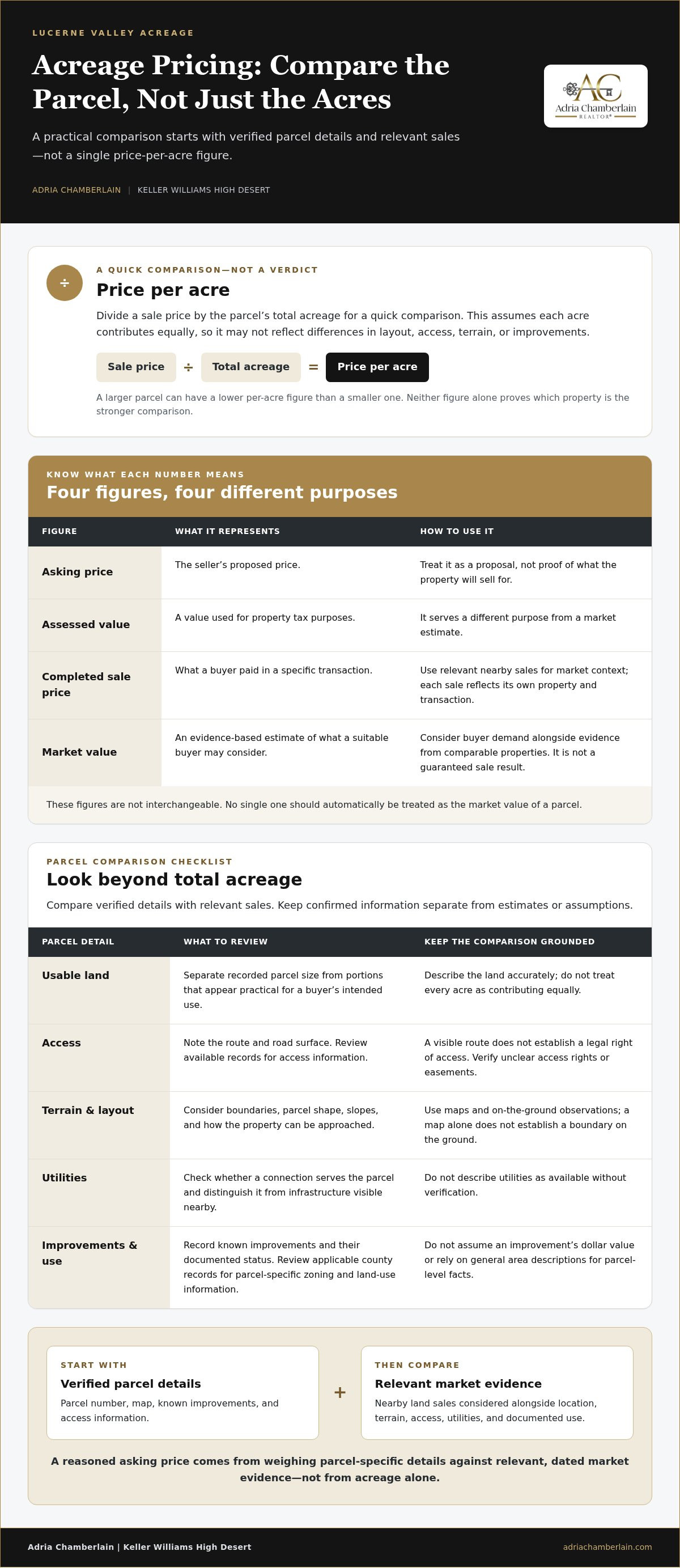
An asking price is the seller’s proposed price. An assessed value is used for property tax purposes, while a completed sale price records what a buyer paid in a specific transaction. These figures serve different purposes, so none should automatically be treated as the market value of your parcel. Market value is better considered through buyer demand and evidence from comparable properties.
Use matters, too. A parcel’s documented characteristics and the uses buyers understand it to support can shape who might consider it. Since buyers may have different goals, clear information about the property’s known features makes comparisons more useful.
Price per acre is a clue, not a verdict. Dividing a sale price by the parcel’s total acreage creates a quick comparison, but assumes each acre contributes equally. That may not reflect differences in layout, access, terrain, or improvements. A larger parcel can have a lower per-acre figure than a smaller one without either figure, by itself, proving which property is the stronger comparison.
Why Lucerne Valley parcels need individual review
Lucerne Valley’s rural desert setting is part of its character, but it doesn’t make every property alike. The overview of Lucerne Valley, California offers general geographic and historical context; an individual parcel still needs its own review. Boundaries and physical layout may affect how land can be approached or used, while road access, terrain, and existing improvements can differ from one property to another.
Review the specific parcel rather than assuming nearby acreage has the same practical appeal. A map, available property records, and reliable details about access or improvements can help distinguish confirmed information from assumptions. If a detail hasn’t been verified, don’t present it as a feature buyers can rely on.
Land usability is the practical potential of a parcel’s documented features, considered alongside comparable market evidence. This keeps pricing grounded: acreage describes how much land there is, while parcel characteristics and relevant sales help explain how buyers may value it. Starting with both gives you a more reasoned foundation than relying on a single broad price-per-acre estimate.
Which Lucerne Valley Acreage Features Can Change a Parcel’s Market Appeal?
Total acreage tells only part of the story. For a more useful assessment, separate the parcel’s recorded size from the portions that appear practical for a buyer’s intended use. This isn’t a judgment about the land. It helps you describe the property accurately and compare it with sales that share relevant characteristics.
Start with available parcel maps and records, then consider what you can observe on the property. A map can help you understand the parcel’s shape and boundaries, but it doesn’t establish where a boundary lies on the ground or prove that a particular route is legally available. Keep verified details separate from estimates or assumptions.
Access, terrain, and usable land
Access and site conditions can affect how easily a buyer can reach and evaluate the property. Note the road surface and route to the parcel, but don’t describe access as a legal right unless supporting records establish it. Terrain and layout matter as well. An irregular shape or sloped area may affect practical use differently from a level, easily approached portion.
Use parcel maps alongside on-the-ground observations. If a boundary, easement, or access right is unclear, treat it as something to verify, not as a feature to promise in the listing. This distinction helps buyers understand what’s known and keeps the pricing discussion tied to supportable facts.
Utilities, improvements, and documented land use
Be precise about utilities. A connection serving the parcel is different from infrastructure visible nearby, and neither should be represented as available without verification. Record known improvements and their documented status, but avoid assigning them an assumed dollar amount. Their relevance comes from how they compare with features of similar properties, not from a presumed value added.
Land-use details deserve the same care. Review applicable San Bernardino County records for parcel-specific zoning and land-use information. A general description of the area cannot establish what applies to an individual lot. The county’s Lucerne Valley Community Action Guide can provide broader local context, while parcel-level questions call for parcel-specific records.
As you organize your notes, distinguish three categories:
- Verified: Details supported by records or other reliable documentation.
- Observed: Conditions you can describe directly, such as the visible road surface or general layout.
- Unconfirmed: Questions about boundaries, access rights, utility connections, land use, or environmental conditions that need further verification.
This separation makes it easier to share accurate information and identify gaps before settling on a price. It also gives a pricing analysis a clearer basis for comparing your parcel with relevant sales. Adria Chamberlain provides land sales guidance and comparative market analysis to help weigh documented features against local market evidence. Learn more through Adria’s acreage pricing guidance.
How to Compare Lucerne Valley Acreage Sales Without Misleading Comparisons
A nearby land sale can help you understand buyer activity, but location alone doesn’t make it a strong comparison. For how to price acreage in Lucerne Valley, look for completed sales with similar characteristics, then account for meaningful differences. A parcel that appears close on a map may differ in scale, access, terrain, utilities, improvements, or documented use.
A comparable sale is useful only when its key differences from your parcel are identified and considered. That doesn’t mean every difference can be translated into a precise dollar adjustment. It means you can judge whether a sale offers a fair point of reference or should carry less weight in your pricing decision.
What makes a land sale a useful comparable?
Begin with properties in or near Lucerne Valley, then compare the details that may shape buyer interest. Record the sale date and information source, and make sure you’re looking at a completed sale rather than an active listing. If a source doesn’t clearly establish the transaction status or property details, label that uncertainty instead of treating the information as confirmed.
Review each candidate sale using the same factors:
- Location and scale: Consider proximity and parcel size, while noting that similar acreage doesn’t guarantee similar appeal.
- Access and terrain: Compare documented access information and observable site characteristics.
- Utilities and improvements: Separate verified connections and documented improvements from nearby infrastructure or listing descriptions.
- Documented use: Compare available land-use information, not assumptions based on a neighboring parcel.
A nearby parcel may still be a weak match if it differs substantially in these areas. A sale farther away might add context if it shares more of the characteristics buyers are likely to weigh. Keep track of why each sale was included and how closely it resembles the subject property.
How to handle sparse or imperfect sales evidence
When close matches are scarce, widen the search carefully rather than forcing a poor comparison. You might consider a broader area or a different sale period, but note what changed and why the expanded evidence is less direct. Multiple imperfect examples can help frame a range of possibilities, but they shouldn’t be presented as exact substitutes for your parcel.
Keep asking prices separate from closed-sale evidence. A listing shows what a seller is asking, not what a buyer ultimately paid. Listing descriptions can also include claims that aren’t independently verified. Record the source and date, and distinguish transaction details from marketing language, estimates, or gaps in public information.
For residential properties, a professional home valuation in Victorville may use a different comparison approach than acreage pricing. Land calls for land-specific evidence, with parcel characteristics considered alongside the terms and timing of relevant sales. A home-focused estimate doesn’t directly answer a land-pricing question.
A Step-by-Step Pricing Process for Acreage Sellers in Lucerne Valley
A clear process can make pricing feel more manageable. The aim isn’t to force every parcel into a formula, but to build a reasoned asking-price range from organized property information and relevant market evidence. Since conditions and available sales change over time, record the period covered by any pricing analysis and revisit it if the evidence becomes dated.
- Gather the parcel’s identifying information. Collect the parcel number, available parcel map, boundary information, and property records you already have. These materials help keep the analysis focused on the correct property. A map can orient your review, but don’t treat it as a substitute for verified boundary or access information.
- Prepare a fact sheet about the land. List known improvements, access details, utility information, and documented land-use details. Label each item as verified, observed, or still unconfirmed. For example, distinguish a utility connection documented for the parcel from infrastructure you’ve only seen nearby.
- Assemble relevant market evidence. Gather available completed sales and note each sale’s date, source, location, and known property characteristics. Keep asking prices separate from closed-sale prices. If evidence is limited, note that limitation instead of making a listing or imperfect match appear more conclusive than it is.
- Compare properties using the same criteria. Review parcel size, location, access, terrain, utilities, improvements, and documented use side by side. Ask how each difference affects the strength of the comparison. A sale with similar acreage may deserve less weight if its access or practical use differs substantially.
- Review a reasoned asking-price range. Consider the strongest comparable evidence alongside verified details about your parcel. A range makes room for uncertainty in the data; an exact figure without sound support can imply more precision than the evidence allows. Note the market period the analysis reflects so you know when conditions may warrant another look.
Use consistent information and review it over time
Organized records make it easier to spot gaps and keep comparisons fair. Use the same verified property facts throughout your review, and update the file if you obtain new documentation. After the property is offered for sale, consider buyer feedback alongside current market evidence. Interest or questions may help identify how buyers are responding, but feedback alone doesn’t establish market value.
If you’re weighing acreage held for investment against other property options, keep the land’s specific characteristics central to the analysis. A general residential comparison, including one for Victorville investment properties, shouldn’t substitute for land-specific sales evidence.
Adria Chamberlain can bring parcel details and relevant, dated market evidence together in a comparative market analysis. To discuss your Lucerne Valley acreage and a practical pricing approach, connect with Adria about your land.
Get a Personalized Acreage Pricing Analysis for Lucerne Valley
A practical pricing framework gives you a place to start, but a personal review can connect the details of your parcel with relevant market evidence. Adria Chamberlain’s land sales and comparative market analysis work can help you assess which property features matter to the comparison, how closely available sales match, and where the evidence leaves room for uncertainty.
A useful analysis considers the parcel’s known characteristics alongside dated market information. That means looking beyond total acreage to details such as access, layout, documented improvements, and land-use information, then comparing those details with relevant sales. If close matches are limited, the analysis should make that clear rather than treating a weaker comparison as a precise measure of value.
A pricing analysis is a tool for making an informed decision, not a guarantee of a particular property value, buyer response, or sale result. Market conditions can change, and the eventual outcome depends on the property and the market when it is offered. A thoughtful review can still help you understand the reasoning behind an asking-price strategy and decide which questions deserve more attention.
What a personalized acreage review can help clarify
A parcel-specific review can identify which details strengthen a comparison and which need more context. It can also help separate useful closed-sale evidence from asking prices or incomplete information, so you can see both the support and the limits behind a proposed range. The goal is to tailor the analysis to the land and your objectives, not to apply a broad per-acre figure without considering the property.
That conversation can be useful whether you’re preparing to sell soon or still weighing your options. Bringing together what’s known about the parcel and relevant market evidence can make the next decision feel more grounded, even when the available comparisons aren’t a perfect match.
How to begin a pricing conversation
To discuss how to price acreage in Lucerne Valley, share the parcel’s location, known acreage, and any property records or maps you have available. You can also describe known improvements and access details, while noting anything you haven’t verified. This gives the pricing conversation a practical starting point without requiring you to have every question answered in advance.
Your timing and goals matter, too. Let Adria know whether you’re preparing for a near-term sale or exploring possibilities for later, and what you hope to understand from the analysis. With those details, she can help you consider the parcel alongside relevant, dated market evidence and talk through a reasoned path forward.
If you’re ready to discuss your land and selling goals, contact Adria to discuss your acreage pricing. The conversation can begin with the information you have and focus on what will help you make your next decision with greater clarity.
Take the Next Step With a Clear Pricing Plan
Your asking price is a decision about more than a number. It also reflects your goals, timing, and how you want to position the property for potential buyers. With a thoughtful plan, you can move forward knowing what supports your pricing approach and where more information may help.
Adria Chamberlain is a licensed REALTOR® (DRE 02032478) who has served High Desert communities since 2017. Her real estate services include land sales and comparative market analyses, helping sellers consider their parcel in light of relevant market evidence. An analysis can inform your decision, but it can’t promise a particular value or sale outcome.
If you’re ready to take the next step in deciding how to price acreage in Lucerne Valley, bring your property details and selling goals into the conversation. Contact Adria to discuss pricing your Lucerne Valley acreage and get guidance tailored to your situation. A clear starting point can make the decisions ahead feel more manageable.
Frequently Asked Questions
Does the county assessed value tell me what my Lucerne Valley acreage is worth?
No. The assessed value is used for property tax purposes, so it shouldn’t be treated as a current estimate of what a buyer might pay. It may offer background, but it can differ from market evidence because it isn’t necessarily based on the parcel’s current buyer appeal or the latest comparable sales. For a selling decision, consider it alongside land-specific market information, not as a substitute for it.
How can I price acreage in Lucerne Valley if there are no close comparable sales?
Use the closest available land sales as context, then be clear about how each one differs from your parcel. Expanding the search to Apple Valley, Hesperia, Victorville, Adelanto, Oak Hills, Helendale, Barstow, Phelan, or Pinon Hills may add perspective, but distance can make a sale less relevant. Don’t treat a broader-area example as a direct match. Note its location, sale date, and limitations before using it to inform a pricing range.
Are online estimates reliable for vacant land in Lucerne Valley?
Online estimates can be a rough reference, but they may not reflect details that shape vacant-land appeal, such as parcel layout, access, documented improvements, or land-use information. Some tools may also rely on limited or outdated property data. Check what information an estimate appears to use and compare it with verified parcel records and relevant land sales. If the estimate’s method or data isn’t clear, avoid treating it as a dependable asking-price recommendation.
Should I price my acreage using a price-per-acre calculation?
Use price per acre as a screening tool, not the final answer. It can help you notice broad differences between sales, but the result may mislead if one parcel has characteristics buyers value differently from another. For example, dividing a sale price by total acreage doesn’t show whether the parcels have similar layouts or improvements. Keep the calculation with your notes, then weigh the underlying property differences before deciding what it means.
Does the parcel number provide enough information to value my acreage?
No. A parcel number helps identify a property in records, but it doesn’t describe every feature that may affect buyer interest. Pair it with available maps, records, and documentation about the parcel. If an important point, such as a boundary detail or access arrangement, isn’t clear from the information you have, mark it as unresolved rather than assuming the parcel number answers it. That distinction can help keep your pricing discussion accurate.
When should I revisit the asking price for acreage in Lucerne Valley?
Revisit it when new information could change your view of the market or the property’s position. That may include a newly completed, relevant land sale, a meaningful change in competing listings, or buyer feedback that raises a consistent question about the asking price. Compare the new evidence with the period covered by your original analysis. A review doesn’t automatically mean changing the price; it gives you a chance to make a considered decision.
Can two nearby Lucerne Valley parcels have different values per acre?
Yes. Proximity doesn’t make two parcels identical, and a per-acre calculation can reflect differences in parcel size as well as property characteristics. One lot may have a different shape, access situation, terrain, documented use, or set of improvements from a nearby lot. Buyers may weigh those factors differently. Compare the underlying details and sale circumstances before treating one parcel’s per-acre figure as a reliable guide for another.


