

What does a lender’s foreclosure notice mean, and how quickly should you respond? When that envelope arrives, it’s easy to worry that every next move could make things worse. A notice is a reason to get clear information promptly, not to guess. A practical plan to avoid foreclosure High Desert CA homeowners can explore starts with understanding the notice, asking the loan servicer what options may apply, and getting qualified guidance before making a major decision.
It’s reasonable to weigh each step carefully, especially if you’re unsure whether contacting the lender will help or whether selling could be workable. This article covers immediate actions and compares reinstatement, forbearance, loan modification, and a possible property sale. It also explains where local real estate guidance from Adria Chamberlain may help with sale-related questions, while mortgage decisions belong with your servicer and legal or housing questions with qualified professionals. Whether you’re in Apple Valley, Victorville, Hesperia, or another High Desert community, you’ll have a clearer starting point for your next conversation.
Key Takeaways
- Read the lender notice carefully and organize loan statements, property records, and correspondence before deciding what to do.
- To avoid foreclosure High Desert CA homeowners can start by contacting their loan servicer and asking what options may apply to their loan.
- Compare lender workout discussions, housing counseling, and a possible sale. Eligibility, approvals, timing, and consequences vary.
- Before discussing a sale, gather information about the property’s condition, occupancy, ownership, known liens, and loan.
- Adria can help you consider property value and sale-related questions. Direct mortgage, legal, and housing-counseling questions to qualified professionals.
Facing Foreclosure in the High Desert? Understand the Situation First
A missed mortgage payment or a formal notice can make it feel as though losing your home is already decided. You can’t tell what will happen from that worry alone. Foreclosure is a process a lender may pursue after a borrower defaults on mortgage obligations; it can ultimately lead to the property changing hands. The process and available choices depend on the loan, documents, and applicable law. For a neutral overview of the general concept, read how foreclosure is a legal process.
What does foreclosure mean for a homeowner?
Receiving a lender notice doesn’t, by itself, mean the home has transferred to someone else or establish which options remain. Read the document carefully, note any stated dates or requested actions, and get qualified guidance promptly. Keep it with your mortgage statements and other loan correspondence so you can refer to its exact wording when speaking with the servicer or an advisor.
Real estate guidance can help you understand property-sale considerations, but a real estate agent doesn’t replace a lawyer or mortgage professional. Ask your loan servicer about your account and available options. For legal questions, consult a qualified attorney; a HUD-approved housing counselor may also help you understand housing-related options.
Why local homeowners should act promptly
Whether you’re in Apple Valley, Victorville, Hesperia, Adelanto, or Barstow, start by identifying what the notice says and who sent it. Don’t set the letter aside because you’re worried that contacting the lender could make things worse. Ignoring communication can leave important questions unanswered. A clear conversation can help you understand what the servicer is requesting and which options it may consider.
Before you call, write down questions such as what the notice means, whether the servicer needs documents, and where to send them. Record the date of the conversation and the name or department you spoke with. If you’re unsure about a deadline or the legal effect of a document, seek qualified legal or housing guidance rather than relying on assumptions.
Early, informed conversations can help homeowners understand which options may remain available. No single path fits every situation, and no conversation guarantees a particular outcome. For homeowners looking to avoid foreclosure High Desert CA, a practical starting point is a careful review of the documents, prompt communication with the servicer, and guidance suited to the loan and property.
What to Do First to Avoid Foreclosure in California
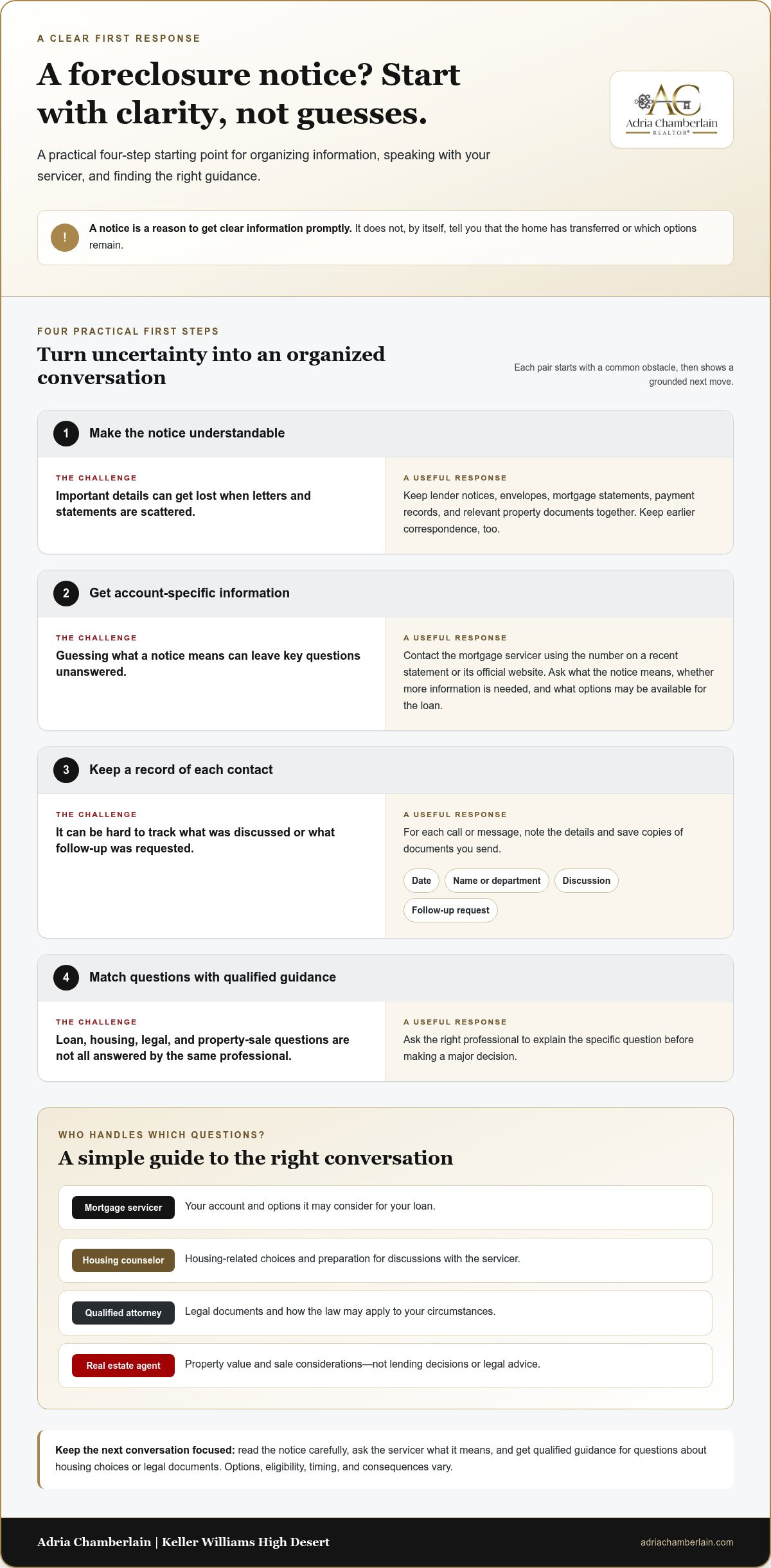
After reviewing a lender notice, focus on gathering reliable information and keeping a clear record. These steps can help you prepare for useful conversations, but they don’t replace advice based on your specific loan and documents.
- Open and organize every notice. Keep lender letters, envelopes, loan statements, payment records, and relevant property documents together. Don’t discard earlier correspondence.
- Contact the mortgage servicer. Use the phone number on a recent statement or the servicer’s official website. Ask what the notice means, whether more information is needed, and what options may be available for your loan.
- Keep a contact log. Record the date of each call or message, the representative’s name or department, what you discussed, and any follow-up request. Save copies of documents you send.
- Get guidance for questions that need expertise. A HUD-approved housing counselor or qualified California attorney can help you understand your choices and documents before you decide what to do.
How to organize lender notices and loan information
Set aside your mortgage statements, payment history or receipts, lender notices, and account correspondence. Add property records that may help explain ownership or the home’s circumstances. Note dates printed on documents, but don’t rely on your own interpretation of legal deadlines. If a term or notice is unfamiliar, ask the servicer, a qualified counselor, or an attorney to explain it.
For homeowners looking for ways to avoid foreclosure High Desert CA, an organized file makes it easier to explain the situation clearly, whether you’re contacting a servicer from Apple Valley, Victorville, or another local community.
Who can explain your options?
The mortgage servicer can answer account questions and describe options it may consider. A housing counselor can help you understand housing-related choices and prepare for discussions with the servicer. An attorney can explain legal documents and how the law may apply to your circumstances. A real estate agent can discuss property value and sale considerations, but can’t make lending decisions or provide legal advice.
The U.S. Department of Housing and Urban Development offers information about avoiding foreclosure and connecting with a HUD-approved housing counselor. For general California legal information, the California Courts Self-Help Center is another place to start; an attorney can provide advice tailored to your case. Direct loan questions to the servicer, housing-option questions to a counselor, legal questions to an attorney, and potential-sale questions to a real estate agent.
If selling is one option you’re considering, talk with Adria about property-sale considerations while directing loan and legal questions to the appropriate professionals.
Compare Foreclosure-Prevention Options and a Possible Home Sale
There isn’t one solution that fits every homeowner. A loan workout focuses on addressing the mortgage; a sale involves transferring the property. To avoid foreclosure High Desert CA homeowners can compare these paths by asking what each involves, who must approve it, and how it could affect their situation. Eligibility, required documents, timing, and consequences vary, so confirm details with the servicer and qualified housing, legal, or financial professionals.
| Path to explore | What it generally involves | Who can clarify the details |
|---|---|---|
| Lender workout discussion | Ask whether the servicer may consider options such as reinstatement, a repayment arrangement, forbearance, loan modification, or another workout for your loan. Reinstatement generally involves bringing the account current; other options may change how payments are handled. Availability and terms depend on the loan. | Your mortgage servicer can explain the options it may consider and the information it needs. |
| Housing counseling | A housing counselor can help you understand possible paths, organize questions, and prepare for a conversation with the servicer. Counseling is guidance, not lender approval. | A HUD-approved housing counselor can discuss housing-related options. |
| Possible property sale | A sale may be considered if keeping the home isn’t workable. Whether it can address the mortgage depends on the property, loan balance, transaction details, and any approvals required. | A real estate agent can discuss value and sale planning; the servicer and qualified professionals can address loan, legal, and financial questions. |
How lender workout discussions differ from selling
A loan modification generally means asking the servicer to change loan terms. Forbearance may involve a temporary change in payments, while a repayment arrangement may address missed payments under terms the servicer approves. These are possibilities to ask about, not guaranteed offers. The servicer determines what may be available for a specific loan and explains any proposed terms. The California Courts Self-Help Guide offers information to help homeowners understand foreclosure and related options. Ask a qualified professional how a proposed choice may affect your circumstances rather than assuming its effect on credit, debt, or taxes.
When a short sale or traditional sale may enter the conversation
A traditional sale is generally intended to pay off the mortgage and other amounts due from the sale proceeds. Whether the proceeds will be enough depends on the loan and transaction costs, and a sale’s timing doesn’t guarantee foreclosure will be avoided. In a short sale, the sale price may not cover the mortgage balance, so lender approval may be needed. Approval and timing can affect whether that route is feasible.
Understanding the home’s potential value is one part of sale planning, not a promise of a particular price or outcome. Adria can help homeowners consider property value and sale-related questions while mortgage and legal decisions remain with qualified professionals.
How to Evaluate a Sale Before a Foreclosure Process Advances
A property sale may be worth discussing, but it isn’t the right path for everyone and can’t guarantee that foreclosure will be avoided. Before weighing a sale, gather details about the home, ownership, loan, and possible transaction. This gives you and your qualified advisors a clearer starting point.
What affects a High Desert home-sale assessment?
A comparative market analysis, or CMA, estimates a home’s potential market value by considering relevant local information, including comparable sales, location, property features, and condition. It isn’t a guaranteed sale price. A home in Victorville may have different nearby comparisons from one in Apple Valley or Hesperia, so an estimate should reflect the property and its local context rather than a broad regional assumption.
As you prepare to discuss a possible sale, organize:
- Property condition: Note repairs, updates, and areas that may need attention.
- Occupancy: Record who lives in the home and whether anyone else has a right to occupy it.
- Ownership: Gather available ownership records and identify everyone who may need to participate in a sale.
- Known liens: List any known claims against the property, such as other loans, for a professional review.
- Loan information: Keep recent statements and lender correspondence together, and ask the servicer for current account information.
What a real estate agent can and cannot do
Adria can discuss a potential listing, property-sale considerations, and short-sale or foreclosure transactions. She can also help you understand how a CMA informs sale planning. A real estate agent can’t decide whether a lender will approve an option, interpret legal rights, or guarantee that a transaction will close before a particular date. Keep the servicer involved in loan questions and consult qualified legal or tax professionals about decisions with legal or financial effects.
Before deciding, compare what a sale might involve with information from your servicer and professional advisors. A potential price alone won’t tell you whether proceeds can address the loan or whether the timing fits your circumstances. If you’re considering how to avoid foreclosure High Desert CA through a sale, use the checklist to prepare for a careful discussion rather than assuming the sale will resolve the situation.
Talk with Adria about your property options if you’d like to discuss local value and possible sale considerations.
Get Personalized Foreclosure and Property-Sale Guidance in the High Desert
When a lender notice raises questions, start by understanding what it says, contacting the servicer through verified contact details, and getting qualified guidance before choosing a path. A possible sale is one option to discuss, not a guaranteed way to stop foreclosure. The right next step depends on your loan, documents, property, and circumstances.
What to prepare before discussing a possible sale
A few basic records can make a property-focused conversation more useful. Gather what you have, even if the file isn’t complete:
- Lender notices, recent loan statements, and relevant correspondence
- Available ownership information and details about anyone with an interest in the property
- Basic property information, including condition, occupancy, and known repair needs
- A list of questions, plus any dates stated in the documents
Keep copies of your records and note what you still need to ask the servicer. Don’t assume a date in a notice explains your legal options or the time available. Ask a qualified attorney about legal effects and a tax professional about potential tax questions. The servicer is the source for loan-specific information.
A steady next step for High Desert homeowners
Adria can help you discuss local property value, a possible listing, and real estate considerations related to a short sale or foreclosure transaction. That guidance can help clarify the property side of the decision, but it can’t determine lender eligibility, provide legal or tax advice, or guarantee a sale or a particular result.
Whether your home is in Apple Valley, Victorville, Hesperia, Adelanto, Barstow, Helendale/Silver Lakes, or Phelan, asking questions doesn’t commit you to listing or choosing a specific course of action. Adria also serves Oak Hills, Pinon Hills, and Lucerne Valley. A conversation can help you understand what a sale might involve and what questions to take back to your servicer or professional advisor. If you’re exploring how to avoid foreclosure High Desert CA, take the process one informed conversation at a time.
Contact Adria for personalized High Desert real estate guidance to discuss your property options without pressure to make an immediate decision.
Take Your Next Step With Clearer Information
A lender notice deserves prompt attention, but it doesn’t decide the outcome on its own. Review the documents, contact your mortgage servicer to understand loan-specific options, and seek qualified legal or housing guidance before making a decision. If a sale is worth exploring, consider the property details and loan information together. A sale may be one possible path, not a guaranteed way to avoid foreclosure.
For homeowners working to avoid foreclosure High Desert CA, Adria can discuss local property value, a potential listing, and short-sale or foreclosure transactions. Adria is a licensed REALTOR® affiliated with Keller Williams High Desert, serving High Desert and Inland Empire communities since 2017. Her DRE number is 02032478. Mortgage, legal, and tax questions should still go to the appropriate qualified professionals.
You don’t have to settle on a path before asking real estate questions. Contact Adria for personalized High Desert real estate guidance to talk through property-sale considerations. A conversation can help you identify a practical next step, and you can move forward at your own pace.
Frequently Asked Questions
Can I avoid foreclosure if I have already missed mortgage payments?
Possibly, but missing payments doesn’t determine the final outcome by itself. Contact your mortgage servicer using verified contact details and ask what options may apply to your loan, what information it needs, and what your notice means. Homeowners looking for ways to avoid foreclosure High Desert CA can also speak with a HUD-approved housing counselor or qualified attorney. Available choices depend on your loan, documents, and circumstances, so don’t assume an option will be approved.
What should I do first when I receive a foreclosure notice in California?
Read the notice carefully, keep it with your loan statements and payment records, and contact your mortgage servicer using a phone number from a recent statement or its official website. Ask what the document means, whether the servicer needs information from you, and what options it may consider. Record your conversations and follow-up requests. If you’re unsure about a date or legal language, promptly ask a qualified attorney or housing counselor to explain it.
Can selling my home stop foreclosure in the High Desert?
A home sale may be one path to discuss, but it doesn’t automatically stop foreclosure or guarantee that the process will end in time. The outcome can depend on the loan, any required lender approvals, the sale proceeds, and transaction timing. Contact your servicer about the loan and any active process while a real estate agent helps you understand property value and sale considerations. Consult qualified legal and tax professionals about consequences specific to your situation.
What is a short sale, and does the lender have to approve it?
A short sale is generally a sale where the expected proceeds may not cover the mortgage balance and related amounts due. The lender or servicer may need to approve the transaction and its terms. Requirements, review, and timing depend on the loan and circumstances, so approval isn’t guaranteed. Ask your servicer what it requires, and consult qualified legal or tax professionals about possible effects before making decisions. A real estate agent can discuss the property and sale process.
How much time do I have before foreclosure in California?
There isn’t one reliable timeframe that applies to every homeowner. The stage of the process, documents issued, loan, and individual circumstances can affect what happens next. Read each notice and take any stated dates seriously, but don’t rely on a general estimate to calculate your options. Contact the mortgage servicer promptly, and ask a qualified California attorney to explain deadlines or legal rights that may apply to your specific documents.
Can a real estate agent give me legal advice about foreclosure?
No. A real estate agent can discuss property value, a possible listing, and sale-related considerations, including short-sale or foreclosure transactions. An agent can’t replace an attorney, interpret your legal rights, or decide what a lender may approve. Direct loan questions to your mortgage servicer and seek legal guidance from a qualified attorney. If you’re weighing a sale, keep the real estate conversation separate from legal, lending, and tax advice.
Is foreclosure help available in Apple Valley, Victorville, or Hesperia?
Homeowners in Apple Valley, Victorville, and Hesperia can seek loan-specific information from their mortgage servicer and housing guidance from a HUD-approved counselor. Adria Chamberlain can discuss local property value and sale considerations; she serves these communities as well as Adelanto, Oak Hills, Helendale, Barstow, Phelan, Pinon Hills, and Lucerne Valley. For legal questions, speak with a qualified attorney. The right support depends on whether you need loan, housing, legal, or real estate guidance.


