

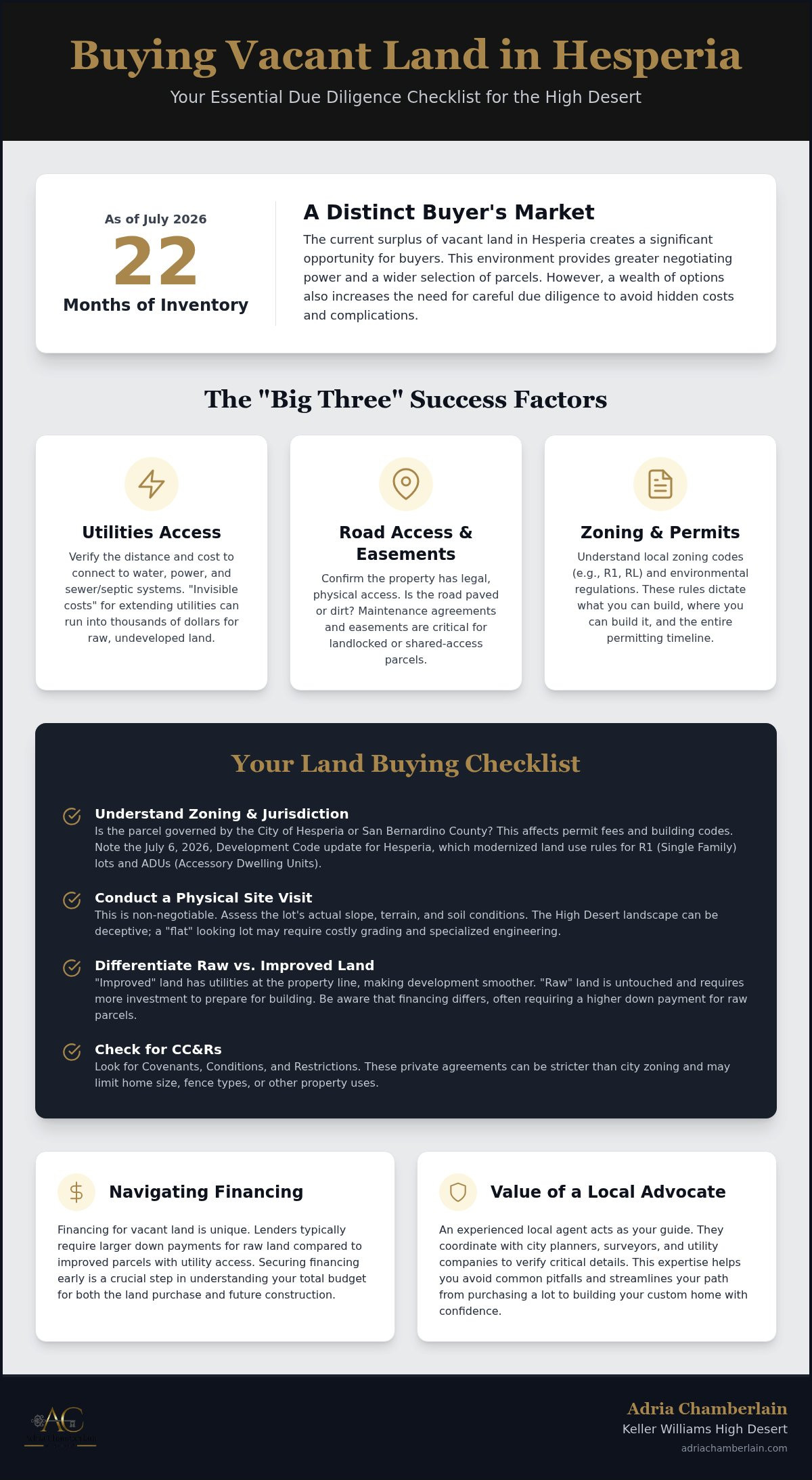
Did you know that as of July 2026, there are 22 months of inventory available for those buying vacant land in Hesperia? This surplus creates a distinct buyer's market, giving you more negotiating power than seen in previous years. However, a wealth of options also means a higher risk of choosing a parcel with hidden complications. It's common to feel anxious about whether a lot is truly buildable or if utility costs will eventually break your budget.
I believe you deserve to feel confident and secure in your investment. I've developed this comprehensive checklist to help you master the complexities of purchasing raw land in the High Desert. I'll explain the recent July 6, 2026, zoning code updates and provide a clear roadmap for your due diligence. You'll learn exactly which local factors to verify so you can move toward closing with total peace of mind.
Key Takeaways
- Discover how Hesperia’s 2026 development code updates influence what you can build and where your investment holds the most value.
- Identify the critical "Big Three" factors, which include utilities, road access, and environmental permits, that determine the success of buying vacant land in Hesperia.
- Navigate the unique financing landscape of the High Desert, including the specific down payment requirements for raw land versus improved parcels.
- Learn why a physical site visit is non-negotiable for assessing slope and terrain before you commit to a purchase.
- Understand how a dedicated local advocate coordinates with city planners and surveyors to streamline your path to custom home ownership.
The Appeal and Challenges of Buying Vacant Land in Hesperia
Buying vacant land in Hesperia represents more than just a real estate transaction; it's a path toward custom home ownership or a strategic long-term investment. In 2026, the market has shifted significantly. With 22 months of inventory available as of July 2026, buyers currently hold more leverage than they've had in years. This environment allows you to be selective, ensuring the lot you choose perfectly aligns with your vision for the future.
Why Hesperia is a Strategic Choice for Land Buyers
The geography of Hesperia, California offers a unique balance that's difficult to replicate elsewhere. You get the spacious, rural feel of the High Desert while remaining close to the suburban amenities found in Victorville and Apple Valley. Many buyers are drawn here because lot sizes are significantly larger than what you'll find in coastal California, often at a fraction of the price. The ongoing development of master-planned communities like Silverwood and Tapestry, which saw initial move-ins in early 2026, continues to drive infrastructure improvements that benefit the entire region.
Common Pitfalls for First-Time Land Buyers
It's easy to see a low price tag and assume you've found a bargain, but "cheap" land can sometimes be the most expensive to develop. One of the primary distinctions you'll encounter is the difference between raw land and improved land. Raw land is completely untouched, often lacking utility access or paved roads. Improved land usually has utilities like water and electricity at the property line, which makes the building process much smoother. I've seen many buyers face unexpected "invisible costs" because they didn't account for:
- Utility Connection Fees: Bringing power or water from several hundred feet away can cost thousands.
- Grading and Terrain: The High Desert terrain isn't always flat. Slopes require specialized engineering and permits.
- Zoning Restrictions: Hesperia updated its development code on July 6, 2026. These rules dictate exactly what you can build, whether it's a single-family home or a property for agricultural use.
Navigating these complexities requires a deep understanding of the local landscape. Because the desert terrain can be deceptive, having a guide who knows the specific soil conditions and city requirements is essential to ensuring your investment remains sound. I focus on helping you identify these factors early so you don't run into roadblocks after you've already committed to a purchase.
Understanding Zoning and Land Use in the High Desert
Zoning is essentially the playbook for your property. It acts as a set of rules that governs exactly how a piece of land can be used, what can be built on it, and what activities are allowed. When you are buying vacant land in Hesperia, these regulations are the most important factor in determining if your vision for the lot is actually possible. Zoning impacts every detail of development, including the minimum square footage of a home, where you can place a driveway, and whether you can keep livestock like horses or goats.
City of Hesperia vs. San Bernardino County Jurisdiction
One detail that often surprises buyers is that a Hesperia mailing address doesn't always mean the property is within city limits. Some parcels fall under the jurisdiction of San Bernardino County. This distinction is vital because the governing body determines your building permit fees, timeline for approvals, and specific construction standards. For example, "Rural Living" (RL) zoning is a common designation in unincorporated county areas. It typically offers more freedom for animal keeping but may have different requirements for road improvements compared to city lots. Understanding broader California Land Use Regulations can provide context on how state laws influence these local decisions, but the specific governing agency remains your primary point of contact for permits.
Decoding Local Zoning Codes
The City of Hesperia updated its development code on July 6, 2026, to streamline growth and modernize land use. You will likely encounter codes such as R1, which stands for Single Family Residential. In plain English, this usually means one main house per lot. However, many Hesperia lots now allow for Accessory Dwelling Units (ADUs), often called "granny flats." If your goal is to build a secondary structure for family or rental income, you must verify that the lot size and utility capacity can support it. Beyond city rules, I always advise clients to check for neighborhood CC&Rs (Covenants, Conditions, and Restrictions). These private agreements can sometimes be stricter than city zoning, potentially limiting the height of your home or the type of fencing you can install. If you are unsure about a specific parcel's potential, I can help you search for land listings that already align with your building goals.
I strongly encourage you to verify any zoning information directly with the Hesperia Planning Department before moving forward with an offer. They can provide the most current maps and confirm if there are any specific easements or setbacks that might shrink your buildable area. Taking this step early ensures that your investment is sound and your plans are realistic for the High Desert landscape.
Your Essential Hesperia Land-Buying Checklist
Success when buying vacant land in Hesperia depends on looking past the mountain views to see the practical realities of the dirt. Before you fall in love with a specific parcel, I suggest reviewing my residential land for sale High Desert guide to build a foundation of local knowledge. From there, you can focus on the "Big Three": Utilities, Access, and Environment. These factors often dictate whether a property is a strategic investment or a financial burden.
Utilities: Water, Power, and Waste
Don't assume a lot has utility access just because there are houses nearby. You need to check for "water in the street" by contacting the local water district. If it's not available, you might need a private well, which involves significant drilling and equipment costs. Similarly, check if the property requires a sewer connection or a septic system. If sewer lines aren't present, you'll need a septic system, which requires a "perc test" to ensure the soil can handle waste drainage. For electricity, verify the distance to the nearest power pole. Connection costs can climb quickly if the utility company has to run lines over a long distance.
Environmental and Terrain Considerations
The High Desert is home to protected species, most notably the Western Joshua Tree. Current regulations require surveys before any land clearing or construction can begin. I've seen projects delayed because owners didn't account for these legal protections early in their planning. You should also evaluate the terrain. A physical site visit is non-negotiable. Walking the land helps you assess the slope; steep inclines often require expensive grading or specialized foundations. Additionally, check if the parcel sits in a flood zone, which might require specific drainage plans or specialized insurance coverage.
Legal Access and Easements
I always recommend obtaining a preliminary title report early in the process. This document reveals legal hurdles like liens or easements that might restrict where you can build. For instance, a utility easement might run right through the middle of your preferred building site, making that area unbuildable. Access is another critical factor. You need to verify if the property is on a publicly maintained road or a private easement. Landlocked parcels, which have no direct legal access to a public street, can create significant legal hurdles and high costs. Ensuring your lot has clear, deeded access is one of the most important steps in your due diligence.
Navigating Financing and Legal Considerations for Raw Land
Financing a land purchase is a different ballgame than buying a pre-built home. Lenders generally see vacant land as a higher risk because there's no structure to act as immediate collateral. If you're buying vacant land in Hesperia, you should prepare for a larger down payment than you might expect. While a standard home might only require 3% or 5% down, raw land lenders in 2026 typically require between 30% and 50% down. I can help you navigate these requirements so you feel confident in your budget from the start.
Financing Options for Hesperia Land
You have a few distinct paths to explore depending on your timeline. A raw land loan is strictly for the dirt itself, while a construction-to-permanent loan covers both the land purchase and the eventual building costs. As of mid-2026, interest rates for land loans range from 5.5% to 12.0%. These rates are often 1% to 1.5% higher than standard mortgage rates due to the perceived risk. Because of this, seller financing is a very common alternative in the High Desert. In these cases, the seller acts as the lender, which can sometimes lead to more flexible terms. Local credit unions are another excellent resource. They often have a deeper understanding of the Hesperia market and may offer better terms than large national banks that aren't familiar with our terrain.
The Role of Inspections and Surveys
Protecting your investment involves more than just securing a loan. A professional boundary survey is vital to confirm exact acreage and property lines. You don't want to start construction only to realize your foundation encroaches on a neighbor's parcel. A soil report is also necessary before designing a foundation. High Desert soil has unique characteristics, and an engineer needs this data to ensure your home is structurally sound. I also strongly recommend Title Insurance for every transaction. It protects your ownership rights against hidden liens or past claims that might not appear in a standard search. While I'm here to guide you through the real estate process, please consult with a tax professional to discuss the specific financial impacts of land ownership. If you need help finding a financial partner who understands our area, reach out to me for a list of local lenders who specialize in land transactions.
How a Local High Desert Advocate Simplifies Your Land Purchase
Adria Chamberlain brings a deeply personal and supportive approach to every transaction. Navigating the complexities of the High Desert requires more than just a real estate license; it demands a connection to the community and its professional network. When I assist clients with buying vacant land in Hesperia, I act as your dedicated advocate, coordinating the many moving parts that come with raw land development. I work closely with local surveyors, well drillers, and city planners to ensure the information you have is accurate and actionable. Instead of leaving you to manage technical hurdles alone, I provide the same level of care and steady leadership that I offer for residential property listings Hesperia. My commitment is to your long-term success, prioritizing integrity and local insight over high-pressure sales tactics.
Personalized Representation for Land Buyers
Every land buyer has a different vision. Whether you're planning a custom estate or looking for a long-term hold, I tailor my search to your specific build goals. I spend time vetting listings before you even step foot on the dirt, checking for obvious red flags in zoning or utility access. When buying vacant land in Hesperia, the specific terrain and soil conditions matter just as much as the price. For those looking at land through the lens of future income, I draw on my experience in Victorville rental property analysis to help you determine if a parcel aligns with current market trends and investment potential. This proactive approach saves you time and protects you from properties that might not meet your needs.
Starting Your Hesperia Land Journey
The path to land ownership should feel manageable and personal. I invite you to reach out for a no-obligation consultation where we can discuss your vision for the High Desert. During this conversation, I can help you set up a custom land alert for the Hesperia area, ensuring you're among the first to see new opportunities as they hit the market. My local network also allows me to occasionally find "off-market" opportunities that aren't visible on major search portals. If you have questions about a specific parcel you’ve seen while driving through the neighborhood, don't hesitate to ask. I'm here to provide the calm expertise and professional guidance you need to turn your High Desert goals into a reality.
Secure Your Future in the High Desert
Your journey toward owning a piece of the High Desert starts with a clear plan and the right local insights. By now, you understand that buying vacant land in Hesperia requires careful attention to the July 2026 zoning updates and a thorough vetting of the "Big Three": utilities, legal access, and environmental factors. These details determine whether your lot is a buildable dream or a costly challenge. I focus on uncovering these invisible factors early so you can invest with total confidence.
I've been serving High Desert communities as a licensed REALTOR® since 2017. My experience in complex land and probate transactions allows me to guide you through every hurdle with calm expertise. As a local resident, I'm deeply rooted in this community and committed to protecting your interests. If you're ready to take the next step, please contact Adria Chamberlain for a personalized Hesperia land-buying consultation. I'm here to answer your specific questions and help you find a parcel that perfectly fits your vision. I look forward to helping you build your future here.
Frequently Asked Questions
Is it hard to get a loan for buying vacant land in Hesperia?
Obtaining a loan for buying vacant land in Hesperia is typically more challenging than securing a standard mortgage. Lenders view raw land as a higher risk because there is no structure to serve as immediate collateral. You should expect to provide a down payment between 30% and 50% of the purchase price. Interest rates also tend to be 1% to 1.5% higher than traditional home loans. I can connect you with local lenders who understand our specific market.
How much does it cost to clear a Joshua Tree from my property?
Western Joshua Trees are legally protected species in California, and you cannot simply remove them. The process involves hiring a certified biologist to conduct a survey and applying for permits through the California Department of Fish and Wildlife. Costs vary based on the number of trees and the specific mitigation fees required by the state. It is vital to verify these requirements during your due diligence period to avoid significant legal penalties and project delays.
What is a "perc test" and why do I need one for land in Hesperia?
A "perc test," or percolation test, measures how quickly the soil on your property absorbs water. This is a critical requirement if your land is not connected to a city sewer line. In Hesperia, many rural lots require a private septic system, and the health department won't issue a building permit without a passing test. The results determine the size and type of septic system your specific piece of land can support.
Can I live in an RV on my vacant land while I build my house?
Generally, the City of Hesperia doesn't allow residents to live in an RV on vacant land, even during the construction of a permanent home. Local codes usually restrict RV use to short-term camping or storage unless specific temporary permits are obtained for a construction site. These regulations are in place to ensure health and safety standards are met. I always recommend checking the current Hesperia Development Code or consulting with the planning department for the latest rules.
How do I know if a piece of land in Hesperia has water rights?
Determining if a parcel has water rights involves reviewing the property's preliminary title report and contacting the Hesperia Water District. Most residential lots within city limits are served by the local utility, but rural parcels may rely on private wells. In the High Desert, water rights are complex and often tied to specific adjudications. I can help you investigate the water status of a property to ensure you have a reliable source before closing your purchase.
What is the difference between Hesperia city land and county land?
The primary difference lies in which government agency has jurisdiction when you are buying vacant land in Hesperia. City land follows the Hesperia Development Code, while county land is governed by San Bernardino County regulations. This affects everything from permit fees and timeline expectations to rules for keeping animals. Even if a property has a Hesperia address, it might be in an unincorporated county area, so verifying the exact jurisdiction is a top priority.
Are there specific building requirements for High Desert terrain?
Yes, building in the High Desert requires specific engineering to handle our unique environment. Foundations must be designed for local soil conditions, and structures must meet standards for high wind loads and, in some areas, snow loads. Drainage is also a major factor; you may need a specific plan to manage runoff during heavy rain. Working with local contractors who understand these High Desert terrain requirements is essential for a successful and durable build.
How much are typical property taxes on vacant land in San Bernardino County?
For a new buyer in 2026, the effective property tax rate in San Bernardino County typically ranges between 1.1% and 1.3% of the purchase price. This includes the 1% base rate plus various local bonds and assessments. On July 21, 2026, a new rate for the San Bernardino Valley Municipal Water District was approved at $0.04 per $100 of assessed value. It's important to factor these recurring costs into your long-term investment strategy.


